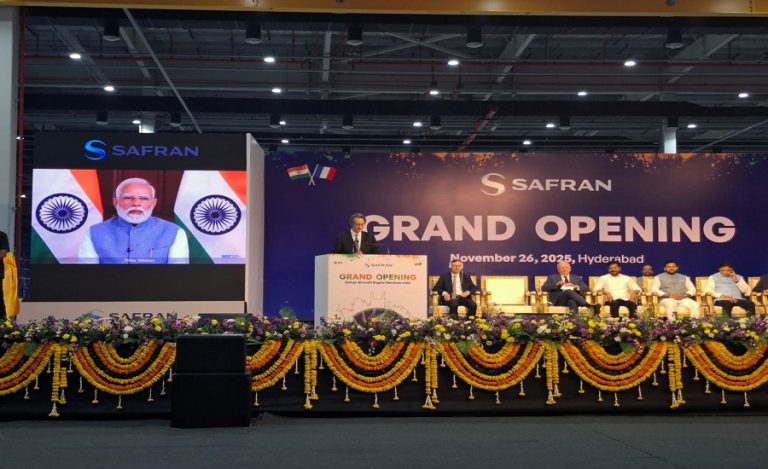
Prime Minister Narendra Modi virtually inaugurated the Safran Aircraft Engine Services India (SAESI) facility in Hyderabad, marking a significant milestone in the country’s aviation sector. This state-of-the-art maintenance, repair, and overhaul (MRO) facility, designed for LEAP engines that power modern commercial aircraft, represents a critical step in India’s journey toward self-reliance in aviation technology, high-value employment generation, and positioning the nation as a global aerospace hub. With an initial investment of ₹1,300 crore and operational plans set for 2026, SAESI underscores India’s growing ambition to become a leader in civil aviation maintenance, capable of servicing hundreds of aircraft engines annually while fostering indigenous expertise. The inauguration also reflects India’s rising stature in the global aerospace ecosystem and the government’s continued focus on strengthening technical skills and infrastructure in high-growth sectors.
Indigenous Aviation Capabilities and Strategic Significance
The SAESI facility is designed to service up to 300 LEAP engines per year and will employ over 1,000 highly skilled Indian technicians and engineers upon reaching full operational capacity by 2035. LEAP engines, a product of CFM International—a 50:50 joint venture between Safran Aircraft Engines and GE Aerospace—power the popular narrow-body Airbus A320neo and Boeing 737 MAX aircraft, both of which dominate the global commercial aviation market. Establishing such a facility in Hyderabad not only enhances India’s indigenous technical capabilities but also strengthens the country’s aerospace supply chain resilience, ensuring that maintenance, repair, and overhaul operations are increasingly localized.
India, currently one of the world’s fastest-growing civil aviation markets, has seen domestic carriers place orders for over 1,500 planes in recent years, creating a robust demand for aviation maintenance services. With the expansion of air travel, the SAESI facility provides a timely solution to meet the growing need for high-quality MRO services. By developing local expertise in servicing advanced aerospace engines, India reduces reliance on foreign facilities and minimizes foreign exchange outflows associated with overseas maintenance.
The choice of Hyderabad as the location for this facility is strategically significant. The city has emerged as a hub for technology and manufacturing in India, with a growing pool of engineering talent capable of supporting high-end aviation projects. By combining domestic technical expertise with global standards of aviation engineering, the facility is expected to become a benchmark in MRO services, driving innovation in engine maintenance processes, predictive diagnostics, and operational efficiency. The investment in cutting-edge infrastructure also signals India’s readiness to attract further foreign aerospace companies seeking to expand their footprint in Asia’s emerging aviation market.
Employment Generation, Skill Development, and Global Aviation Leadership
Beyond its technical and operational significance, the SAESI facility is poised to create high-value employment opportunities for over 1,000 skilled technicians and engineers, contributing to India’s larger objective of nurturing a knowledge-driven workforce. The project aligns with the government’s vision to develop indigenous capabilities in specialized sectors such as aviation, where technical expertise and advanced engineering skills are critical for sustaining long-term growth. By training a new generation of aerospace professionals, SAESI aims to equip India’s workforce with globally competitive skills in aircraft engine maintenance, diagnostic analysis, repair, and overhaul operations.
The facility is expected to play a pivotal role in reducing India’s dependence on foreign MRO services, which currently results in significant outflow of foreign exchange. By localizing high-value operations, SAESI strengthens domestic capabilities while enhancing the country’s strategic autonomy in aerospace technology. In addition, the establishment of such a world-class facility enhances India’s attractiveness as a global aviation hub, capable of offering end-to-end services—from engine production to maintenance, repair, and overhaul—for leading aircraft models worldwide.
The broader implications of SAESI extend to the aviation ecosystem, including airline operators, suppliers, and component manufacturers. With an operational timeline set for 2026, the facility is expected to support the rapid growth of the civil aviation sector by ensuring timely maintenance of engines, reducing aircraft downtime, and improving operational efficiency for carriers. Furthermore, the development of such specialized infrastructure encourages investment in ancillary industries, research and development in engine technologies, and collaborative initiatives with global aerospace partners.
By hosting a high-standard MRO facility domestically, India not only strengthens its technical expertise but also enhances its global reputation in aviation maintenance. The project demonstrates the country’s ability to meet international benchmarks in aerospace engineering and reinforces India’s strategic goal of becoming a self-reliant and globally competitive aviation hub. Through SAESI, India is taking concrete steps to secure a leadership position in the maintenance, repair, and overhaul sector while empowering its workforce, reducing external dependencies, and fostering innovation in aircraft engine servicing.
The SAESI facility also exemplifies a broader vision of integrating advanced technology and human skill development. Modern aviation maintenance demands proficiency in predictive analytics, AI-based diagnostics, precision repair techniques, and advanced workflow management—all areas where SAESI intends to cultivate expertise. By training technicians and engineers to work on sophisticated LEAP engines, the facility ensures that India’s aviation professionals remain at the cutting edge of global aerospace standards.
In addition to servicing Airbus A320neo and Boeing 737 MAX aircraft engines, the SAESI initiative is expected to influence the country’s larger aviation maintenance strategy. The facility’s operations will enhance supply chain efficiency, shorten turnaround times for aircraft maintenance, and support India’s growing airline fleet with reliable, locally managed services. By fostering a culture of excellence, adherence to global safety standards, and operational precision, SAESI contributes directly to the expansion and modernization of India’s civil aviation sector.
Overall, the Safran Aircraft Engine Services India facility is more than just an MRO unit; it represents a long-term investment in India’s technical sovereignty, workforce capability, and global positioning within the aviation industry. Through such strategic initiatives, India continues to assert its role as a key player in the international aerospace landscape, balancing domestic skill development with high-quality engineering standards and contributing to the country’s economic growth, technological advancement, and aviation leadership.