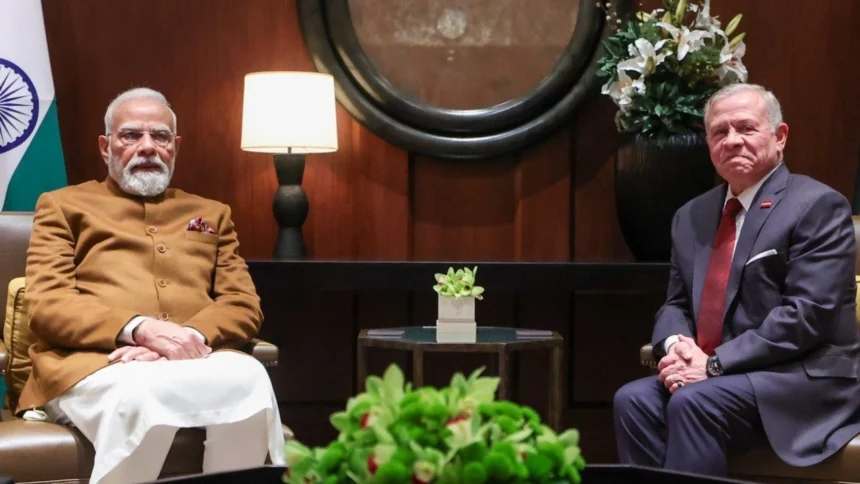
Prime Minister Narendra Modi on Monday held wide-ranging talks with Jordan’s King Abdullah II ibn Al Hussein in Amman, marking a rare full-fledged bilateral visit after nearly four decades and underscoring the growing strategic depth of ties between India and the Hashemite Kingdom at a time of regional and global flux.
The meeting at the Husseiniya Palace came as India and Jordan commemorated the 75th anniversary of the establishment of diplomatic relations, lending added historical significance to the visit. Prime Minister Modi, who is on a two-day visit to Jordan as part of a broader three-nation tour, described the engagement as an opportunity to inject new momentum into bilateral relations, while King Abdullah II highlighted the enduring friendship and expanding cooperation between the two countries. The discussions covered a broad spectrum of issues, ranging from trade and technology to regional security, counterterrorism, and developments in West Asia.
The visit, the first full bilateral engagement by an Indian Prime Minister to Jordan in 37 years, was marked by ceremonial warmth and substantive dialogue. King Abdullah II personally received Prime Minister Modi in a gesture reflecting the close and respectful ties between the two nations, setting the tone for a visit that both sides see as a turning point in their partnership.
Strengthening bilateral cooperation across economic, technological and people-centric sectors
During delegation-level talks, Prime Minister Modi emphasised India’s commitment to expanding cooperation with Jordan across key economic and developmental sectors. He said both countries would continue to work closely in areas such as trade, fertilisers, digital technology, infrastructure development, and people-to-people exchanges, building on the steady growth witnessed in recent years.
India and Jordan already share robust economic ties, with India emerging as Jordan’s third-largest trading partner. Bilateral trade stands at approximately 2.8 billion dollars, reflecting strong commercial engagement despite the geographical distance between the two nations. Jordan plays a particularly important role in supplying fertilisers to India, especially phosphates and potash, which are critical inputs for India’s agricultural sector. Leaders on both sides indicated that this economic relationship could be further diversified into new areas, including technology-driven industries and investment partnerships.
Prime Minister Modi expressed confidence that his discussions with King Abdullah II would add depth and strategic direction to bilateral ties. He acknowledged the positive ideas shared by the Jordanian leadership for taking the relationship to new heights and thanked the King for his friendship and commitment toward India. The Prime Minister noted that the 75th anniversary of diplomatic relations was not merely a commemorative milestone but a source of inspiration for future cooperation.
King Abdullah II echoed these sentiments, describing the visit as a reflection of decades of mutual respect, trust, and productive collaboration. He said both nations share a desire to advance prosperity for their people and that cooperation had expanded steadily across multiple sectors over the years. The Jordanian monarch highlighted that Prime Minister Modi’s visit provided an important opportunity to chart new paths for economic cooperation, particularly in areas such as investment and technology.
Beyond government-to-government engagement, people-to-people ties formed an important part of the discussions. Jordan is home to a vibrant Indian diaspora of over 17,500 people, working across sectors including textiles, construction, and manufacturing. Prime Minister Modi, who was warmly welcomed by members of the Indian community upon his arrival in Amman, acknowledged their role in strengthening the bridge between the two societies. He described the diaspora’s affection, pride in India’s progress, and strong cultural bonds as a reflection of the enduring connection between India and Jordan.
The visit also has a forward-looking agenda. On December 16, Prime Minister Modi and King Abdullah II are scheduled to jointly address an India–Jordan business event, bringing together leading business figures from both countries. The event is expected to explore opportunities for collaboration in trade, investment, and innovation, aligning economic ambitions with strategic priorities.
Shared perspectives on regional peace, counterterrorism and global challenges
A significant portion of the Modi–Abdullah talks focused on regional and global issues, particularly developments in West Asia. Prime Minister Modi reiterated that India and Jordan share a clear and common stance against terrorism, extremism, and radicalisation. He praised King Abdullah II for his active and positive role on regional issues, including the Gaza situation, and expressed hope that peace and stability would prevail across the region.
Underlining the importance of moderation and dialogue, Prime Minister Modi recalled earlier engagements with King Abdullah II, including their participation in a conference on Islamic heritage during the King’s visit to India in 2018. He noted that the Jordanian monarch’s efforts to promote moderation were vital not only for regional peace but also for global harmony. Modi also reflected on their first meeting on the sidelines of the United Nations in 2015, at an event focused on countering violent extremism, where King Abdullah II had delivered what Modi described as inspirational remarks.
King Abdullah II, in turn, welcomed Prime Minister Modi back to Jordan and said the Indian leader’s presence carried deep significance as the two nations marked 75 years of diplomatic relations. He highlighted Jordan’s appreciation for India’s consistent and principled positions on regional issues and its constructive engagement on matters of global concern.
Both leaders acknowledged that the current international environment presents complex challenges, from regional conflicts to global economic uncertainty. Against this backdrop, they agreed on the importance of dialogue, cooperation, and multilateral engagement. India and Jordan, they noted, have traditionally supported stability, peaceful resolution of disputes, and collective efforts to combat terrorism.
The visit also reflects Jordan’s role as a key interlocutor in West Asia and India’s growing engagement with the region. Jordan was the first stop on Prime Minister Modi’s four-day, three-nation tour, which will also take him to Ethiopia and Oman. Officials have described the itinerary as part of India’s broader outreach to strengthen partnerships across regions of strategic importance.
Symbolism and history also played a role in shaping the visit. Prime Minister Modi is scheduled, subject to weather conditions, to visit Petra along with the Crown Prince. The ancient city, known for its historical trade linkages, serves as a reminder of centuries-old connections between the Indian subcontinent and the Middle East.
This visit stands out because it is Prime Minister Modi’s first full-fledged bilateral visit to Jordan. Although he had transited through the country in February 2018 en route to Palestine, Indian officials have noted that even that brief stop was marked by exceptional courtesies from the Jordanian leadership. The current visit, however, is the first comprehensive bilateral engagement by an Indian Prime Minister in nearly 37 years, highlighting its diplomatic weight.
As discussions concluded, both sides reaffirmed their commitment to strengthening all dimensions of cooperation and working together on shared challenges. The emphasis throughout the visit remained on partnership, mutual respect, and a shared vision for peace and prosperity, rooted in a relationship that has evolved steadily over 75 years.