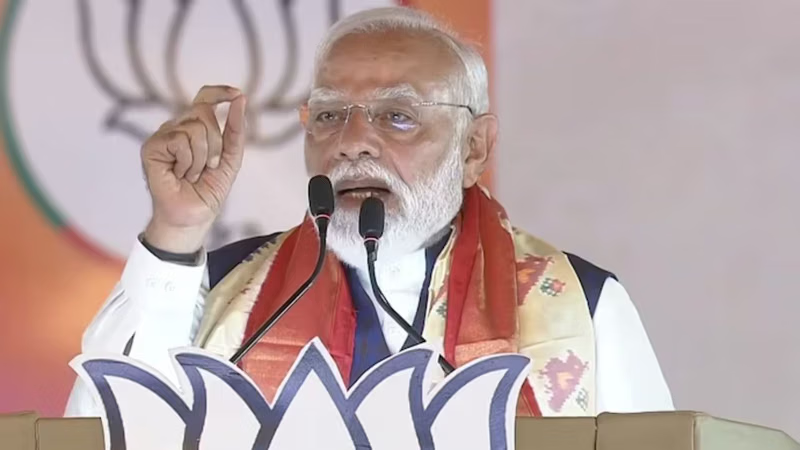
Prime Minister Narendra Modi on Sunday issued a strong appeal for economic discipline, fuel conservation and responsible consumer behaviour as India faces growing pressure from the escalating global economic crisis linked to geopolitical tensions in West Asia and disruptions in international trade routes. Addressing a public gathering in Secunderabad, the Prime Minister urged citizens to reduce unnecessary use of petrol, diesel and imported goods in order to protect India’s economy and preserve valuable foreign exchange reserves.
The Prime Minister’s remarks come at a time when global crude oil prices remain highly volatile due to rising instability in West Asia, uncertainty surrounding maritime trade routes and increasing tensions affecting international supply chains. India, which imports a significant portion of its energy requirements, remains particularly vulnerable to fluctuations in global fuel markets.
During his address, PM Modi stressed that patriotism during difficult times should not remain limited to slogans alone but must also reflect in everyday economic behaviour. He said every citizen now carries a shared responsibility in helping the country manage economic pressure through practical decisions involving fuel consumption, transportation choices and spending habits.
The Prime Minister specifically appealed to people to avoid unnecessary consumption of petrol and diesel. According to him, imported petroleum products should only be used according to genuine needs because excessive imports directly increase the burden on India’s foreign exchange reserves.
India remains among the world’s largest crude oil importing nations. Rising international oil prices not only increase fuel expenses but also impact transportation costs, industrial production, inflation and household budgets across sectors. The government has therefore intensified its focus on conservation and energy efficiency measures.
PM Modi stated that reducing fuel consumption has now become both an economic necessity and a national responsibility. He said the current global situation demands collective participation from citizens rather than dependence only on government policy interventions.
Highlighting transportation reforms, the Prime Minister encouraged greater use of public transport systems, particularly metro rail networks operating in major Indian cities. He said increased dependence on public transportation could significantly reduce fuel consumption while simultaneously easing traffic congestion and lowering pollution levels.
The Prime Minister also promoted carpooling as an effective way to reduce India’s dependence on imported fuel. Sharing vehicles for office travel and daily commuting, he noted, can collectively create substantial fuel savings over time.
Electric vehicles also featured prominently in his speech. PM Modi encouraged citizens to gradually shift toward electric mobility wherever feasible. India has already accelerated investments in EV infrastructure, charging stations, battery manufacturing and green transportation initiatives under multiple government programs aimed at reducing fossil fuel dependence.
The Prime Minister directly linked energy conservation with foreign exchange savings. He warned that the ongoing international crisis has sharply increased global prices of fuel, fertilisers and industrial commodities, making careful management of imports increasingly important for economic stability.
Apart from energy conservation, PM Modi also advised citizens to reconsider unnecessary foreign travel during the current economic environment. According to him, limiting avoidable overseas trips could help preserve foreign exchange reserves and reduce external financial pressure.
The Prime Minister revisited behavioural changes adopted during the Covid pandemic years. He pointed out that India had successfully adapted to work from home systems, online conferences and virtual communication during that period. Restarting such practices wherever possible, he suggested, could once again help reduce transportation expenses and fuel consumption.
According to PM Modi, digital flexibility and economic discipline can together play an important role in protecting the country during periods of international instability.
Another major focus of the speech involved edible oil imports. India imports large quantities of edible oils every year, contributing significantly to the import bill. PM Modi appealed to households to reduce edible oil consumption both for health benefits and economic reasons.
He stated that even small reductions in consumption by millions of families could collectively create a major positive impact on India’s import expenditure and foreign exchange management.
The Prime Minister also encouraged citizens to support locally manufactured products and adopt responsible spending habits during uncertain global economic conditions.
Gold imports were another area highlighted during the speech. PM Modi advised people to postpone non essential gold purchases for at least one year if possible. India remains one of the world’s largest consumers of gold, and high import volumes often create additional pressure on the country’s foreign exchange reserves.
Economic experts note that the current geopolitical tensions in West Asia have created uncertainty across global commodity and energy markets. The Strait of Hormuz, through which a major portion of global oil trade passes, has become an especially sensitive region because of conflict related risks.
Any prolonged disruption in maritime energy transportation routes could lead to sharp increases in international crude oil prices. Such developments directly affect India due to its heavy dependence on imported crude oil supplies.
PM Modi acknowledged that the government is continuously working to shield ordinary citizens from the full impact of the global crisis. However, he admitted that rising international fuel and fertiliser prices are already influencing domestic economic conditions.
India has significantly expanded investments in renewable energy over the past decade to reduce vulnerability to external energy shocks. Solar energy generation, ethanol blending, electric mobility expansion and green hydrogen projects have emerged as important pillars of India’s long term energy strategy.
The Prime Minister said the present global crisis once again demonstrates the importance of self reliance, sustainable development and diversified energy planning.
Economists believe the Prime Minister’s remarks reflect growing concerns regarding inflationary pressure and rising import costs. Higher fuel prices affect multiple sectors simultaneously, including agriculture, logistics, manufacturing and household spending.
Citizens in both urban and rural areas are already witnessing increases in transportation and fuel related expenses due to volatility in global commodity markets.
Political observers noted that PM Modi’s speech was not only an economic advisory but also an attempt to create broader public awareness regarding how individual consumption patterns influence national economic stability.
The emphasis on collective participation mirrors India’s previous responses during periods of crisis where public cooperation played an important role in stabilising economic activity.
The government now appears to be encouraging similar behavioural adjustments to address challenges emerging from geopolitical instability, global supply disruptions and rising commodity prices.
The Prime Minister concluded by stressing that economic discipline, responsible consumption and national unity are essential for protecting India during uncertain global conditions.
As geopolitical tensions continue affecting energy markets, shipping routes and commodity prices worldwide, India’s focus on conservation, domestic production and sustainable economic planning is expected to remain central to policy discussions in the months ahead.