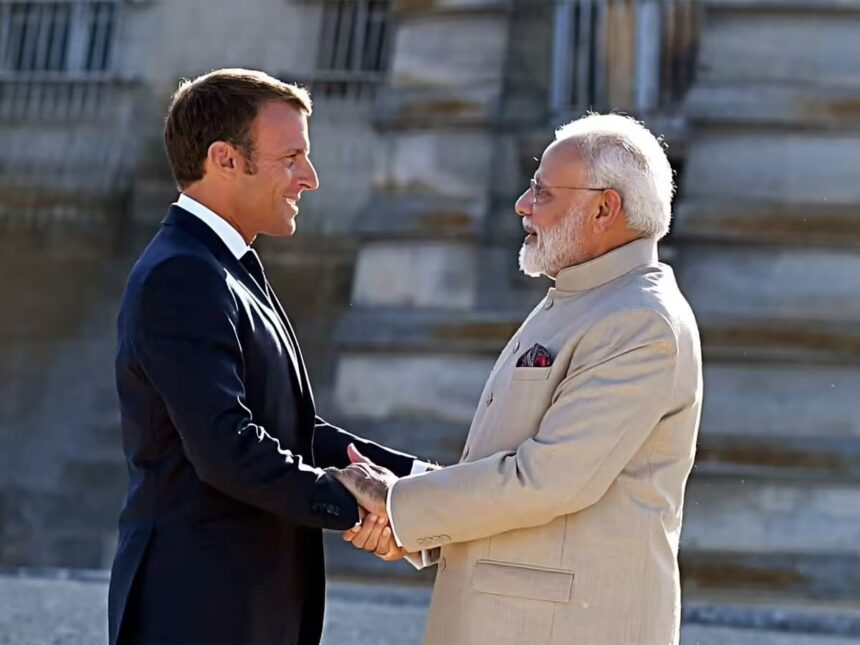
Prime Minister Narendra Modi is hosting French President Emmanuel Macron in Mumbai during a high-profile visit that underscores the growing depth and breadth of India–France relations. The talks come at a crucial juncture, shortly after India approved a major defence acquisition of 114 Rafale fighter jets from France, and as both countries look to strengthen collaboration in emerging technologies, economic engagement, and global strategic issues. President Macron’s visit reflects the steady evolution of bilateral ties into a comprehensive partnership that spans security, innovation, culture and people-to-people exchanges.
Strategic Partnership, MoUs and Expanding Economic Engagement
The bilateral meeting in Mumbai is expected to focus on reviewing the progress of the India–France strategic partnership and setting an ambitious roadmap for future cooperation. Over the past two decades, ties between New Delhi and Paris have grown into one of India’s most stable and trusted international relationships, rooted in shared democratic values, respect for strategic autonomy and a converging vision for global order. During their discussions, Modi and Macron are expected to explore ways to further diversify cooperation into new sectors while consolidating existing areas of strength.
A key outcome of the meeting is likely to be the signing of around a dozen memorandums of understanding and agreements across multiple domains. These proposed pacts are expected to cover defence production, trade facilitation, skilling initiatives, healthcare collaboration and resilient supply chains. Officials on both sides view these agreements as instruments to translate political intent into tangible outcomes, particularly in areas that support economic growth, employment generation and technological self-reliance.
Trade and investment discussions are set to feature prominently, with both leaders keen to unlock the full potential of bilateral economic ties. France is already among India’s key European investors, with French companies playing an active role in sectors such as energy, infrastructure, transport, defence manufacturing and digital services. The Mumbai meeting provides an opportunity to address barriers to trade, encourage greater private sector engagement and align regulatory frameworks to facilitate smoother business operations.
Technology and innovation are also central to the agenda, reflecting the shared emphasis on future-oriented cooperation. Modi and Macron are expected to highlight collaboration in areas such as artificial intelligence, digital public infrastructure, clean energy technologies and space research. The launch of the India–France Year of Innovation during the visit symbolises this forward-looking approach, with both governments aiming to foster collaboration between startups, research institutions and academic communities in the two countries.
Cultural and people-to-people ties are another important pillar of the partnership. The formal launch of the India–France Year of Innovation and Cultural Commemoration at the iconic Gateway of India reflects a shared belief that cultural exchange and creative collaboration strengthen mutual understanding. Events planned through 2026 in both countries are expected to showcase innovation, heritage, art and ideas, reinforcing the human dimension of bilateral relations.
Defence Cooperation, Rafale Deal and Global Strategic Issues
Defence cooperation stands at the heart of the India–France relationship, and the Mumbai meeting comes in the wake of a landmark decision by India to procure 114 Rafale fighter jets from France under a government-to-government framework. The deal is widely seen as a significant boost to India’s air power capabilities and a reaffirmation of trust between the two strategic partners. For France, it reinforces its position as a key defence partner for India, capable of delivering advanced technology and long-term support.
Beyond the Rafale acquisition, defence discussions are expected to focus on deepening collaboration across air, land and maritime domains. Both sides have been working to implement the Defence Industrial Roadmap agreed to in 2024, which aims to enhance joint research, co-development and co-production of defence equipment. Greater involvement of Indian industry, including public sector units and private players, is a priority as India seeks to strengthen its domestic defence manufacturing ecosystem.
The visit also coincides with the sixth Annual Defence Dialogue between India and France, scheduled to take place in Bengaluru. The dialogue is expected to result in the renewal of the bilateral defence cooperation agreement for another decade, providing a stable framework for long-term strategic collaboration. Maritime security, joint exercises and interoperability are likely to be key themes, particularly given shared interests in the Indian Ocean region.
Regional and global issues are set to form an important part of the leaders’ conversations. Modi and Macron are expected to exchange views on the Russia–Ukraine conflict, the situation in Gaza and broader developments in West Asia. Both leaders have previously emphasised the importance of dialogue, respect for sovereignty and adherence to international law in addressing global crises.
The Indo-Pacific region is another area of convergence, with India viewing France as an indispensable partner due to its status as a resident power with territories and military presence in the Indian Ocean. At a time when geopolitical uncertainties are reshaping regional dynamics, New Delhi and Paris see value in coordinating their approaches to ensure a free, open and rules-based Indo-Pacific. Cooperation in maritime domain awareness, humanitarian assistance and disaster relief is expected to be highlighted as part of this shared vision.
President Macron’s visit also includes participation in the AI Impact Summit, reflecting the growing importance of artificial intelligence governance and ethical frameworks in global discourse. India and France have both advocated for inclusive and responsible AI development, and their collaboration in this field underscores a shared commitment to shaping global norms that balance innovation with safeguards.
The reception accorded to President Macron in Mumbai, attended by senior state leaders, highlighted the significance India attaches to the visit. Messages exchanged on social media by leaders from both sides emphasised warmth, continuity and a shared determination to take the partnership to the next level. Accompanied by business leaders and representatives from economic, industrial, cultural and digital sectors, Macron’s delegation reflects the comprehensive nature of the engagement.
As Modi and Macron meet in Mumbai, the focus remains firmly on translating long-standing goodwill into concrete outcomes. From defence and trade to innovation and global governance, the visit underscores a shared belief that the India–France partnership is not only resilient but also adaptable to the challenges and opportunities of a rapidly changing world.