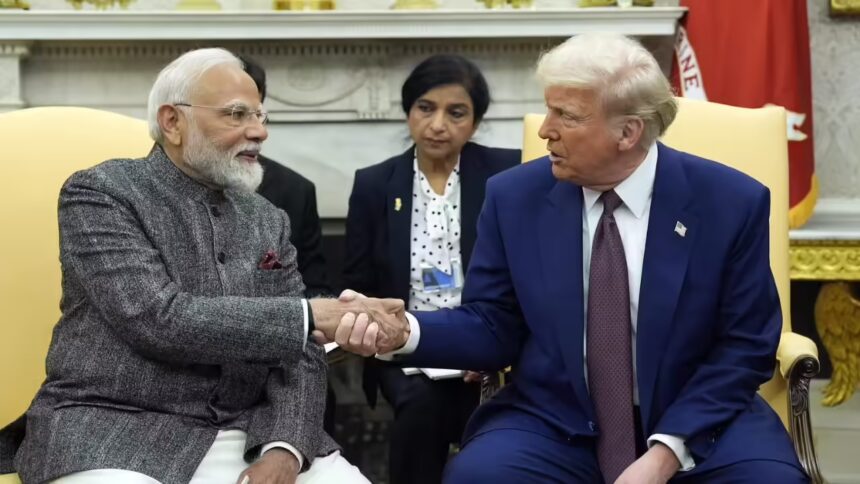
Amid heightened tensions in global trade and geopolitical uncertainties, Indian Prime Minister Narendra Modi and US President Donald Trump have struck a conciliatory note, underscoring their commitment to unlocking the “limitless potential” of India-US trade ties. This renewed optimism comes despite recent strains caused by Washington’s decision to double tariffs on Indian goods and continued pressure on New Delhi over its energy partnership with Russia. In a series of positive social media exchanges within the span of four days, both leaders projected a forward-looking approach, framing their relationship as one of “close friends and natural partners,” while their respective teams work behind the scenes to push forward a long-stalled trade agreement.
Renewed Optimism Despite Tariff Hikes
The latest round of exchanges between PM Modi and Donald Trump has drawn attention not only for its conciliatory tone but also for its timing. Just days earlier, the United States had announced a sharp increase in tariffs on Indian goods, doubling them to 50%. The move, linked by US officials to India’s ongoing purchases of Russian energy, had cast a shadow over the bilateral relationship. Yet, both leaders appear intent on projecting stability and mutual trust.
In his message, Prime Minister Modi called India and the United States “close friends and natural partners,” while expressing confidence that current trade negotiations would pave the way for new opportunities in the bilateral partnership. He emphasized that teams from both countries were working to conclude discussions “at the earliest,” suggesting that momentum remains alive despite the turbulence in negotiations. PM Modi also noted that he looked forward to another conversation with Donald Trump soon, reinforcing the personal rapport the two leaders have publicly displayed in the past.
Donald Trump, for his part, reciprocated the goodwill. In a post on his social media platform Truth Social, he said that the United States and India were continuing negotiations to “address trade barriers” between the two nations. He added that he was eager to speak with PM Modi in the coming weeks and expressed certainty that discussions would reach a “successful conclusion” beneficial for both nations. The remarks marked a shift in tone, considering the criticism India has recently faced from senior members of Donald Trump’s team.
These public exchanges have taken on outsized significance, given that official trade talks between the two governments had broken down weeks earlier. While the formal negotiations remain stalled, Indian officials have confirmed that communication channels remain open, and that both countries remain committed to a trade deal, originally envisioned for conclusion later this year. For PM Modi, highlighting cooperation in trade underscores India’s need for greater market access and strategic collaboration with Washington, even as New Delhi continues to balance its ties with Russia. For Donald Trump, signaling warmth toward India helps maintain his image of strong leadership in foreign affairs, particularly amid ongoing challenges in dealing with China and the European Union.
Tensions Over Russia, China, and Global Sanctions
Even as PM Modi and Donald Trump exchanged positive messages, the broader context reflects growing complexity in India-US relations. Hours before Donald Trump’s remarks, the Financial Times reported that he had urged the European Union to impose tariffs of up to 100% on both China and India. According to the report, Donald Trump made this demand during a phone call to senior US and EU officials meeting in Washington to coordinate their next package of sanctions against Russia. The move was intended to pressure Moscow to end its war in Ukraine, but it directly implicated India, which has increased its imports of Russian oil since the start of the conflict.
This dual messaging from Washington – conciliatory in tone from Donald Trump, but aggressive in policy demands from his advisers – highlights the tightrope India must walk. On one hand, India relies on discounted Russian oil to stabilize its energy needs and maintain economic growth. On the other, the country sees its strategic partnership with the United States as vital for counterbalancing China and securing advanced technology, defense cooperation, and market access.
White House trade adviser Peter Navarro has been particularly vocal in his criticism of India, accusing the country of “profiteering” from Russian oil and claiming its tariffs harm American jobs. He has argued that India must “come around” in trade negotiations rather than aligning with Russia and China, warning that such a stance “won’t end well for India.” These statements stand in stark contrast to Donald Trump’s social media posts celebrating his “very good friend” PM Modi and highlighting the special relationship between the two nations.
The divergence in tone underscores a broader pattern in US foreign policy: while leaders often highlight personal ties and optimism in public, the machinery of government pursues harder-edged policies behind the scenes. For India, the challenge is to navigate these contradictions without compromising its sovereignty or long-standing positions. PM Modi has consistently rejected any suggestion of third-party mediation in regional disputes, including past claims by Donald Trump that he had brokered a ceasefire between India and Pakistan. Indian officials maintain that such issues will only ever be handled bilaterally, without foreign intervention.
Beyond the Russia question, India and the US remain tied together through their participation in the Quad grouping, alongside Japan and Australia. Plans for a Quad Summit in India later this year remain under discussion, though no final dates have been announced. The summit could provide another venue for PM Modi and Donald Trump to showcase their partnership, particularly in the face of China’s rising assertiveness in the Indo-Pacific.
Personal Diplomacy and the Road Ahead
The personal rapport between PM Modi and Donald Trump has long been a defining feature of India-US relations. From their joint rallies in Houston and Ahmedabad during Donald Trump’s presidency to their frequent phone calls, the two leaders have cultivated an image of camaraderie. Their recent exchanges, the second such instance within four days, signal an effort to restore that dynamic despite underlying frictions. On Saturday, Donald Trump had told reporters that he would “always be friends” with PM Modi and emphasized the “special relationship” between India and the United States. PM Modi, in turn, reciprocated with a positive assessment of ties, setting the stage for their latest round of exchanges.
For PM Modi, emphasizing partnership with the United States serves both economic and strategic purposes. India is seeking to boost exports, attract investment, and gain access to advanced technologies, all areas where American cooperation can be crucial. At the same time, aligning more closely with Washington strengthens India’s hand in managing challenges posed by China, both at the border and in the broader Indo-Pacific region. For Donald Trump, highlighting his friendship with PM Modi plays into his broader narrative of maintaining strong alliances while also signaling to domestic audiences that he can secure beneficial trade deals for the United States.
Despite these public displays of goodwill, the path to a substantive trade deal remains fraught. Talks have broken down before, and significant gaps persist on issues ranging from tariffs on agricultural products to intellectual property protections and digital trade. The broader geopolitical environment, particularly India’s continued ties with Russia, further complicates matters. Nonetheless, both sides have reasons to push forward. For India, concluding a deal would mark a significant achievement for PM Modi’s government, showcasing its ability to navigate a turbulent global economy. For Donald Trump, a successful trade agreement with India would bolster his claims of delivering results in foreign policy, particularly ahead of critical political milestones in the United States.
The trajectory of India-US relations has often oscillated between optimism and strain, but the underlying reality remains one of deepening interdependence. Trade between the two nations has expanded significantly in recent years, and both governments recognize the potential for even greater growth. The challenge lies in translating positive rhetoric into tangible outcomes, a process that will require not only political will but also flexibility on contentious issues.