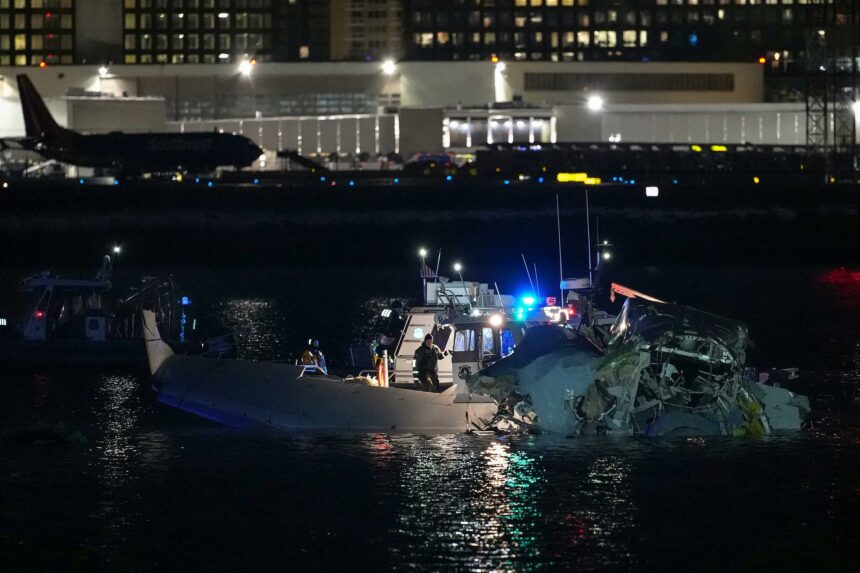
A major aviation disaster occurred near Ronald Reagan National Airport in Washington, D.C., when a passenger jet and a U.S. Army helicopter collided. The accident took place on Wednesday night, U.S. time, as American Airlines flight AA5342, which had taken off from Wichita, Kansas, crashed into a military helicopter at a low altitude. Both aircraft plunged into the Potomac River.
This devastating crash claimed the lives of all 60 passengers and four crew members on board the passenger flight, including renowned U.S. and Russian figure skaters, as well as the three military personnel aboard the helicopter. Rescue teams quickly arrived at the scene, but no survivors were found.
Despite modern aviation safety systems, this collision has raised serious concerns. Passenger aircraft are typically equipped with TCAS (Traffic Collision Avoidance System), which monitors nearby airspace and alerts pilots to potential midair collisions. Developed in 1974, TCAS has undergone several advancements. TCAS I provides only a Traffic Advisory (TA), alerting pilots to a potential threat but requiring them to decide on an evasive maneuver. In contrast, TCAS II is a more advanced system that not only issues collision warnings but also provides clear instructions to pilots, such as climbing, descending, or changing direction to avoid impact.
However, TCAS is mandatory only for commercial aircraft under international regulations outlined in the Chicago Convention. Military helicopters, on the other hand, are not bound by these rules, and reports indicate that the military helicopter involved in this crash was not equipped with TCAS.
Even if the system had been present, TCAS has limitations at low altitudes (below 300 meters). It relies on radio altimeter data, which becomes less reliable near the ground, leading to potential inaccuracies in collision avoidance instructions. Moreover, at such a low altitude, aircraft have limited maneuverability, as descending further is not an option. The passenger jet’s last recorded altitude was 90 meters, while the military helicopter was at 60 meters, making it difficult for TCAS to provide effective warnings.
Ronald Reagan National Airport operates in an extremely congested airspace, where commercial, military, and private aircraft share limited corridors. This has resulted in several near misses in recent years. In April 2024, a commercial flight had to take emergency evasive action to avoid a helicopter flying just 100 meters below it. The pilot later reported that no warning was issued by air traffic control (ATC) regarding the presence of the helicopter.
Following this near miss, U.S. Senator Tim Kaine strongly opposed a proposal to increase flights at Ronald Reagan National Airport, citing safety concerns. However, despite opposition, the plan was approved in May 2024.
Now, the National Transportation Safety Board (NTSB) has launched an in-depth investigation to determine how this catastrophic accident occurred despite advanced collision-avoidance technology and what measures need to be taken to prevent such tragedies in the future.