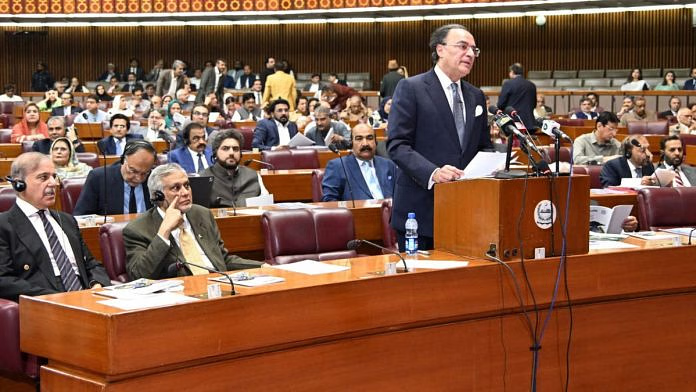
In the face of mounting economic pressures and soaring debt levels, Pakistan has announced a significant increase in its defence budget for the financial year 2025-26. Finance Minister Muhammad Aurangzeb, while presenting the annual budget on June 10, revealed that PKR 2,550 billion has been allocated to defence — a nearly 20% hike from the previous year. This move underscores Islamabad’s strategic priorities, even as it grapples with a debt burden and economic instability.
Sharp Rise in Defence Allocation
The new defence outlay marks a substantial jump from last year’s allocation of PKR 2.1 trillion. In 2024-25, Pakistan’s military spending was estimated at around $10.2 billion, with approximately $2 billion directed toward equipment and strategic assets. The Stockholm International Peace Research Institute (SIPRI) also reported Pakistan’s ongoing efforts to enhance its nuclear capabilities and expand its missile defence systems. Ahsan Iqbal, Pakistan’s Planning Minister, had signaled the hike earlier, emphasizing the necessity to equip the armed forces given regional threats. “It is our national duty to provide our military with whatever it needs,” Iqbal said, referring to recent border tensions and the need for heightened readiness.
Economic Stress and Debt Woes
Despite the defence focus, Pakistan continues to face deep economic challenges. According to its economic survey for 2024-25, the country paid $7.8 billion in external debt servicing last fiscal year. Total public debt now stands at a staggering PKR 76 trillion. Islamabad owes significant sums to countries such as China ($15 billion), Japan ($3 billion), and France (over $1 billion), with its total foreign debt nearing $87.4 billion.
India’s Comparative Advantage
When compared to India, Pakistan’s defence capabilities are modest. India’s defence budget for 2025-26 stands at $78.7 billion, up by 9.5% from the previous year. Its overall military spending is estimated at $86.1 billion, making it the world’s fifth-largest defence spender. India has consistently ramped up its defence investments over the past decade, focusing on indigenous weapon production and strategic acquisitions, including fighter jets and advanced air-defence systems. Although Pakistan holds a numerical edge in mobile rocket systems, with 600 units against India’s 264, the broader defence landscape remains heavily tilted in India’s favor.