As Bihar gears up for a high-stakes electoral battle, the Opposition alliance has placed its hopes on Congress leader Rahul Gandhi to reshape the state’s social justice narrative and mobilize Dalit and Extremely Backward Class (EBC) voters. Gandhi’s renewed political messaging, centered around equality, representation, and justice for marginalized communities, is emerging as a strategic tool to challenge the ruling NDA’s entrenched caste equations and consolidate a wider anti-BJP bloc ahead of the polls.
Rahul Gandhi’s Social Justice Message Gains Ground in Bihar
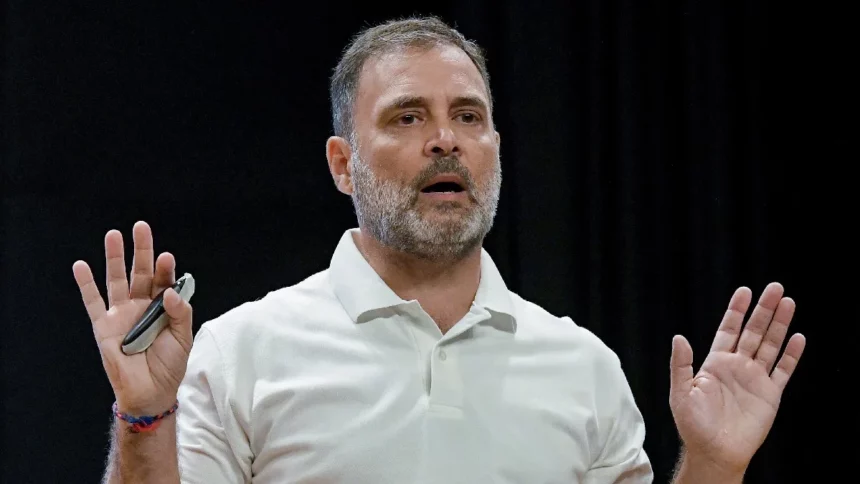
Addressing a massive poll rally in Begusarai on Sunday, Rahul Gandhi pledged that if the Opposition’s Mahagathbandhan comes to power, its government would work for the most backward classes, Dalits, minorities, and even the poor among the general castes. His speech struck a chord with the audience, as he positioned himself as a leader of inclusivity and social transformation rather than caste-based politics. According to senior Congress functionaries, Gandhi’s statement carries two distinct messages in Bihar’s political context: first, that the government under the Mahagathbandhan will not be dominated by one caste group, and second, that the Congress intends to play a central role in shaping the state’s social justice agenda.
Party insiders describe Gandhi’s remarks as part of a carefully calibrated strategy aimed at expanding the Congress’s influence among backward communities. By emphasizing justice and equal opportunity, Gandhi has sought to reclaim ground lost over the years to regional players who have traditionally dominated caste-based politics in Bihar.
The competition for Dalit and backward votes in Bihar is intense. On one side stands the NDA, led by Chief Minister Nitish Kumar, who has built his image as a pro-backward, development-oriented leader. On the other is the Mahagathbandhan, which hopes Gandhi’s political presence and his consistent advocacy for caste census and affirmative policies will help bridge the gap between traditional Congress support bases and the aspirational backward communities.
“Rahul Gandhi is best suited to bring Dalit and EBC votes for the Mahagathbandhan. He has tirelessly fought for the rights of marginalized groups and was instrumental in pushing for the caste census,” said Avinash Pande, Congress general secretary for Uttar Pradesh and one of the party’s key observers in Bihar. He added that Gandhi’s consistent efforts to give voice to neglected communities have earned him the trust of Dalits and EBCs, who now view him as the Opposition’s most credible champion of social justice.
Echoing this sentiment, Ashok Bharti, chairman of the National Confederation of Dalit and Adivasi Organisations (NACADOR), noted that Gandhi has managed to instill confidence among Dalits, Adivasis, and Other Backward Classes by demonstrating a genuine commitment to their cause. “Rahul Gandhi has shown that he is serious about social justice. His political approach resonates with those who have historically been left out of the development narrative,” Bharti said.
Dalit and EBC Votes: The Deciding Factor in Bihar’s Political Landscape
Bihar’s electoral map underlines why Dalit and EBC votes are central to every major political alliance. The state has 38 reserved assembly seats for Scheduled Castes and two for Scheduled Tribes. In the 2020 assembly elections, the NDA secured 21 of these SC seats, while the Opposition alliance managed to win 17. Each bloc captured one of the two tribal seats. This evenly split result underscores how pivotal the Dalit and tribal vote bank remains to the outcome of state elections.
Rahul Gandhi’s campaign, therefore, is focused on reversing the trend by emphasizing policies that appeal directly to these communities. One of the key instruments in this outreach is the “Nyay Patra” a 10-point charter released by the Congress specifically targeting EBCs. The document promises a special act to prevent atrocities against EBCs, reservation in government contracts, and an increase in EBC reservation from 20% to 30%, surpassing the quota currently implemented by Nitish Kumar.
By launching his Bihar campaign with this charter, Gandhi has signaled a clear intention to challenge the NDA’s narrative of being the only alliance committed to social welfare and inclusive governance. A senior Congress leader from Delhi said, “Rahul Gandhi has deliberately made the EBCs his focus group in Bihar. Through the Nyay Patra, he’s communicating that Congress is not just talking about social justice—it’s ready to legislate for it.”
The Congress believes that Gandhi’s ability to transcend narrow caste identities gives him a unique advantage over other leaders in the Opposition camp. “Tejashwi Yadav carries the image of being a Yadav-centric leader, while other regional figures mostly cater to their caste groups. Gandhi, however, is positioned as a unifying figure who speaks for all backward and marginalized sections,” the leader explained.
However, political observers caution that while Gandhi’s rhetoric is powerful, converting it into votes will be a significant challenge. The NDA continues to maintain a strong organizational network and a loyal social coalition. Nitish Kumar’s governance model, combined with leaders like Chirag Paswan and Jitan Ram Manjhi, gives the ruling alliance a robust outreach among Dalit and EBC voters. These leaders, each with their dedicated caste followings, add layers of strength to the NDA’s social base that the Opposition will find difficult to counter.
A senior Congress functionary based in Patna acknowledged the challenge but emphasized that Gandhi’s campaign plan reflects a clear intent to contest the NDA on its own turf. “His rallies and messages are now being tailored to directly engage Dalit and backward voters. The Congress strategy is to highlight social justice as a moral and political alternative to the NDA’s development model,” the leader said.
Political analysts point out that Gandhi’s message also taps into a growing sentiment among backward communities seeking a greater share of power and representation. The Congress hopes to exploit this undercurrent by positioning Gandhi as the face of a broader movement for equality rather than just a political campaign.
At a symbolic level, Gandhi’s campaign imagery—visiting Dalit homes, interacting with EBC youth, and emphasizing inclusivity—serves as a contrast to what the Congress frames as the NDA’s transactional caste politics. His frequent references to the caste census, reservation expansion, and redistribution of economic benefits are aimed at reinforcing his image as a leader genuinely committed to addressing structural inequality.
Meanwhile, the Mahagathbandhan is trying to craft a united narrative that complements Gandhi’s message. While the Rashtriya Janata Dal (RJD) continues to draw on its traditional Yadav-Muslim support base, the Congress’s entry into the social justice space allows the alliance to project a more balanced image. Left parties within the coalition also add ideological weight, particularly among students, marginalized workers, and rural poor, who view Gandhi’s message as an extension of progressive politics.
Still, the Opposition faces a steep climb. Nitish Kumar’s reputation as a governance-focused leader, coupled with his longstanding identification with the backward classes, poses a formidable barrier. Moreover, the NDA’s alliance partners bring individual caste strengths that together create a formidable social arithmetic. Chirag Paswan’s Lok Janshakti Party (Ram Vilas) retains significant influence among Dalits, while Manjhi’s Hindustani Awam Morcha appeals to Mahadalits.
Despite this, Congress strategists argue that Gandhi’s credibility on social justice issues—backed by his vocal demand for a national caste census—gives him an edge. The party believes that by taking a firm stand on redistribution and affirmative action, Gandhi can gradually erode the NDA’s advantage among the backward classes.
A Congress insider noted, “What sets Rahul apart is his moral authority on the issue. He doesn’t talk about caste for electoral arithmetic; he talks about it as a matter of justice and equality. That resonates with voters who are tired of tokenism.”
The Congress’s strategy also includes targeted outreach programs in rural Bihar, where local leaders are holding small meetings to explain the provisions of the Nyay Patra and Gandhi’s vision for backward empowerment. The idea, party officials say, is to convert abstract ideas like social justice into tangible promises—employment, education, and social protection—backed by legislative intent.
Analysts also point out that Gandhi’s campaign has been carefully designed to contrast with Nitish Kumar’s leadership style. While Kumar’s governance model is technocratic and centered around administrative efficiency, Gandhi’s approach seeks to humanize politics by focusing on empathy and inclusion. His speeches frequently highlight personal stories of struggle, discrimination, and resilience, connecting with audiences on an emotional level that traditional economic arguments often fail to reach.
In this larger political context, the upcoming election in Bihar is shaping up as more than just a contest between alliances—it is becoming a referendum on the idea of social justice itself. For Gandhi, the challenge lies in translating moral appeal into political momentum; for the NDA, it is about maintaining its coalition of caste-based loyalties while defending its governance record.
As the campaign intensifies, Gandhi’s ability to sustain his social justice narrative amid the NDA’s counteroffensive will determine whether the Congress can regain relevance in Bihar’s deeply stratified political arena. His upcoming rallies are expected to further spotlight issues of representation, caste equity, and rights-based governance, signaling that the Opposition’s electoral strategy hinges not only on criticizing the government but also on offering a credible alternative vision for inclusive politics.
Ultimately, the Opposition’s bet on Rahul Gandhi reflects a strategic calculation that Bihar’s political future will be shaped less by slogans of development and more by the promise of dignity and justice for those historically left behind. Whether this message can overcome the state’s entrenched caste loyalties remains the crucial question as Bihar prepares for another defining election.