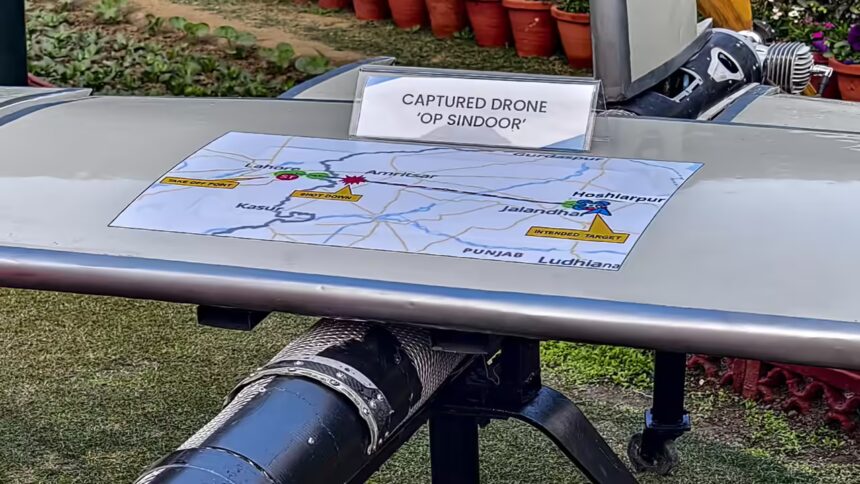
India’s military establishment has revealed major operational details linked to Operation Sindoor, exposing what officials describe as one of the most aggressive coordinated drone warfare attempts ever faced by the country. According to the latest post operation military review, Pakistan launched nearly 900 drones toward Indian territory during the night of May 7 and 8 as part of a large scale aerial assault allegedly supported by China and Turkiye.
The disclosures came during a high level defence briefing marking one year since the Pahalgam terror attack and the subsequent Indian military response under Operation Sindoor. Senior officials from the Indian Army and Indian Air Force stated that Pakistan’s drone strategy was designed not only to launch attacks but also to test India’s integrated warfare capabilities, surveillance infrastructure and economic resilience during conflict.
The military review report has now triggered fresh geopolitical discussions because Indian officials directly linked Chinese surveillance systems and Turkish drone technology support to Pakistan’s aerial offensive plans.
The Indian defence establishment stated that the drones were launched in swarm formations stretching from the Line of Control in Kashmir to the international border regions near Gujarat. Officials said the attacks represented a modern network centric warfare strategy inspired by lessons drawn from the ongoing Russia Ukraine conflict.
According to Indian military assessments, Pakistan’s objective was not merely physical destruction but also technological and economic warfare aimed at exhausting India’s defence response systems.
During the official briefing in Jaipur, Director General of Military Operations General Rajeev Ghai and Air Marshal Avdhesh Kumar Bharti explained how India’s Integrated Air Command and Control System successfully neutralised nearly the entire drone threat without allowing significant damage to strategic military infrastructure.
The Indian military claimed that not a single major Indian defence installation suffered critical damage despite the scale and intensity of the attempted attacks.
Defence officials revealed that Pakistan, along with Chinese and Turkish assistance, had prepared a four layer operational strategy behind the drone offensive.
The first objective involved overwhelming Indian air defence systems using large numbers of low cost drones.
Military officials stated that Pakistan attempted to replicate NATO style swarm drone tactics similar to those increasingly visible in modern European battlefields. By launching hundreds of inexpensive drones simultaneously, Pakistan allegedly hoped India would be forced to waste expensive missile interceptors and air defence resources.
According to the review, many of the drones used in the assault reportedly cost between ₹30,000 and ₹50,000, while Indian surface to air missile systems and interceptor technologies can cost several crore rupees per deployment.
Indian officials stated that this formed part of an economic warfare strategy intended to impose disproportionate financial costs on India during prolonged conflict conditions.
The second objective reportedly focused on forcing India into an expensive aerial defence battle by exhausting missile inventories and increasing operational deployment costs.
Defence experts have increasingly warned globally that modern drone warfare allows smaller and cheaper systems to challenge sophisticated military infrastructure economically rather than purely militarily.
The military review suggested that Pakistan attempted to exploit this vulnerability through mass deployment tactics supported by foreign technological assistance.
The third strategic objective allegedly involved forcing India’s radar and reconnaissance systems to expose operational patterns and surveillance capabilities.
Indian officials claimed that Pakistan attempted to conduct network warfare rather than traditional battlefield retaliation. The review alleged that China contributed through advanced surveillance integration support, including assistance linked to the Beidou satellite navigation and monitoring system.
The Indian military believes the drone assault was designed partly as a large scale intelligence gathering exercise intended to study Indian aerial response timings, radar activation patterns and defence communication systems.
The fourth objective focused on exposing potential gaps within India’s aerial surveillance and operational manpower deployment systems.
However, Indian officials claimed the operation instead demonstrated the effectiveness of India’s Integrated Air Command and Control System, commonly referred to as IACCS.
According to the defence briefing, India’s network centric warfare capability successfully integrated radar systems, fighter aircraft coordination, missile defence platforms and real time surveillance data to neutralise the majority of threats efficiently.
The military stated that nearly 98 percent of incoming drones were intercepted or destroyed before reaching intended targets.
Officials described the operation as a major validation of India’s evolving multi domain warfare readiness.
The revelations have intensified discussions regarding the rapidly changing nature of warfare in South Asia.
Military strategists increasingly believe future conflicts may rely heavily on drones, cyber systems, surveillance networks and artificial intelligence driven battlefield coordination instead of conventional troop heavy warfare.
India’s experience during Operation Sindoor is now being analysed as a case study in counter swarm defence capability under high pressure conflict conditions.
The Indian Army also released updated casualty and operational figures linked to the campaign.
According to officials, more than 100 Pakistani soldiers and over 100 terrorists operating from camps inside Pakistan and Pakistan occupied Kashmir were killed during the broader military operation.
Indian authorities stated that Operation Sindoor was launched not simply as retaliation but as a long term strategic doctrine shift aimed at eliminating terror infrastructure across the border.
Military officials described the operation as the beginning of a new phase in India’s anti terrorism posture rather than a one time military response.
The operation itself began during the early hours of May 7, 2025.
Indian Air Force fighter jets reportedly destroyed nine terror hideouts within just twenty three minutes between 1:05 AM and 1:27 AM. Officials claimed that approximately 100 terrorists were eliminated during the strikes.
Pakistan subsequently attempted missile attacks targeting fifteen Indian cities later the same evening, according to Indian military accounts.
Indian air defence systems reportedly intercepted incoming threats while retaliatory measures significantly weakened Pakistan’s aerial offensive capability.
The situation escalated further on May 8 when Pakistan allegedly launched nearly 1000 drones targeting 36 Indian locations stretching from Leh to Gujarat.
Indian officials stated that almost all incoming drones were neutralised successfully.
The Indian military further claimed that four Pakistani air defence systems and one radar installation were destroyed during retaliatory operations.
The most intense escalation reportedly occurred during the night of May 9.
According to Indian officials, Pakistan launched long range weapons toward 26 separate Indian locations between 10:30 PM and 1:55 AM.
India then responded with coordinated drone strikes and BrahMos missile attacks launched through Sukhoi fighter aircraft platforms.
Indian authorities claimed these retaliatory strikes destroyed eleven Pakistani airbases and multiple aircraft.
The disclosures surrounding Operation Sindoor have now become central to India’s broader strategic messaging regarding national security and regional deterrence.
The naming of the operation itself also carried symbolic importance.
According to officials, multiple names were initially considered for the mission, including Operation Mangalsutra. However, Prime Minister Narendra Modi reportedly approved the final name “Operation Sindoor” because many women had lost their husbands during the Pahalgam terror attack.
Military officials said the name symbolised both sacrifice and national resolve.
The operation has since become one of the most discussed military campaigns in recent Indian strategic history.
Defence analysts believe the review highlights how regional conflicts are increasingly becoming interconnected with global military technologies and alliances.
The alleged involvement of Chinese surveillance systems and Turkish drone support demonstrates how geopolitical partnerships now influence battlefield tactics even in regional conflicts.
The revelations may also further complicate India’s diplomatic relations with both China and Turkiye.
India has repeatedly expressed concern regarding defence cooperation between Islamabad, Beijing and Ankara.
Turkiye has expanded its global drone export footprint significantly over the past decade, while China continues strengthening strategic military ties with Pakistan through technology transfers and joint defence projects.
Indian military planners are now expected to accelerate investments in anti drone systems, artificial intelligence based defence coordination and integrated electronic warfare capabilities.
Experts believe the scale of the drone assault during Operation Sindoor has permanently changed India’s understanding of future battlefield threats.
The operation also highlighted the growing importance of integrated command structures in modern warfare.
Rather than relying solely on individual service branches, India increasingly used joint operational coordination involving the Army, Air Force, radar systems, cyber surveillance and missile defence integration.
Military observers believe this shift reflects lessons drawn from contemporary conflicts worldwide.
The anniversary review has generated strong reactions across strategic and political circles because it directly addresses the evolving security challenges facing India in a rapidly transforming geopolitical environment.
As drone warfare becomes more sophisticated and accessible globally, countries are increasingly preparing for conflicts where technology, surveillance and network disruption may matter as much as conventional military strength.
For India, Operation Sindoor now represents both a warning and a demonstration of capability.
Officials insist the operation proved that India possesses the operational readiness and technological resilience required to counter complex hybrid warfare threats involving drones, surveillance systems and coordinated aerial attacks.
At the same time, the revelations underscore the growing volatility of regional security conditions and the increasing role of international strategic alignments in shaping South Asian military confrontations.