Global oil markets witnessed a dramatic surge on Monday as renewed conflict involving Iran, Israel, and the United States disrupted crude shipments through the strategically vital Strait of Hormuz. Brent crude and U.S. West Texas Intermediate futures climbed sharply in early Asian trade, reflecting growing concerns over potential supply shortages.
Brent crude futures rose as much as 13% to touch $82.37 per barrel, marking their highest level since January 2025. Prices later moderated but remained elevated, trading around $78.28 by 0605 GMT, up more than 7%. U.S. West Texas Intermediate crude also climbed over 12% intraday to reach $75.33 before easing to around $71.76.
The surge followed retaliatory Iranian strikes after initial bombings by Israel and the United States that reportedly killed Iran’s Supreme Leader Ali Khamenei. Renewed missile exchanges reportedly damaged multiple tankers in Gulf waters, intensifying fears of sustained disruption to global oil flows.
Strait of Hormuz Disruptions
The Strait of Hormuz, a narrow but critical maritime passage between Iran and Oman, connects the Persian Gulf to the Arabian Sea. On a typical day, nearly one-fifth of global oil consumption passes through this corridor. Major exporters including Saudi Arabia, the United Arab Emirates, Iraq, Iran, and Kuwait rely on this route to ship crude and refined products to Asian markets such as China and India.
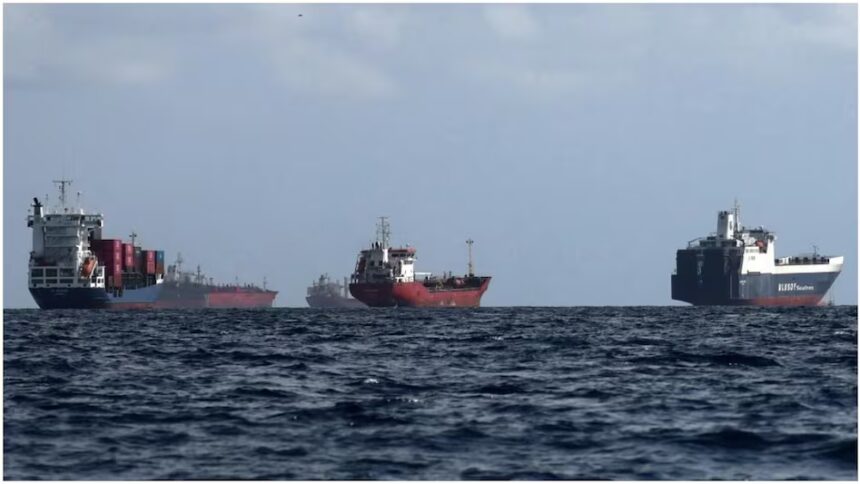
Shipping data indicated that more than 200 vessels, including oil and liquefied natural gas carriers, dropped anchor outside the strait amid escalating tensions. Reports confirmed that three tankers sustained damage and one seafarer was killed in recent attacks.
Energy analysts noted that a prolonged effective closure of the Strait of Hormuz would severely disrupt supply chains and drive prices significantly higher. China and India, among the world’s largest oil importers, would face immediate challenges securing alternative supplies.
Markets React but Temper Gains
Despite the sharp spike, oil prices pared some gains later in the trading session. Analysts suggested that markets had already factored in a geopolitical risk premium in anticipation of escalation.
Priyanka Sachdeva, senior analyst at Phillip Nova, described the development as a serious geopolitical shock but not yet a systemic crisis. She indicated that markets are closely watching whether disruptions become prolonged or remain contained.
Brent had already risen more than 19% this year prior to the latest escalation, while WTI was up approximately 17% before the recent spike. The current surge compounds upward pressure on energy costs globally.
OPEC+ and Global Supply
Amid the volatility, OPEC+ announced a modest production increase of 206,000 barrels per day for April. However, analysts observed that most OPEC+ producers are already operating near full capacity, with Saudi Arabia being one of the few with significant spare production capability.
The International Energy Agency confirmed it is in contact with major Middle Eastern producers. The agency coordinates emergency releases of strategic petroleum reserves among developed nations during supply disruptions.
According to Goldman Sachs, visible global oil inventories stand at approximately 7.827 million barrels, equivalent to about 74 days of demand, which is near historical averages. However, sustained disruption in the Strait of Hormuz could quickly erode available buffers.
Impact on Asian Economies
Asian governments have begun assessing stockpile availability. South Korea signaled it may release petroleum reserves to stabilize domestic industries if disruptions persist. India is exploring alternative shipping routes to mitigate risks tied to Gulf supply interruptions.
Energy security concerns are particularly acute for fast-growing economies dependent on Middle Eastern crude. Any prolonged instability would likely translate into higher import costs and inflationary pressure.
U.S. Gasoline Prices Rise
The conflict has also driven up U.S. gasoline futures. Prices surged as much as 9.1% to $2.496 per gallon, the highest level since July 2024, before easing slightly. Analysts warned that retail gasoline prices in the United States could surpass $3 per gallon if tensions continue.
Higher fuel costs could carry political implications, particularly with U.S. midterm elections approaching. Rising energy prices often influence consumer sentiment and economic outlook.
Outlook for Oil Prices
Citi analysts projected Brent crude could trade between $80 and $90 per barrel in the coming week amid sustained tensions. Their baseline scenario anticipates either leadership changes in Iran or de-escalation efforts within one to two weeks.
The trajectory of oil prices now hinges on geopolitical developments. If the Strait of Hormuz remains operational and diplomatic channels reopen, markets may stabilize. However, any further tanker attacks or shipping blockades could send prices sharply higher.
For now, global energy markets remain on edge, balancing risk premiums against supply fundamentals as conflict-driven uncertainty clouds the outlook.