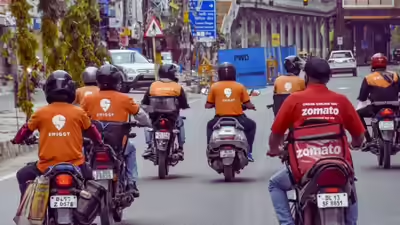
As India prepares to ring in the new year, a nationwide strike by gig and platform-based delivery workers has raised concerns about possible disruptions to food and quick-commerce services, with unions warning that peak-hour walkouts on December 31 could significantly affect customers and platforms alike.
nationwide strike intensifies amid peak festive demand
A large-scale protest by delivery workers affiliated with the Gig and Platform Services Workers Union has entered a critical phase on New Year’s Eve, a day that typically records one of the highest order volumes of the year for food delivery and quick commerce platforms. Union leaders claim that between one hundred thousand and one hundred fifty thousand delivery workers may participate in the strike during peak hours, potentially disrupting services across major cities and several tier two locations.
The strike is being supported by multiple regional and national unions, including members associated with the Indian Federation of App-Based Transport Workers. According to Shaik Salauddin, a prominent union leader and co-founder of the federation, workers across cities are mobilising to draw attention to long-standing grievances related to fluctuating earnings, safety risks, and what they describe as arbitrary account deactivations driven by opaque platform algorithms. He emphasised that the timing of the strike was deliberate, aimed at highlighting the dependence of platform businesses on gig labour during periods of maximum demand.
The protest follows a similar strike held on December 25, when tens of thousands of delivery workers reportedly logged off their apps during peak windows. That action led to visible disruptions across platforms such as Swiggy, Zomato, Blinkit, Instamart, and Zepto, before services gradually stabilised later in the day. Union representatives argue that the continuation of protests reflects unresolved issues rather than isolated incidents of dissatisfaction.
Participation in the December 31 strike is expected to span metro cities such as Delhi, Mumbai, Bengaluru, Hyderabad, and Chennai, as well as multiple tier two cities where platform-based delivery has expanded rapidly over the past few years. If turnout matches union projections, customers may face longer delivery times, limited availability of delivery partners, or temporary suspension of services during high-demand slots on New Year’s Eve.
The union leading the protest has described itself as India’s first women-led national trade union representing gig and platform workers, adding a symbolic dimension to the movement. Organisers say the strike is not only about immediate earnings but also about asserting workers’ rights within a rapidly growing platform economy that increasingly relies on algorithmic management and flexible labour.
worker demands, platform responses, and economic implications
At the core of the strike is a comprehensive list of demands submitted to Mansukh Mandaviya, the Union Minister of Labour and Employment. The memorandum, signed by union president Seema Singh and national coordinator Nirmal Gorana, outlines concerns that unions say have worsened over time despite repeated protests and negotiations.
Key demands include a guaranteed minimum monthly earning of forty thousand rupees for delivery workers, the abolition of mandatory peak-hour, slot-based, and weekend work systems, and compensation for workers when orders are cancelled by customers. Unions argue that frequent cancellations, often beyond the worker’s control, directly reduce earnings and unfairly shift business risks onto delivery partners.
Another major demand is the discontinuation of ultra-fast delivery mandates, such as ten- and twenty-minute delivery targets, which unions say encourage unsafe driving practices and increase the risk of accidents. Workers are also calling for a minimum per-kilometre rate of twenty rupees across platforms including Swiggy, Zomato, Blinkit, Zepto, Flipkart, and BigBasket, arguing that current rates fail to account for fuel costs, vehicle maintenance, and inflation.
Social security and workplace protections feature prominently in the demands. These include emergency leave provisions, comprehensive maternity benefits for women delivery workers, and restrictions on work radius for women, limiting assignments to within seven kilometres of their homes. Unions have also demanded an end to arbitrary id blocking, punitive rating systems, and mandatory pre- and post-delivery photo uploads, which they say add stress and surveillance without improving service quality.
Another significant issue raised is the increasing reliance on artificial intelligence-driven systems for customer support and worker management. The union has called for the replacement of automated responses with round-the-clock human customer support, arguing that algorithmic systems often fail to address real-world issues faced by workers on the ground. The restoration of physical company hubs, where workers can seek assistance and resolve disputes in person, is also among the demands.
The timing of the strike is particularly sensitive for platforms and brands. Christmas and New Year’s Eve are among the busiest days of the year for food delivery and quick commerce, with sharp spikes in orders for meals, beverages, party supplies, and last-minute purchases. Industry data from recent years shows that demand during this festive window can surge by more than one hundred percent for certain categories, making uninterrupted delivery operations critical for platform revenues and merchant partners.
While platform companies have not publicly detailed their contingency strategies, industry executives indicate that firms are closely monitoring participation levels and adjusting operations accordingly. Platforms such as Swiggy, Zomato, and Zepto are reportedly offering higher incentives and surge pay to encourage delivery partners to stay online during peak hours, aiming to minimise service disruptions. However, unions argue that short-term incentives do not address structural issues around pay stability and worker welfare.
The strike also carries broader economic and policy implications. As the platform economy continues to expand, disputes between gig workers and companies are becoming more frequent and more visible. Unions warn that neglecting gig workers’ rights could undermine the sustainability of India’s digital and consumption-driven growth model. In its memorandum, the union stated that India’s development ambitions cannot be realised if workers forming the backbone of the platform economy continue to face what it described as exploitation and insecurity.
For customers, the immediate concern is whether food and essential deliveries will be available smoothly on New Year’s Eve. For platforms, the strike highlights growing pressure to rethink labour practices amid rising regulatory scrutiny and worker mobilisation. As delivery workers prepare to log off during one of the most lucrative windows of the year, the standoff underscores a deeper tension between rapid platform growth and the demand for fairer working conditions in India’s gig economy