Nepal Holds General Election After Months of Political Turmoil
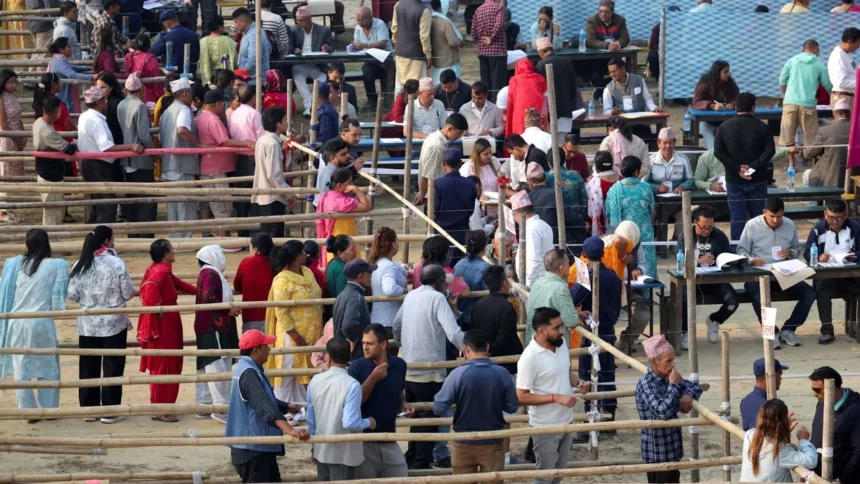
Voters across Nepal went to the polls on 5 March 2026 to elect 275 members of the House of Representatives, the lower house of the federal parliament.
The election was called after a period of political instability and mass protests that led to the resignation of former prime minister K. P. Sharma Oli in September 2025.
Nearly 18.9 million voters were registered to participate in the election, with more than 3,400 candidates from 68 political parties contesting seats.
The vote is expected to shape Nepal’s political future and determine the next government after months of uncertainty.
Interim Government Led by Sushila Karki
Following the political crisis, the country was temporarily governed by an interim administration led by Sushila Karki.
She was appointed interim prime minister by Ram Chandra Poudel after the dissolution of the parliament.
Karki became the first woman to head a government in Nepal’s history, with the main responsibility of stabilising the country and conducting fair elections.
Her interim cabinet consisted mainly of technocrats and civil society leaders.
Youth Protests Triggered Political Crisis
The early election was largely triggered by the 2025 Gen Z protests that swept across the country.
Young people took to the streets in large numbers to protest corruption, unemployment, and alleged nepotism within political circles.
Public frustration had been growing for months due to economic stagnation and a large number of skilled workers leaving Nepal to work abroad.
The protests intensified after the government banned 26 social media platforms, including YouTube, Facebook and WhatsApp.
Authorities argued the platforms had failed to comply with new digital regulations.
However, critics claimed the move was an attempt to suppress dissent.
Violent Clashes and Government Resignation
The protests soon escalated into widespread unrest.
Thousands of demonstrators gathered at Maitighar Mandala and marched toward the federal parliament building in Kathmandu.
Security forces attempted to disperse crowds, and clashes broke out between protesters and authorities.
According to reports, at least 76 people were killed and more than 2,000 injured during the violence.
Several government buildings were damaged, including offices in the government complex at Singha Durbar.
Amid mounting pressure and widespread unrest, Prime Minister K. P. Sharma Oli resigned from office.
Parliament Dissolved and Election Announced
After the resignation, President Ram Chandra Poudel dissolved the House of Representatives to pave the way for fresh elections.
The decision was taken to restore political stability and give citizens an opportunity to elect a new government.
The election date was later announced for 5 March 2026.
Unlike previous elections, the vote was conducted only for the federal parliament, while provincial assemblies remained intact.
Electoral System in Nepal
Nepal’s parliamentary elections use a mixed electoral system combining direct and proportional representation.
Out of the 275 seats in the House of Representatives:
- 165 members are elected through single-member constituencies using the First-Past-The-Post system.
- 110 members are elected through proportional representation from a nationwide party list.
Each voter receives two separate ballots, one for each system.
Political parties must secure at least 3 percent of the nationwide vote to qualify for seats under proportional representation.
Major Political Parties and Leaders
Several major parties and leaders are contesting the election.
The Nepali Congress is led by Gagan Kumar Thapa.
The party has positioned him as its prime ministerial candidate.
The Communist Party of Nepal (Unified Marxist–Leninist), led by K. P. Sharma Oli, is also seeking a return to power.
Another major force is the Nepali Communist Party led by Pushpa Kamal Dahal.
Other parties contesting include the Rastriya Swatantra Party led by Rabi Lamichhane and the Rastriya Prajatantra Party led by Rajendra Lingden.
Surge in Young and First-Time Voters
The election saw a significant increase in voter registration.
More than 800,000 first-time voters were added to the electoral roll.
Many of these voters belong to the same generation that participated in the protests demanding political reform.
Observers believe youth participation could play an important role in determining the election outcome.
Security Arrangements for the Election
To ensure peaceful voting, authorities deployed a large security force across the country.
Around 320,000 personnel from the Nepal Police, Armed Police Force, and Nepal Army were assigned election duties.
Security measures were implemented to prevent violence and ensure smooth voting following the unrest experienced in 2025.
Campaign Focused on Governance and Reform
Political parties focused their campaigns on issues such as governance reform, economic development, and employment.
Several parties promised structural reforms, improved social security systems, and policies aimed at boosting economic growth.
Energy development, particularly hydropower expansion, also emerged as a key campaign issue.
Election Seen as Turning Point
The 2026 general election is widely viewed as a turning point for Nepal’s democracy.
The results will determine whether established political parties retain influence or whether newer political forces gain ground.
The election also represents an opportunity for Nepal to move beyond the political instability triggered by the protests and rebuild public trust in democratic institutions.