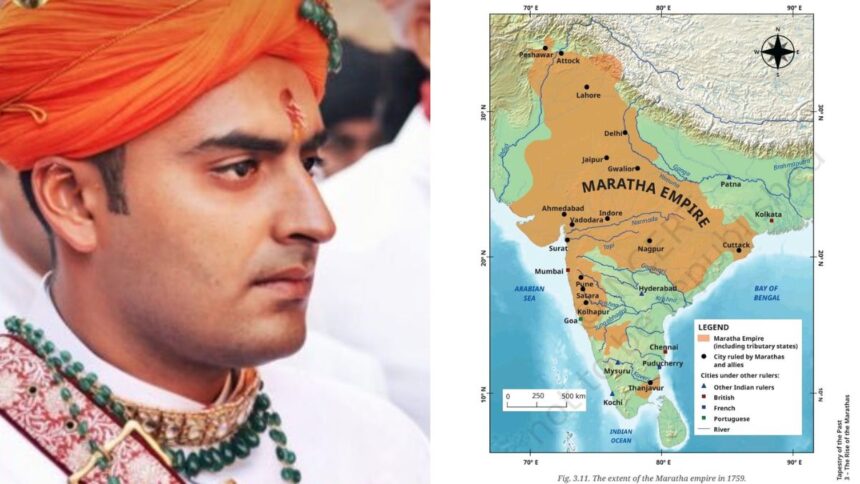
The National Council of Educational Research and Training (NCERT) has initiated a review process after facing criticism over a map featured in its new Class 8 social science textbook. The map in question depicts regions of present-day Rajasthan, including Jaisalmer, as having been under the Maratha Empire, sparking controversy over historical authenticity. In response to this feedback, NCERT has constituted a committee of senior subject experts to assess the concerns and recommend appropriate revisions if needed.
As part of its efforts to align school education with the National Education Policy (NEP) 2020 and the National Curriculum Framework for School Education (NCFSE) 2023, NCERT has been releasing updated textbooks for Classes 1 to 8. The new Class 8 books were launched recently, but the inclusion of the contested map has prompted sharp criticism from individuals claiming historical inaccuracy. Among the most vocal critics is Chaitanya Raj Singh from the erstwhile royal family of Jaisalmer, who called the depiction of his region as part of the Maratha Empire factually incorrect and misleading.
Concerns Over Historical Representation
In a post on social media platform X, Singh asserted that there is no credible historical evidence to suggest Maratha influence, invasion, or administrative control over Jaisalmer. According to him, the map wrongly includes Jaisalmer within the Maratha Empire, which he believes distorts regional history and misinforms students. He also emphasized the absence of any documentation or records to support the claim that Marathas had ever established dominance or governance in that region.
Although NCERT did not specifically reference Singh’s objections in its official statement, it acknowledged having received feedback on educational content in certain textbooks. The organization reiterated its longstanding practice of forming expert panels to evaluate such feedback in a comprehensive and scholarly manner. The newly formed committee, consisting of subject matter experts and academics from reputed institutions, will assess the criticisms and propose evidence-based corrections if necessary.
Role of NCERT and the Editorial Process
The process of creating the new textbooks was carried out under a tight timeline, as emphasized by Michel Danino, chairperson of the curricular group responsible for the social science textbooks. Danino noted that while rigorous efforts were made to maintain accuracy, the compressed schedule limited opportunities for in-depth research into every historical detail. As a result, some sections, including maps, were based on secondary sources previously deemed credible and widely available in the public domain.
Danino clarified that the map was drawn using references from earlier publications and was never intended to suggest definitive control of Jaisalmer by the Marathas. He stressed that such maps often include territories under direct Maratha rule as well as areas that paid tribute, taxes, or entered into treaties. This, he explained, adds complexity to historical boundaries and cautioned against interpreting such illustrations too rigidly.
He further stated that the map in question does not explicitly name Jaisalmer, nor does the chapter provide any narrative about Maratha activity in that region. He admitted, however, that the Class 8 textbook did not include a disclaimer about the approximate nature of historical borders, unlike the Class 7 textbook, which does carry such a caveat. He agreed that including the same disclaimer in all relevant maps would have been more appropriate.
NCERT, while defending the integrity of its textbook development process, has assured stakeholders that any proven inaccuracies will be addressed. Danino confirmed that the curriculum team is actively re-examining the map and if discrepancies are confirmed, a revised version will be created and included in future editions of the textbook.
This incident underscores the sensitive nature of historical representation in education and the challenges of interpreting complex past events in school curricula. It also highlights the importance of academic transparency and the willingness of institutions to make corrections in light of new information or valid critique. The broader effort to modernize Indian school education continues, even as debates like this one reveal the intricate task of balancing factual accuracy with accessible learning content for young students.