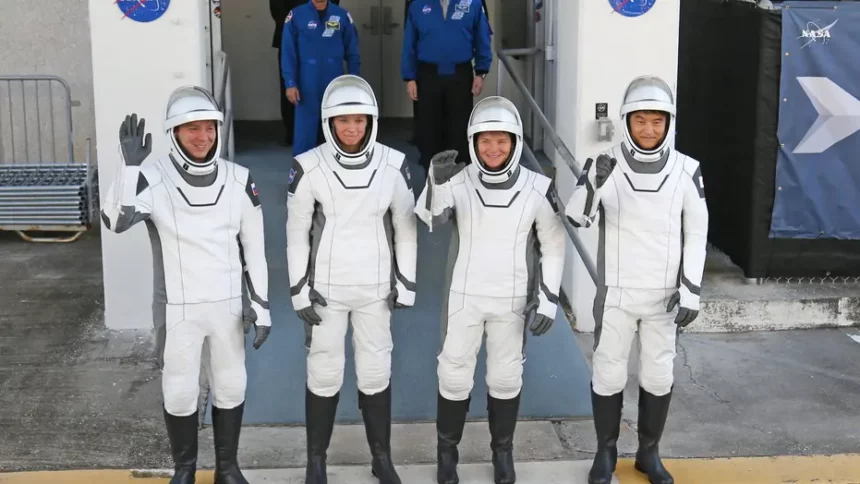
NASA’s Crew-10 mission successfully reached the International Space Station (ISS) following its launch aboard SpaceX’s Falcon 9 rocket. The Crew Dragon capsule lifted off from NASA’s Kennedy Space Center in Florida at 7:03 p.m. ET on Friday (4:33 a.m. IST on Saturday) and separated from the rocket about ten minutes later, beginning its journey to the ISS. The mission brings four new astronauts to the space station: NASA’s Anne McClain and Nichole Ayers, Japanese astronaut Takuya Onishi, and Russian cosmonaut Kirill Peskov.
With their arrival, the total number of astronauts on the ISS has temporarily increased to 11. Crew-10 joins NASA astronauts Nick Hague, Sunita Williams, Butch Wilmore, and Don Pettit, along with Roscosmos cosmonauts Aleksandr Gorbunov, Alexey Ovchinin, and Ivan Vagner. The newly arrived astronauts will undergo a brief handover period before taking over station operations.
A key focus of this rotation is the return of Butch Wilmore and Sunita Williams, who have been stranded on the ISS for nine months due to technical issues with Boeing’s Starliner capsule. The duo initially traveled to the space station in June 2023 but have remained there far longer than intended. Under President Donald Trump’s administration, NASA has accelerated plans to bring them back to Earth, emphasizing the urgency of their return.
Butch Wilmore, Sunita Williams, Hague, and Gorbunov are set to leave no earlier than March 19 aboard a Crew Dragon capsule already docked at the ISS. Their departure is contingent on favorable weather conditions at designated splashdown sites off the Florida coast. NASA’s mission teams will assess these conditions before confirming the schedule.
Crew-10’s arrival ensures continuity of operations and research on the ISS. The team will conduct various scientific studies, including research on lunar navigation, material flammability, and the physiological effects of space travel on the human body. The findings from these experiments will contribute to future spacecraft development and enhance safety measures for deep-space missions.
The new crew members are experienced pilots, with McClain and Ayers having military aviation backgrounds, while Onishi and Peskov are former airline pilots. Their six-month mission will extend into the fall, supporting ongoing research and maintaining the station’s functionality.
NASA’s strategy of overlapping crew rotations ensures seamless transitions in station management. Butch Wilmore and Sunita Williams will provide essential briefings to Crew-10 before their departure, ensuring continuity in operations. With Crew-10 now in place, the ISS remains fully operational as NASA continues to advance space exploration efforts.