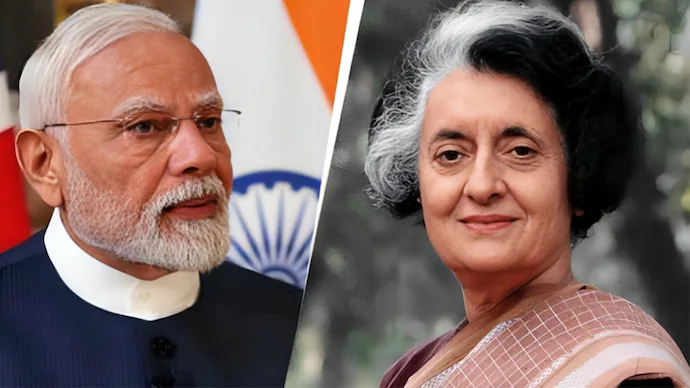
Prime Minister Narendra Modi, 74, has reached a new milestone by becoming India’s second-longest serving prime minister in consecutive terms, surpassing the record held by Indira Gandhi. As of July 25, PM Modi has completed 4,078 days in office across three consecutive terms, marking another chapter in his political journey that began with his swearing-in on May 26, 2014. This achievement places him behind only Jawaharlal Nehru, who remains the longest-serving prime minister in the country’s history.
PM Modi, who is the first prime minister born in Independent India, took oath for his third consecutive term in June last year after leading the Bharatiya Janata Party (BJP) to power for the third time. He holds the distinction of being the longest-serving PM from a non-Congress party, reflecting his enduring popularity and influence in Indian politics.
A New Milestone in India’s Political History
On July 25, PM Narendra Modi surpassed Indira Gandhi’s record of 4,077 consecutive days as prime minister, a tenure she held from January 24, 1966, to March 24, 1977. Indira Gandhi had also served another term as PM from January 14, 1980, until her assassination on October 31, 1984. Her father, Jawaharlal Nehru, remains the country’s longest-serving PM, with a tenure of 16 years and 286 days from August 15, 1947, to May 27, 1964.
Before stepping onto the national stage, PM Modi was the longest-serving chief minister of Gujarat, serving from 2001 until he assumed the role of prime minister in 2014. His political trajectory has been marked by consistent electoral victories, with the BJP securing a majority in the 2014 elections by winning 272 seats in the Lok Sabha, and further improving its tally to 303 seats in the 2019 elections.
PM Modi’s Consistent Electoral Victories
Although the BJP did not secure a simple majority in the 2024 elections, it emerged as the single largest party, enabling PM Modi to form the government for a third consecutive term with the support of National Democratic Alliance (NDA) partners. This feat has positioned PM Modi as the first and only non-Congress prime minister to complete at least two full terms and to be re-elected for a third term.
PM Modi is also the first sitting prime minister since Indira Gandhi in 1971 to be re-elected with a majority and the only leader apart from Jawaharlal Nehru to win three consecutive elections as the leader of a party. His ability to secure a mandate in three back-to-back elections demonstrates his continued relevance and influence in the Indian political landscape.
Born in post-Independence India, PM Modi has shaped his tenure with a focus on development, economic reforms, and a strong nationalist narrative that has resonated with a broad section of the Indian electorate. As he continues his tenure, PM Modi’s leadership reflects a blend of continuity and change in the governance of the world’s largest democracy, marking an era where a non-Congress leader has established a long-standing presence at the highest political office in India.