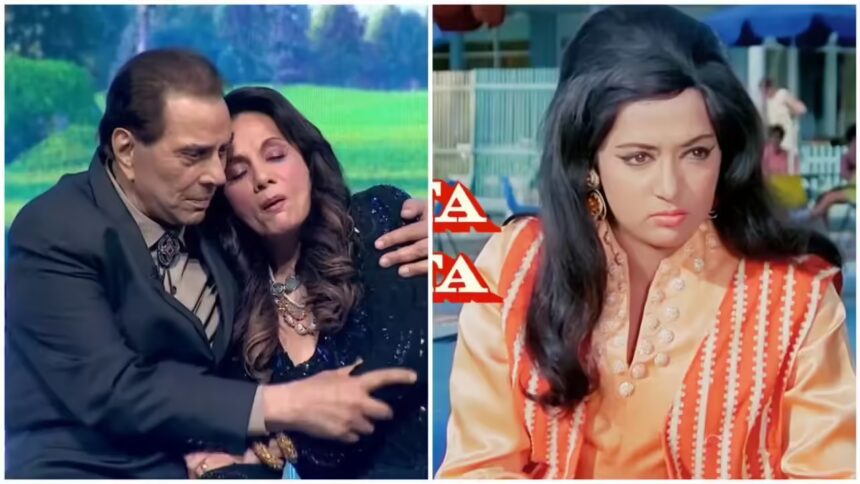
Veteran Bollywood actress Mumtaz has revisited her celebrated career with candid reflections, asserting that she delivered more hit films than Hema Malini while explaining why she refused major projects and continues to command high fees for television appearances, even decades after stepping away from the limelight.
In a recent conversation, Mumtaz, once among the most popular and highest-paid actresses of Hindi cinema, spoke openly about her professional choices, her sense of self-worth, and the financial discipline she maintained at the peak of her career. Her remarks have reignited discussion about the competitive landscape of 1970s Bollywood, the economics of stardom, and how leading actresses negotiated power, prestige, and payment in an industry dominated by big producers and iconic male stars.
Turning down landmark films and comparing careers with Hema Malini
Mumtaz revealed that she was originally offered the iconic film **Seeta Aur Geeta**, which later became a defining success for **Hema Malini**. According to Mumtaz, the project came to her first, but she chose to walk away because the remuneration offered did not match her stature at the time. She recalled that the film was being made by **Ramesh Sippy**, a respected filmmaker-producer, who she felt underestimated her market value.
Reflecting on that period, Mumtaz said she was flooded with offers and did not believe her future depended on a single film, no matter how promising it appeared. She explained that many established producers carried an assumption that leading actresses would accept lower fees out of goodwill or prestige, especially when a project involved a major banner or a respected name. In her case, she felt confident enough to say no.
When reminded that Seeta Aur Geeta went on to become the biggest film of Hema Malini’s career, Mumtaz responded by directly comparing their filmographies. She asserted that she had delivered more hit films overall and questioned how many truly big films Hema Malini had in comparison. While making the claim, she added that she was not trying to boast and expressed humility by saying that she left judgment to God.
Her comments highlight the intense yet often understated rivalry among top actresses of that era, where box-office numbers, audience recall, and producer demand defined hierarchy. Mumtaz’s perspective underscores how success was measured not just by one iconic role, but by consistency and volume of hits over time. She positioned herself as an actress who commanded respect through sustained popularity rather than individual milestones.
Despite her frank comparison, Mumtaz also stressed that she never believed in making enemies in the industry. She described producers as the backbone of an actor’s livelihood and said maintaining mutual respect was essential. For her, professionalism meant clearly stating one’s terms without personal animosity, even if that resulted in lost opportunities.
Fee discipline, television appearances, and working with Dharmendra
Beyond films, Mumtaz also spoke about her approach to television appearances, revealing that she charged between ₹18 and ₹20 lakh to appear as a guest on a TV show, including those featuring her longtime co-star **Dharmendra**. She said this was not a sudden demand but a principle she adopted once she became a major star.
Mumtaz explained that she made her first television appearance with Dharmendra relatively late and that even today, she continues to receive numerous invitations from TV producers. According to her, she has always been upfront about her fee, telling channels to proceed only if they are willing to meet it. She acknowledged that many performers appear on shows for significantly lower amounts, sometimes even for free, but maintained that every individual has the right to decide their own worth.
She recalled doing only one major television show, **Indian Idol**, for which she was paid around ₹18–20 lakh by **Sony**. Apart from that appearance, she said she declined thousands of offers because producers were unwilling to match her price. In her words, she made it clear that if someone wanted her presence, they would have to “throw money and watch the show.”
Mumtaz emphasised that this firm stance on fees was not something she practiced when she was struggling or relatively unknown. She acknowledged that early in her career, she did not have the leverage to dictate terms. However, once she achieved stardom, she decided to set a clear price and stand by it, regardless of external pressure. She said this consistency earned her peace of mind, even if it meant fewer public appearances.
Her reflections also carried a note of pride in her professional independence. Mumtaz suggested that knowing one’s value and refusing to compromise was essential for longevity and self-respect in a volatile industry. She presented her approach as a lesson in dignity rather than defiance, arguing that clear boundaries prevent exploitation and misunderstanding.
Through her remarks, Mumtaz offered a rare glimpse into the mindset of a leading actress who navigated fame on her own terms. Her recollections about turning down major films, comparing legacies with contemporaries, and maintaining strict fee standards illustrate how stardom in Hindi cinema was as much about negotiation and self-belief as it was about talent and popularity.