Mumbai witnessed an emotionally charged and musically rich evening as India’s most celebrated singers came together to pay tribute to Padma Vibhushan awardee Ustad Ghulam Mustafa Khan at the Hazri programme 2026. Held at Jio World Garden in Bandra Kurla Complex on Saturday, the concert marked the fifth death anniversary of the iconic classical vocalist and guru. For the first time, several of his eminent disciples shared a single stage, not as stars commanding applause, but as devoted students expressing gratitude to the teacher who shaped their musical journeys. The event stood out not merely as a concert, but as a deeply spiritual and cultural offering rooted in the guru-shishya tradition.
The tribute brought together A R Rahman, Hariharan, Sonu Nigam, and Shaan, all of whom have achieved towering success across genres but trace their musical grounding to Ustad Ghulam Mustafa Khan. The gathering became a celebration of his legacy, his philosophy of music, and his lifelong commitment to nurturing talent. Every performance was infused with reverence, humility, and a shared sense of belonging to a lineage that has profoundly influenced Indian music.
Disciples perform as students, blending classical roots with popular melodies
The evening unfolded as a carefully curated journey through devotion, nostalgia, and musical excellence. Composer A R Rahman opened the concert with a set steeped in Sufi spirituality, setting the tone for the tribute. He rendered soul-stirring compositions such as Kun Faya Kun, Khwaja Mere Khwaja, and Arziyan, drawing the audience into a meditative space. Rahman’s performance reflected the influence of his guru’s emphasis on emotional depth and discipline, values that have remained central to his musical identity despite his global success.
Following his solo set, Rahman joined members of the Mustafa family to present Aao Balma and Piya Haji Ali, symbolising the continuity of tradition and the inseparable bond between the maestro’s family and his students. The collaboration highlighted how Ustad Ghulam Mustafa Khan’s teachings transcended individual careers and fostered a collective musical ethos rooted in respect and learning.
Singer Shaan brought a different yet equally heartfelt energy to the stage. Known for his versatility and charm, Shaan performed popular numbers such as Main Hoon Don, Chand Sifarish, and Om Shanti Om, songs that showcased his mainstream success. However, the most poignant moment of his set came when he recited Ustad Saheb’s ghazal Chale Aao. The recitation, delivered with restraint and sincerity, underscored Shaan’s grounding in classical sensibilities and his enduring reverence for his mentor.
Hariharan’s segment seamlessly bridged classical training and contemporary expression. With songs like Tu Hi Re, Roja, Bahon Ke Darmiyan, and Yaadein, he reminded the audience of his ability to convey emotion through melody. His voice carried the weight of years of training under Ustad Ghulam Mustafa Khan, particularly in the nuanced handling of ragas and phrasing. Each song felt less like a performance and more like a personal offering, shaped by discipline and gratitude.
Sonu Nigam concluded the evening with a powerful and emotionally resonant set that included Pardesiya, Kal Ho Naa Ho, Abhi Mujh Mein Kahin, and Sandese Aate Hain. His performance encapsulated the spirit of the tribute, combining technical brilliance with heartfelt emotion. Nigam’s renditions reflected the vocal control and expressiveness instilled by his guru, traits that have defined his career across decades. As he sang, the sense of collective remembrance and respect filled the venue, leaving the audience visibly moved.
Throughout the concert, the artists repeatedly acknowledged that they were not performing as celebrities but as students paying homage. Their interactions on stage, shared anecdotes, and moments of silence spoke volumes about the influence Ustad Ghulam Mustafa Khan had on their lives. The absence of competitive showmanship and the presence of shared humility made the evening stand apart from conventional musical events.
Legacy of a maestro whose influence shaped generations of Indian music
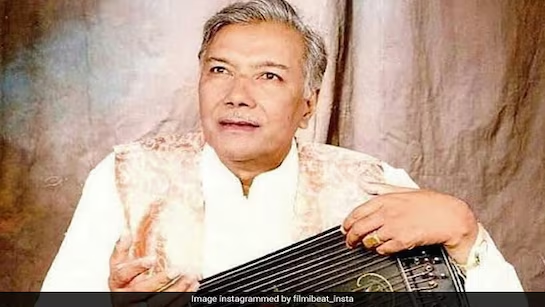
Ustad Ghulam Mustafa Khan occupies a unique and revered place in the history of Indian music. Born on March 3, 1931, in Badaun, Uttar Pradesh, he belonged to the Rampur-Sahaswan gharana, a lineage known for its emphasis on clarity, layakari, and emotional depth. From a young age, his prodigious talent earned him the title of “Junior Tansen,” a reflection of the promise he showed as a classical vocalist.
Over the decades, Ustad Ghulam Mustafa Khan became not only a respected performer but also one of the most influential gurus in Indian music. His approach to teaching went beyond technique, focusing on discipline, humility, and a deep understanding of music as a spiritual practice. He believed that classical training formed the foundation of all musical expression, regardless of genre, a philosophy evident in the diverse success of his students.
His list of disciples reads like a chronicle of Indian music itself. From legendary voices such as Lata Mangeshkar and Asha Bhosle to contemporary icons like A R Rahman, Sonu Nigam, Hariharan, and Shaan, his influence cut across generations and styles. Many of these artists have often spoken about how his guidance shaped their vocal techniques, emotional maturity, and respect for music as a lifelong pursuit.
In recognition of his immense contribution, Ustad Ghulam Mustafa Khan received several of India’s highest honours. He was awarded the Padma Shri in 1991, followed by the Padma Bhushan in 2006, and the Padma Vibhushan in 2018. He also received the Sangeet Natak Akademi Award in 2003, cementing his status as a towering figure in Indian classical music. These accolades reflected not only his personal achievements but also his role in preserving and transmitting musical heritage.
Ustad Ghulam Mustafa Khan passed away on January 17, 2021, in Mumbai, leaving behind a legacy that continues to resonate through his students and their music. The Hazri programme 2026, organised by his son Rabbani Mustafa Khan and daughter-in-law Namrata Gupta Khan through NR Talent and Event Management, served as a reminder that his presence endures through the voices he shaped and the values he imparted.
The concert was more than a remembrance; it was a reaffirmation of the guru-shishya parampara in a modern context. In an era driven by instant fame and rapid consumption, the evening stood as a testament to patience, learning, and reverence. The sight of some of India’s biggest musical names bowing, both literally and figuratively, to their guru reinforced the idea that true artistry begins with humility.
As the final notes faded at Jio World Garden, the audience was left with the sense that Ustad Ghulam Mustafa Khan’s legacy is not confined to history or awards. It lives on in every nuanced alaap, every emotionally charged lyric, and every artist who continues to carry forward his teachings. The tribute in Mumbai thus became not just an event, but a living expression of gratitude, continuity, and the enduring power of a great teacher’s influence.