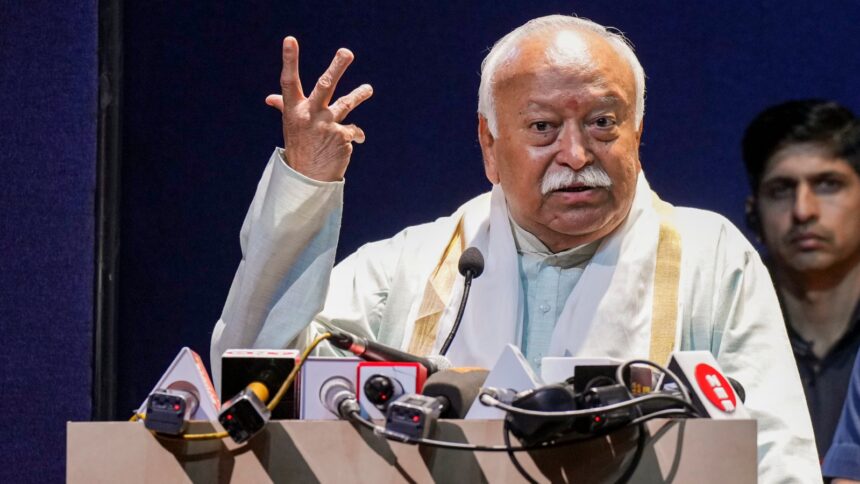
In the wake of the United States imposing a 50 percent tariff on Indian goods, Rashtriya Swayamsevak Sangh (RSS) chief Mohan Bhagwat addressed a gathering at Vigyan Bhawan during the second day of a three-day lecture series titled ‘100 Years of the Sangh’s Journey – New Horizons.’ Speaking before an audience that included diplomats from over 55 countries and representatives from more than 30 international organizations, Bhagwat outlined a comprehensive vision for India’s national policy that emphasizes self-reliance, swadeshi practices, ethical international trade, and the promotion of cultural and constitutional values. His remarks, delivered just hours after the new tariffs were implemented, underscored the need for India to engage in global trade voluntarily and without external pressure, advocating a model of mutual self-reliance that prioritizes domestic production, cultural preservation, and ethical governance.
Promoting Self-Reliance and Swadeshi in the Face of Global Economic Pressures
Mohan Bhagwat’s address centered on the principle that India must strengthen its economic self-sufficiency and reduce dependence on imported goods wherever feasible. He emphasized that national policy should ensure that international trade is undertaken voluntarily, not under compulsion or external pressure, pointing out that India possesses the capacity to manufacture essential goods domestically. Bhagwat stressed that while mutual interdependence is natural in global trade, it is critical for India to cultivate a culture of self-reliance and prioritize local production. He elaborated on practical aspects of swadeshi, urging citizens to favor domestic products, support local economies, and avoid importing items that can be produced within the country. Using relatable examples, he suggested that products like beverages should be made at home rather than imported, illustrating the broader principle of minimizing unnecessary foreign dependence.
Bhagwat also clarified that swadeshi does not equate to isolationism. Rather, it entails a thoughtful prioritization of what India can produce independently while maintaining selective engagement with global markets. He encouraged citizens to embrace locally manufactured goods and strengthen regional economies by purchasing products from their own states and communities. According to him, neglecting local production harms villages and local industries, and cultivating self-reliance is essential not only for economic resilience but also for maintaining social and cultural cohesion. Through his message, Bhagwat linked economic self-reliance with broader national objectives, asserting that fostering indigenous production and consumption is integral to India’s long-term strategic and cultural autonomy.
Bhagwat extended the concept of self-reliance beyond economic dimensions, connecting it with cultural practices and daily life. He advocated that Indians should reconnect with traditional customs, including language, attire, cuisine, and domestic rituals, emphasizing the role of personal and communal dharmic practices in fostering a cohesive society. He underscored the importance of maintaining a prayer room at home and wearing traditional clothing such as dhotis, stressing that these practices are part of cultivating a balanced and dharmic lifestyle. The underlying message was that economic and cultural self-reliance are mutually reinforcing pillars that ensure India’s internal stability and strengthen its position in a rapidly evolving global order.
Dharmic Governance, Constitutional Values, and India’s Global Role
Beyond the focus on economic self-sufficiency, Bhagwat addressed governance and constitutional values as critical elements of national policy. He urged citizens to respect the rule of law in all circumstances, advocating non-violence and lawful responses to provocation or disrespect toward religious beliefs. Bhagwat warned against radicalism, wokeism, and rising social fragmentation worldwide, describing these trends as threats to societal cohesion. He highlighted that unprincipled consumerism and materialism are contributing to the proliferation of what Mahatma Gandhi identified as seven social sins, encompassing commerce without morality, science without humanity, and politics without principle. By invoking Gandhi’s philosophy, Bhagwat linked ethical conduct, self-restraint, and moral responsibility to India’s broader societal and economic goals.
Bhagwat’s lecture also focused on India’s role in fostering regional stability and building diplomatic and economic ties with neighboring countries. He noted that much of South Asia shares historical, cultural, and geographical connections with India, and suggested that reconnecting with these neighbors is both a duty and a strategic necessity. By leveraging shared cultural values and historical ties, India can promote peace, stability, and prosperity across the subcontinent, benefiting not only itself but the entire region. Bhagwat positioned India’s dharmic heritage as a model for international engagement, highlighting how India’s unique cultural ethos can inform global norms and approaches to cooperation and mutual respect.
Central to Bhagwat’s vision is the concept of dharm as distinct from religion. He elaborated that dharm transcends ritualistic practices and dietary norms, embodying a higher principle of moral and ethical conduct that harmonizes individual, societal, and natural interests. He argued that cultivating a dharmic way of life is essential not only for domestic cohesion but also for inspiring global ethical conduct. India, as a dharmic nation, has the potential to contribute to global stability by promoting relational values, cultural understanding, and ethical leadership. Bhagwat invoked Swami Vivekananda’s philosophy to underscore that India must prepare itself to offer dharm to the world, thereby becoming a moral and strategic anchor in global affairs.
Mohan Bhagwat further emphasized that the RSS must evolve into a global model organization, demonstrating ethical governance, community-driven economic practices, and innovative approaches to social development. He highlighted the importance of policies that enable production by the masses rather than mass production alone, advocating inclusive economic growth rooted in local participation and self-reliance. By strengthening domestic capacities and ethical governance frameworks, Bhagwat suggested that India could present a compelling model for other nations seeking to balance economic development with moral and cultural integrity. He argued that such initiatives, starting with India and extending to neighboring countries, would yield benefits not only for India but also for the global community, reinforcing principles of mutual respect, cooperation, and sustainable development.
Mohan Bhagwat’s address at Vigyan Bhawan provided a comprehensive framework linking self-reliance, swadeshi, dharmic values, ethical governance, and India’s strategic engagement with the world. By promoting domestic production, cultural preservation, constitutional adherence, and moral responsibility, Bhagwat articulated a vision where India asserts its economic and ethical sovereignty while contributing constructively to global order. His emphasis on voluntary international trade, combined with the prioritization of local production and ethical conduct, offers a blueprint for navigating contemporary challenges in global commerce, cultural preservation, and geopolitical engagement. The lecture reaffirmed the RSS’s commitment to preparing India for a future where national resilience, dharmic values, and strategic foresight guide policy and societal progress, ensuring that India remains a leading example of ethical self-reliance and responsible global participation.