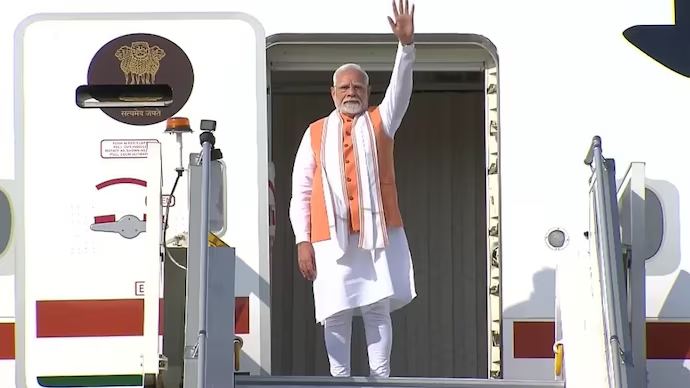
Prime Minister Narendra Modi arrived in the Netherlands on Friday during the second leg of his ambitious five-nation diplomatic tour, setting the stage for a fresh round of strategic discussions focused on trade, technology, defence cooperation, and renewable energy partnerships. The visit has drawn significant international attention as India continues to strengthen its engagement with key European nations amid shifting global economic and geopolitical dynamics.
Mr. Modi landed in Amsterdam to a formal welcome by senior Dutch officials, highlighting the importance the Netherlands has attached to the Indian leader’s visit. He was received at the airport by Rear Admiral Ludger Brummelaar, Adjutant-General and Chief of the Military Household of His Majesty the King, Dutch Foreign Minister Tom Berendsen, and India’s Ambassador to the Netherlands Kumar Tuhin, along with several senior government representatives.
The prime minister’s visit is expected to deepen the India-Netherlands partnership at a time when both nations are seeking stronger cooperation in sectors critical to future global growth. From renewable energy and semiconductor technology to maritime security and investment partnerships, the agenda reflects how diplomatic relations are increasingly being shaped by economic and technological priorities.
The Netherlands stop comes after the first phase of Mr. Modi’s wider international outreach programme and is being closely watched by global observers who see the tour as part of India’s larger strategy to expand its influence across Europe and beyond.
India and Netherlands Push for Stronger Strategic Partnership
The meeting between Prime Minister Modi and Dutch Prime Minister Rob Jetten is expected to focus heavily on strengthening bilateral cooperation across multiple sectors. Officials familiar with the discussions indicate that both sides are keen to move beyond traditional diplomacy and build a more future-oriented strategic partnership.
Trade remains one of the strongest pillars of India-Netherlands relations. The Netherlands has emerged as one of India’s key economic partners in Europe, with strong commercial links in agriculture, logistics, chemicals, technology, and clean energy. Indian policymakers view the Netherlands as an important gateway to Europe because of its advanced infrastructure, global connectivity, and business-friendly ecosystem.
The discussions are expected to include measures aimed at improving investment flows, enhancing supply chain cooperation, and creating opportunities for Indian and Dutch companies to collaborate more closely in high-growth sectors.
Technology cooperation is likely to dominate a major portion of the talks. India’s rapid digital transformation and expanding innovation ecosystem have made it an attractive partner for countries looking to diversify technology partnerships. The Netherlands, known globally for its expertise in semiconductor research, advanced engineering, water technology, and sustainable innovation, is seen as a natural collaborator for India’s long-term development ambitions.
Officials are also expected to discuss collaboration in artificial intelligence, cybersecurity, smart mobility, and digital infrastructure. India’s push to become a global manufacturing and innovation hub aligns closely with Dutch expertise in high-tech industrial systems.
Renewable energy will remain another major focus area during the visit. India has significantly accelerated its clean energy transition over the last few years, investing heavily in solar power, green hydrogen, and sustainable industrial projects. The Netherlands, which has emerged as a leading European player in climate-focused innovation, could become an important partner in supporting India’s energy transition goals.
Both countries are expected to explore possibilities for cooperation in offshore wind energy, hydrogen infrastructure, sustainable urban planning, and carbon reduction technologies. Analysts believe these discussions could lead to long-term partnerships between businesses, research institutions, and government agencies.
Royal Meeting Adds Diplomatic Significance
Apart from bilateral talks with Prime Minister Rob Jetten, Mr. Modi is also scheduled to call on King Willem-Alexander and Queen Máxima during his stay in the Netherlands. Such meetings carry symbolic as well as diplomatic importance, reflecting the warmth and maturity of bilateral relations.
The royal engagement is expected to reinforce cultural and political ties between the two nations while also highlighting the growing importance of India in European diplomatic calculations.
India’s expanding economic footprint and rising geopolitical influence have made it a priority partner for many European countries seeking stable and diversified global relationships. The Netherlands, with its strong global trade networks and strategic position within Europe, sees India as a major long-term economic and political partner.
Diplomatic experts note that visits involving both government leadership and royal interaction often help create a stronger atmosphere for future cooperation. Beyond the ceremonial aspects, such engagements signal mutual respect and long-term commitment at the highest levels.
The Indian diaspora in the Netherlands has also welcomed the visit enthusiastically. Community members gathered in parts of Amsterdam to greet the prime minister, reflecting the emotional and cultural connection many overseas Indians continue to maintain with developments back home.
Defence and Maritime Cooperation Expected to Expand
Another key aspect of the visit is expected to be defence and maritime cooperation. While India and the Netherlands are not traditional military allies, both nations share important interests in maritime stability, secure trade routes, and regional security cooperation.
India’s strategic importance in the Indo-Pacific region has grown rapidly over the past decade, and European countries are increasingly seeking stronger engagement with New Delhi in matters related to maritime security and global trade protection.
The Netherlands, known for its maritime expertise and naval capabilities, could become an important partner for India in areas such as port logistics, naval technology, and maritime awareness systems.
Officials are likely to discuss defence technology cooperation, cybersecurity frameworks, and broader security coordination mechanisms during the high-level meetings. Analysts believe that such partnerships are becoming increasingly important as global geopolitical uncertainties continue to reshape international alliances and economic strategies.
India has also been working aggressively to modernise its defence manufacturing capabilities through international partnerships and technology-sharing agreements. Dutch innovation in specialised engineering and logistics could support some of these efforts in the years ahead.
Economic Diplomacy at the Heart of Modi’s Global Outreach
Prime Minister Modi’s current international tour reflects India’s evolving diplomatic strategy, where economic partnerships are being prioritised alongside traditional political relations. Unlike earlier eras of diplomacy focused mainly on political alignment, modern international engagement increasingly revolves around trade, investment, technology, energy security, and industrial cooperation.
The Netherlands visit fits directly into this broader approach.
India is currently positioning itself as one of the world’s fastest-growing major economies, while simultaneously attempting to reduce strategic dependencies and strengthen domestic manufacturing. Building deeper partnerships with technologically advanced economies like the Netherlands helps support those objectives.
European nations are also recalibrating their global partnerships amid changing geopolitical realities, supply chain disruptions, and growing concerns around economic resilience. India’s large market, skilled workforce, and expanding technological capabilities make it an attractive partner in this environment.
Experts believe the discussions in Amsterdam could lead to stronger institutional cooperation in research, startup ecosystems, higher education, clean technology, and industrial innovation. Such collaborations may not always produce immediate headlines, but they often shape long-term economic and strategic relationships.
The timing of the visit is also important because global competition around critical technologies, energy systems, and supply chains has intensified dramatically in recent years. Countries are increasingly seeking trusted partners capable of supporting sustainable and secure economic growth.
For India, strengthening relations with the Netherlands provides access not only to European markets but also to advanced innovation ecosystems and global logistics networks.
Global Attention on India’s Expanding Diplomatic Reach
Mr. Modi’s five-nation tour has generated considerable international attention because it highlights India’s increasingly active role in global diplomacy. As geopolitical tensions and economic uncertainty continue to affect multiple regions, India has attempted to position itself as a stable and influential global player capable of maintaining relationships across different power centres.
The Netherlands leg of the tour reflects that balancing strategy.
India’s diplomatic engagement today extends far beyond conventional political ties. The country is now actively involved in conversations surrounding energy transition, digital governance, trade diversification, manufacturing partnerships, and global supply chain resilience.
The meetings in Amsterdam are therefore expected to carry significance beyond bilateral relations alone. Observers believe they also represent a broader signal about India’s growing relevance within European strategic planning.
The Dutch government’s warm reception for the Indian prime minister demonstrates the value European nations increasingly place on stronger engagement with New Delhi. For India, such visits help reinforce its image as an emerging global power capable of shaping international conversations on technology, economy, sustainability, and security.
As Prime Minister Modi continues the remaining legs of his international tour, the Netherlands visit is likely to be remembered as a key diplomatic stop focused on practical cooperation and long-term strategic alignment.
The outcomes of the meetings may unfold gradually over time, but the direction is already becoming clear: India and the Netherlands are preparing to deepen a partnership that increasingly reflects the priorities of a rapidly changing world.