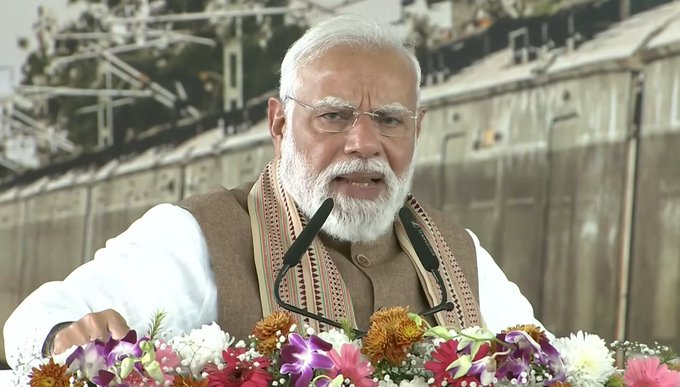
Prime Minister Narendra Modi launched a sharp attack on the Indian National Congress during a massive public gathering in Meerut, accusing the party of disrupting Parliament and engaging in what he described as political theatrics instead of constructive debate. Referring to a recent uproar in the Lok Sabha during the Budget Session, he stated that leadership cannot be achieved by symbolic gestures or attempts to occupy the Prime Minister’s seat, but only by winning the trust and hearts of the people.
Recalling the February 4 incident, the Prime Minister said that just as he was about to deliver his Motion of Thanks on the President’s Address, women MPs from the Congress surrounded his designated seat in the House. According to him, such actions reflect desperation and weaken parliamentary decorum. He emphasized that Parliament is a sacred space for debate and national decision-making, and disruptions diminish the dignity of democratic institutions.
Addressing the crowd, Modi asserted that political ambition must be rooted in public service rather than spectacle. He remarked that occupying a chair in the House does not equate to earning the mandate of citizens. The only legitimate path to the Prime Minister’s office, he argued, is through democratic support expressed in elections.
The Prime Minister further accused Congress of repeatedly obstructing parliamentary proceedings. He claimed that the party not only fails to participate constructively but also prevents its allies from raising issues. According to him, such behavior ultimately harms the broader Opposition, as allied parties suffer reputational damage due to Congress’s actions.
Modi extended his criticism beyond Parliament to a recent protest by the party’s youth wing during the India-AI Impact Summit 2026 held at Bharat Mandapam in New Delhi. He described the demonstration as an attempt to turn an international event into a political battleground. The summit, which focused on artificial intelligence and technological advancement, was attended by global representatives and industry leaders.
The Prime Minister said the protest projected a negative image of the nation at a time when India was hosting one of the largest AI gatherings in the developing world. He questioned whether such actions aligned with national interest, arguing that domestic political differences should not overshadow international engagements that showcase India’s technological progress.
According to Modi, India is striving toward the vision of a developed nation, often referred to as Viksit Bharat. He maintained that progress in sectors such as digital infrastructure, innovation, and artificial intelligence reflects years of policy continuity and reform. He expressed disappointment that instead of celebrating these achievements, some political forces choose confrontation and disruption.
He accused Congress of being ideologically adrift and unable to adapt to changing aspirations among young Indians. By criticizing the youth wing’s demonstration style, he suggested that such protests indicate a lack of substantive policy alternatives. Modi argued that modern politics demands clarity of vision and constructive solutions rather than symbolic acts.
The Prime Minister also took a broader swipe at what he described as attempts to defame the country on global platforms. Drawing a cultural analogy, he said that when a village hosts a wedding, the community works collectively to ensure guests carry a positive impression. In contrast, he claimed, certain leaders undermine national pride during major international events.
While criticizing Congress, Modi acknowledged that some allies within the Opposition bloc had distanced themselves from the controversial protest. He expressed satisfaction that regional parties had voiced concern over the incident, suggesting that not all Opposition forces endorse disruptive tactics.
In his remarks directed at the media, Modi urged journalists to avoid generalizing Congress’s actions as representative of the entire Opposition. He argued that repeatedly labeling incidents as “Opposition protests” shields the Congress from accountability and unfairly implicates other parties.
The Prime Minister’s speech in Meerut came at a politically sensitive moment, as national discourse intensifies ahead of key electoral cycles. By highlighting parliamentary disruptions and protests at international forums, Modi positioned his party as focused on governance and development, while portraying Congress as reliant on agitation.
Political analysts observe that such rhetoric reflects a broader strategy of contrasting stability with chaos. The ruling party emphasizes economic reforms, digital initiatives, infrastructure expansion, and global diplomacy, while accusing its rivals of negativity. Congress, on the other hand, argues that protests are necessary to highlight concerns such as unemployment, inflation, and trade policies.
The February 4 Lok Sabha episode became a flashpoint in this narrative battle. Supporters of the government viewed the surrounding of the Prime Minister’s seat as a breach of decorum. Opposition voices defended the move as a symbolic protest aimed at drawing attention to unresolved issues. The contrasting interpretations underscore the polarized political environment.
Similarly, the India-AI Impact Summit protest sparked debate over the boundaries between domestic dissent and international representation. Critics of the demonstration argued that global events should remain insulated from partisan politics. Supporters countered that democracy allows expression of grievances in all forums.
Modi’s speech attempted to frame both incidents within a larger argument about responsibility in public life. He repeatedly stressed that power flows from citizens, not from momentary disruptions. Leadership, he maintained, requires sustained engagement with people’s aspirations.
The Prime Minister concluded by reiterating that democratic institutions must be respected. While disagreement is integral to democracy, he argued that it should be expressed through debate, policy proposals, and electoral competition rather than obstruction. By invoking themes of national pride, development, and public trust, Modi sought to consolidate his support base while challenging the credibility of Congress.
As political discourse evolves, episodes like the Lok Sabha disruption and the AI Summit protest are likely to remain points of contention. They reflect deeper questions about how opposition politics should function in a rapidly changing India. For now, the Prime Minister’s remarks have intensified the war of words, setting the stage for further debates inside and outside Parliament.