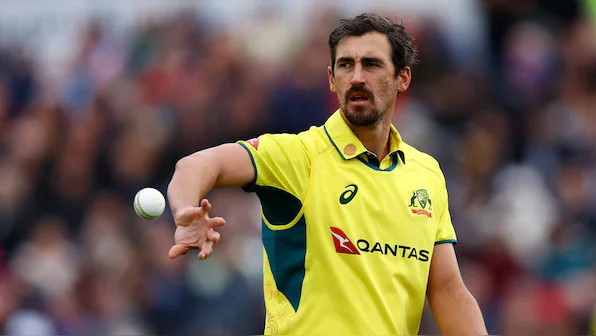
Australian fast bowler Mitchell Starc has finally opened up about his withdrawal from the ongoing ICC Champions Trophy in Pakistan and the UAE, citing fitness concerns and undisclosed “personal views” as key reasons behind his decision. Mitchell Starc, a crucial component of Australia’s pace attack, was a surprising omission from the squad, especially with the absence of his regular strike partners, Pat Cummins and Josh Hazlewood, due to injuries. Cricket Australia had initially stated that Mitchell Starc had pulled out due to “personal reasons,” without providing further details, fueling speculation over his absence.
Now, speaking publicly for the first time since his withdrawal, Mitchell Starc clarified that his primary reason was lingering ankle pain, which troubled him during Australia’s recent Test series in Sri Lanka. However, he admitted that fitness was not the only factor, subtly alluding to additional considerations that influenced his decision. While appearing on the Willow Talk podcast, which is co-hosted by his wife and Australia’s women’s team captain Alyssa Healy, Mitchell Starc stated that multiple factors played a role in his opting out of the marquee tournament, including his own personal stance on certain matters. Without delving into specifics, he acknowledged that his decision was driven by “some personal views” alongside his fitness struggles.
The revelation has sparked curiosity among cricket fans and analysts, as the Champions Trophy is being hosted under stringent security measures in Pakistan, a country where Australia has historically been cautious about touring due to security concerns. Although Mitchell Starc refrained from explicitly linking his withdrawal to any geopolitical or security issues, his remarks have led to further speculation over whether non-cricketing factors played a role. The timing of his decision has raised eyebrows, considering the depleted nature of Australia’s squad, which is already missing several key players due to injuries and workload management.
The left-arm pacer, who has been an integral part of Australia’s Test and ODI setup for years, also stressed that managing his workload was a key priority, given the packed cricketing calendar ahead. Mitchell Starc has been the only member of Australia’s renowned “Big Three” fast bowling unit—alongside Cummins and Hazlewood—to feature in all of Australia’s last seven Test matches, a run that included high-pressure series against India and Sri Lanka. The 35-year-old emphasized that his current focus is to fully recover ahead of a crucial period in international cricket, which includes the ICC World Test Championship (WTC) final and a Test tour of the West Indies.
Mitchell Starc’s absence from the Champions Trophy also comes at a time when he is gearing up for a significant stint in franchise cricket. He is set to play for Delhi Capitals in the upcoming edition of the Indian Premier League, marking his highly anticipated return to the T20 league after a prolonged absence. His participation in the IPL will serve as a crucial lead-up to Australia’s WTC final against South Africa at Lord’s in June, followed by a three-match Test series against the West Indies. Despite pulling out of the Champions Trophy, Mitchell Starc remains a key figure in Australia’s long-term plans, particularly in the red-ball format, where his experience and wicket-taking ability continue to be invaluable.
While Mitchell Starc’s decision has left a significant gap in Australia’s bowling attack for the Champions Trophy, team management has opted for a younger, relatively inexperienced pace unit to navigate the tournament. His absence, combined with those of Cummins and Hazlewood, has put added pressure on Australia’s bowling reserves, forcing the selectors to rely on emerging fast bowlers who now have an opportunity to prove their mettle on the international stage. The Australian team has had to make tactical adjustments, especially considering the challenging conditions in Pakistan and the UAE, where experienced fast bowlers have historically played a crucial role in achieving success.
As Australia navigates the tournament without three of its premier fast bowlers, the focus remains on how the team adapts and performs in the absence of its senior pacers. Meanwhile, Mitchell Starc’s decision to prioritize fitness and personal considerations over an ICC event will continue to be a topic of discussion, particularly as he prepares for a demanding schedule in the months ahead. With the Champions Trophy underway and Australia looking to make an impact despite the setbacks, the team will be hoping that its next generation of pacers can rise to the occasion and deliver in high-pressure situations.