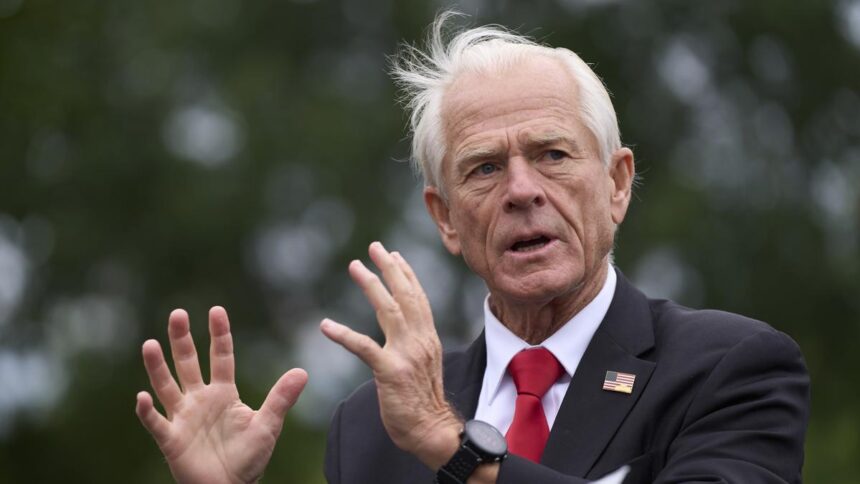
White House trade adviser Peter Navarro has triggered fresh controversy by accusing India and Prime Minister Narendra Modi of indirectly fueling the Russia-Ukraine war through New Delhi’s continued purchase of Russian oil. In an explosive interview, Peter Navarro described the conflict not as “Putin’s war” but as “PM Modi’s war”, arguing that Moscow’s ability to fund its military machine stems from the energy revenues it receives from India’s oil imports. His remarks have sparked diplomatic ripples, drawing attention to the broader tensions between Washington and New Delhi over trade, tariffs, and geopolitical alignments since the start of the Ukraine war.
Peter Navarro’s charge: ‘PM Modi’s war’ and the Russia-Ukraine conflict
Peter Navarro, who has been one of the most outspoken voices in Donald Trump’s circle on trade and foreign policy, chose Bloomberg TV’s program Balance of Power to level his accusations. When asked about India’s role in the Ukraine conflict, Peter Navarro said that American businesses, workers, and taxpayers were all paying the price for what he described as India’s reckless trade choices. According to him, Russia’s war machine is not just funded by oil sales to China but also by growing volumes of crude purchased by India at discounted rates, which in his view undermines global efforts to choke off Moscow’s financial lifeline.
Peter Navarro went a step further by labeling the conflict “Modi’s war”. The anchor, sensing the strong wording, asked whether he had intended to say “Putin’s war” but had misspoken. Peter Navarro’s reply was emphatic: “I mean Modi’s war, because the road to peace runs, in part, through New Delhi.” By choosing to single out India rather than Moscow directly, Peter Navarro sought to amplify the argument that Washington’s sanctions and restrictions on Russia will never be effective if major economies such as India continue to maintain deep energy ties with the Kremlin.
His reasoning was that every barrel of oil purchased by India translates into additional funds for Moscow’s treasury, which in turn sustains its capacity to prolong the war. This chain of funding, he claimed, ultimately forces Ukraine to seek more aid, weapons, and military support from the United States, thereby burdening American taxpayers. “Everybody in America loses because of what India is doing,” he said, adding that U.S. consumers, businesses, and workers all face indirect costs through disrupted markets, job losses, and higher wages driven by India’s trade practices.
Peter Navarro further framed India’s tariff policies as part of the same problem. He argued that American factories and jobs were being undercut by India’s high tariffs, which he described as exploitative. To this he added that the oil trade had created a “double hit” on the United States: trade barriers that harmed America’s competitiveness on one hand, and energy purchases that emboldened Russia on the other. According to Peter Navarro, this was why the Donald Trump administration had no choice but to impose sweeping new tariffs against Indian imports.
The White House adviser’s rhetoric underscored an emerging theme in Washington politics: India, once seen as a key strategic partner in countering China, is increasingly facing criticism from sections of the U.S. establishment who view its neutral stance on the Ukraine war as unacceptable. While Peter Navarro’s words may appear unusually harsh, they reflect a sentiment that is gaining traction in certain policy circles — namely, that New Delhi cannot expect favorable economic ties with Washington while continuing energy trade with Moscow.
Tariffs, arrogance, and the diplomatic fallout
Peter Navarro’s interview did not stop with the accusation of “Modi’s war”. He went on to attack what he saw as India’s “arrogant” defense of its policies. “What’s troubling to me,” he remarked, “is that the Indians are so arrogant about this. They say, ‘Oh, we don’t have higher tariffs. Oh, it’s our sovereignty. We can buy oil from anyone we want.’” His tone suggested frustration with India’s insistence that its energy sourcing decisions are based solely on national interest and market availability.
By invoking democracy, Peter Navarro attempted to pressure India on moral grounds as well. “India, you’re the biggest democracy in the world, OK, act like one,” he said, implying that India’s continued engagement with Russia contradicted the values of a democratic partner that Washington expected it to uphold. The juxtaposition of democracy with oil trade was meant to highlight what Navarro viewed as hypocrisy: that a nation claiming to stand for democratic values was simultaneously sustaining an authoritarian regime engaged in war.
This was not Peter Navarro’s first sharp criticism of India. In earlier statements, he had coined the phrase “Maharaja of tariffs” to describe what he perceived as India’s exploitative trade practices. According to Peter Navarro, India’s tariffs on American goods were set deliberately high, leading to unfair trade balances that disadvantaged the U.S. He has claimed that before Russia’s 2022 invasion of Ukraine, India’s oil trade with Moscow was negligible, but since then it has sharply increased, making India a vital customer for Russian crude. For Peter Navarro, this development is not just an economic issue but a geopolitical one — because it strengthens Russia at a time when Washington is trying to isolate it.
President Donald Trump himself acted on these grievances earlier this month by announcing a 50 percent tariff on Indian imports, one of the most sweeping tariff actions against New Delhi in recent years. Half of these duties had already been implemented earlier, and the remaining 25 percent came into effect on Wednesday. According to the White House, the rationale for the additional tariffs was that India was “directly or indirectly importing Russian Federation oil.”
What made this move even more controversial was the lack of similar penalties on China, which is actually the largest buyer of Russian oil. Critics argue that by sparing Beijing, Washington is sending a contradictory message, punishing India more harshly despite China’s far larger role in sustaining Moscow’s energy revenues. Peter Navarro, however, insisted that both India and China need to stop buying oil from Russia if the Ukraine conflict is to end, even if his administration’s actions appear uneven.
India’s reaction to these tariffs was swift and firm. The government in New Delhi called the decision “unfair, unjustified and unreasonable,” framing it as an attack not just on Indian trade but also on the principle of sovereign decision-making in energy sourcing. Indian officials pointed out that Washington was targeting New Delhi for actions that were being carried out by several other countries as well, all of whom were making decisions based on their own national interest.
Prime Minister Modi, while not directly addressing the tariff escalation, appeared to send a broader message during a domestic speech. He asserted that India was prepared to pay any price to protect its farmers and agricultural sector, which together account for almost one-fifth of the nation’s GDP. The remark was interpreted as a signal that India would not buckle under U.S. trade pressure, particularly when it came to sectors central to the livelihoods of millions of Indian citizens.
Meanwhile, the Ministry of External Affairs reiterated its longstanding position that India’s energy sourcing is guided by market conditions and global circumstances rather than political pressures. This position aligns with India’s broader diplomatic stance since the Ukraine war began in 2022: maintaining a careful balance between longstanding ties with Russia, strategic engagement with the West, and its own domestic energy security needs.
The confrontation between Peter Navarro and New Delhi represents more than just a trade quarrel. It highlights the deeper tensions in the U.S.-India relationship as both countries navigate a world reshaped by war, sanctions, and realignment of global power structures. Washington sees India as a pivotal partner in the Indo-Pacific, particularly in countering China’s rise, but New Delhi insists on preserving its strategic autonomy. Peter Navarro’s labeling of the Ukraine conflict as “Modi’s war” reflects the growing impatience among certain U.S. voices with India’s refusal to align fully with the Western position on Moscow.
For New Delhi, the issue is one of sovereignty and national interest. Officials argue that energy security cannot be sacrificed at a time of global volatility, and that India’s engagement with Russia is not fundamentally different from that of many European states which, until recently, remained dependent on Russian gas. By highlighting these contradictions, India has sought to defend its choices while also cautioning Washington against the dangers of punitive measures that may damage long-term relations.
The clash of perspectives, amplified by Peter Navarro’s inflammatory rhetoric, underscores the delicate balancing act in U.S.-India ties. While the two nations share common interests in technology, defense, and regional stability, disagreements over trade and foreign policy are threatening to complicate the partnership. With tariffs escalating and accusations mounting, the trajectory of this relationship will remain under intense scrutiny in the months ahead.