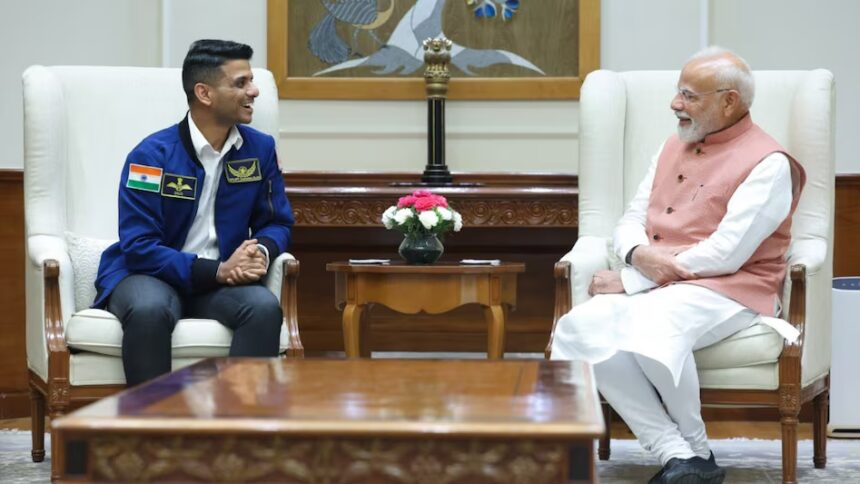
Prime Minister Narendra Modi recently hosted Group Captain Shubhanshu Shukla, the first Indian astronaut to travel to the International Space Station (ISS), at his Lok Kalyan Marg residence. The meeting highlighted the remarkable journey of India’s young space explorer, who participated in the Axiom-4 commercial mission from June 25 to July 15. Shubhanshu Shukla shared insights about living in zero gravity, the challenges of space nutrition, rigorous training, and the importance of inspiring the next generation of Indian astronauts. The interaction, captured in a widely shared video, underscored the human side of space exploration and how experiences in orbit can impact both science and society. PM Modi welcomed Shubhanshu Shukla warmly, walking alongside him with an arm around his shoulder, reflecting both pride and personal connection to India’s growing space ambitions. This meeting marks not only a recognition of Shubhanshu Shukla’s accomplishments but also an opportunity to discuss the future trajectory of India’s space missions, particularly with Gaganyaan and broader astronaut training programs.
Experiencing Space: The Physical, Mental, and Nutritional Challenges
Shubhanshu Shukla elaborated on his unique experiences aboard the ISS, emphasizing how profoundly space affects the human body. “Your body undergoes a lot of changes as soon as you enter space,” Shubhanshu Shukla told PM Modi, describing the immediate adaptation required in zero gravity. Initially, even simple actions like walking or maintaining balance proved challenging. “I couldn’t walk straight at first, but then my colleagues supported me,” he recalled, highlighting the collaborative nature of space missions where teamwork is essential for adapting to extreme environments. The body slowly acclimatizes, but astronauts must allow both their brain and physiology time to adjust to the unfamiliar surroundings. This process of adaptation reflects the resilience required of those venturing beyond Earth, illustrating how space exploration challenges not only physical capabilities but also mental fortitude.
Food in space presents another significant challenge, Shubhanshu Shukla explained. Maintaining proper nutrition while coping with microgravity is critical to sustaining health during long missions. Interestingly, Shubhanshu Shukla highlighted that growing sprouts onboard the ISS requires minimal resources, demonstrating that simple innovations can address complex problems. “Food is a big challenge on the International Space Station,” he noted, adding, “you do not need many resources to grow sprouts; they can be cultivated in a dish filled with water within eight days.” This simple but practical solution hints at the potential for resolving long-term food security concerns for extended missions or future space habitats. The ability to produce fresh food in orbit is more than a convenience; it represents a step toward sustainable living in space, a crucial consideration for India’s future ambitions in human spaceflight.
Shubhanshu Shukla’s reflections also highlighted the interconnectedness of the mind and body during space missions. Zero gravity not only affects movement but also cognitive functioning and sensory perception. The astronaut emphasized the importance of mental preparation and maintaining focus amidst the unusual conditions of space. Such experiences underline the rigorous demands placed on astronauts, requiring a balance of physical endurance, mental acuity, and adaptability. His narration offered PM Modi, and through media coverage, the public, a glimpse into the often unseen complexities of life aboard the ISS. These insights help demystify the human aspect of space travel and inspire aspiring scientists and explorers in India.
Training, ‘Homework,’ and Inspiring the Next Generation
Shubhanshu Shukla also shared his extensive preparation for the mission, which involved intense study and training. Contrary to initial expectations, he found that the mission demanded not just physical readiness but also mastery of engineering disciplines and technical procedures. “It becomes a kind of engineering discipline once you are the test pilot,” he remarked, describing the depth of knowledge required to operate in space safely and effectively. This rigorous training ensures that astronauts can respond to emergencies, perform scientific tasks, and document critical observations during the mission. In addition to personal preparation, Shubhanshu Shukla fulfilled a unique task assigned by Prime Minister Modi—to meticulously document every aspect of the Axiom-4 mission for the benefit of India’s upcoming Gaganyaan program. Shubhanshu Shukla described his colleagues’ lighthearted teasing about the “homework” assigned by the Prime Minister, but he emphasized its importance in supporting India’s broader ambitions in space exploration.
The Prime Minister, recognizing the significance of Shubhanshu Shukla’s achievements, spoke about the need to create a substantial astronaut pool of nearly 50 people. Such an initiative reflects India’s commitment to cultivating a new generation of space explorers who can carry forward the country’s human spaceflight endeavors. Shubhanshu Shukla’s story serves as an inspiration for young students, demonstrating that dreams of space travel are attainable with preparation, perseverance, and dedication. During his time on the ISS, he engaged with children, explaining how his journey evolved and showing them that aspiring to become an astronaut is not only a dream but a reachable goal. This interaction reinforced the broader message of educational inspiration, aligning with India’s emphasis on STEM education and the development of skills for future space missions.
Shubhanshu Shukla’s conversation with PM Modi also highlighted the personal side of his mission. He gifted the Prime Minister the Axiom-4 mission patch and the Indian tricolour that had flown aboard the ISS, symbolizing national pride and achievement. Additionally, he shared photographs captured from orbit, showcasing Earth’s beauty and the perspective gained from space. These moments humanize the astronaut’s journey and underscore the importance of documenting and sharing experiences to inspire others. By combining technical achievements with public engagement, Shubhanshu Shukla bridges the gap between advanced space science and societal inspiration, emphasizing the role of astronauts as both explorers and educators.
Through his narrative, Shubhanshu Shukla conveyed that space missions extend beyond the technical or scientific; they carry the potential to inspire cultural and intellectual growth. The challenges of zero gravity, the discipline required for rigorous study, the intricacies of nutrition, and the emotional impact of observing Earth from space all contribute to a holistic understanding of what it means to be an astronaut. These insights are crucial for preparing the next cohort of Indian space explorers, as the lessons learned can guide training programs, mission planning, and broader national strategies for human spaceflight.
The Prime Minister’s interaction with Shubhanshu Shukla reflects India’s strategic vision for space exploration, emphasizing both achievement and inspiration. Modi’s comments that this mission represents “just the first step” underscore the long-term perspective, highlighting that individual accomplishments are stepping stones toward building robust infrastructure, training, and culture around human spaceflight. By acknowledging Shubhanshu Shukla’s contributions and encouraging the cultivation of a larger astronaut pool, the government signals its intent to sustain India’s growth in space science and exploration.
Shubhanshu Shukla’s reflections on the International Space Station also touched upon the profound impact on one’s perspective of life, Earth, and society. Observing the planet from orbit instills a sense of responsibility toward environmental stewardship and global cooperation. This expanded worldview complements technical training, reinforcing the notion that astronauts serve as ambassadors of humanity, bridging science, policy, and social awareness. By sharing these experiences with PM Modi and the public, Shubhanshu Shukla illustrates the multifaceted value of space exploration, encompassing technological innovation, national pride, education, and inspiration.
Finally, the interaction between PM Modi and Shubhanshu Shukla emphasizes the potential of space exploration to inspire a new generation of Indian scientists, engineers, and astronauts. By sharing detailed accounts of his experiences, Shubhanshu Shukla demonstrates how human spaceflight can cultivate resilience, ingenuity, and global awareness. The mission highlights the importance of nurturing curiosity and providing opportunities for young talent to engage with advanced scientific endeavors. Through this dialogue, India positions itself as a country that values exploration, innovation, and education, ensuring that future space missions are not only technologically successful but also socially impactful.
The meeting concludes with Shubhanshu Shukla’s emphasis on continued learning, preparation, and the ambitious path ahead. As India prepares for its next human spaceflight missions, the experiences shared by Shubhanshu Shukla provide critical insights into life in orbit, training requirements, and the broader societal impact of space programs. The discussion also underscores the role of leadership in inspiring, guiding, and supporting explorers, demonstrating that achievements in space are intertwined with national ambition, education, and the cultivation of future talent.