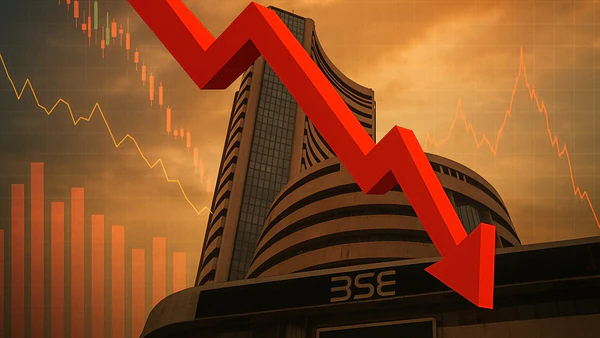
Indian equity markets ended sharply lower on December 16 as persistent selling pressure, weak global cues, and continued foreign fund outflows dragged benchmark indices down in the final hours of trade. The Sensex declined more than 500 points while the Nifty slipped below the psychologically important 25,900 mark, reflecting cautious investor sentiment amid currency weakness and uncertainty in global markets.
Benchmarks slide on weak global cues and sustained foreign outflows
The domestic market opened on a weak note and remained under pressure throughout the session, with only brief and limited recovery attempts toward the close. At the end of trade, the Sensex settled 533.50 points lower, down 0.63 percent, at 84,679.86, while the Nifty declined 167.20 points, or 0.64 percent, to close at 25,860.10. The decline erased gains from the previous session and reinforced the choppy, risk-averse tone that has characterised recent market action.
Selling pressure was visible across most sectors, with metal, information technology, realty, oil and gas, and banking stocks emerging as the biggest drags. Axis Bank, HCL Technologies, Tata Steel, JSW Steel and Eternal were among the top losers on the Nifty, weighing heavily on the index. Financial stocks underperformed as both private and public sector banks saw profit booking, reflecting concerns over tightening liquidity conditions and rising volatility.
The broader markets mirrored the weakness in the benchmarks. The BSE Midcap and Smallcap indices both declined by nearly 1 percent, indicating widespread selling beyond frontline stocks. Market breadth remained decisively negative, with a large majority of stocks closing in the red, underscoring the lack of risk appetite among investors.
Weak global cues added to domestic concerns. Major Asian markets such as Japan and South Korea ended sharply lower, tracking overnight losses in global equities and persistent uncertainty around global growth prospects. Investors also remained cautious ahead of key economic data from the United States, which further dampened sentiment in emerging markets, including India.
Adding to the pressure was the continued weakness in the rupee, which slipped to record lows against the US dollar during the session. The currency crossed the 91 mark, intensifying concerns over imported inflation and capital outflows. Analysts noted that sustained foreign institutional investor selling has been a key factor behind both equity market weakness and currency depreciation. In December alone, foreign investors have sold more than ₹21,000 crore worth of Indian equities, making it the highest monthly outflow so far this year.
Technical outlook cautious as key support levels come into focus
From a technical perspective, market participants highlighted growing signs of weakness in the near term. The Nifty opened with a gap-down and formed a bearish candle on the daily chart, reflecting sustained selling pressure. The index slipped below key short-term moving averages, signalling a deterioration in momentum and a shift toward a more defensive market structure.
Analysts indicated that the immediate support for the Nifty lies in the 25,750–25,700 zone, coinciding with the 50-day exponential moving average. A decisive break below this region could open the door for a deeper correction toward the 25,550–25,500 levels in the short term. On the upside, the 26,000–26,100 range is expected to act as a strong resistance, with any recovery likely to face selling pressure near these levels.
The Bank Nifty also ended lower, closing below its 20-day moving average and forming a bearish pattern on the daily chart. Technical indicators suggest weakening momentum, with immediate support seen around the 58,700–58,600 zone. A sustained move below this level could lead to further downside toward 58,000. On the upside, resistance is expected near 59,300–59,400, followed by the psychologically important 60,000 mark.
Sectorally, only a few pockets showed resilience. Consumer durables, fast-moving consumer goods, and telecom stocks managed to close relatively better, supported by selective buying in names such as Bharti Airtel, Titan Company, Tata Consumer Products, Mahindra and Mahindra, and Bajaj Auto. These stocks provided limited support to the benchmarks but were insufficient to offset the broader market weakness.
On the stock-specific front, Vedanta stood out as a notable gainer after the approval of its demerger plan, which lifted investor sentiment around the stock. In contrast, banking stocks remained under scrutiny after regulatory developments and corporate updates, including management changes at select lenders, though the immediate impact was contained.
Market experts advised investors to remain cautious in the near term, given the combination of weak global cues, sustained foreign selling, and currency volatility. Many recommended a stock-specific approach, focusing on fundamentally strong names while avoiding aggressive directional bets until clarity emerges on global macro trends and currency stability. With volatility expected to remain elevated, traders were advised to book profits on rallies and maintain hedged positions.
Overall, Tuesday’s session reinforced the view that the market is entering a consolidation phase with a negative bias. Unless key resistance levels are decisively reclaimed, sentiment is likely to remain fragile, with downside risks dominating the near-term outlook.