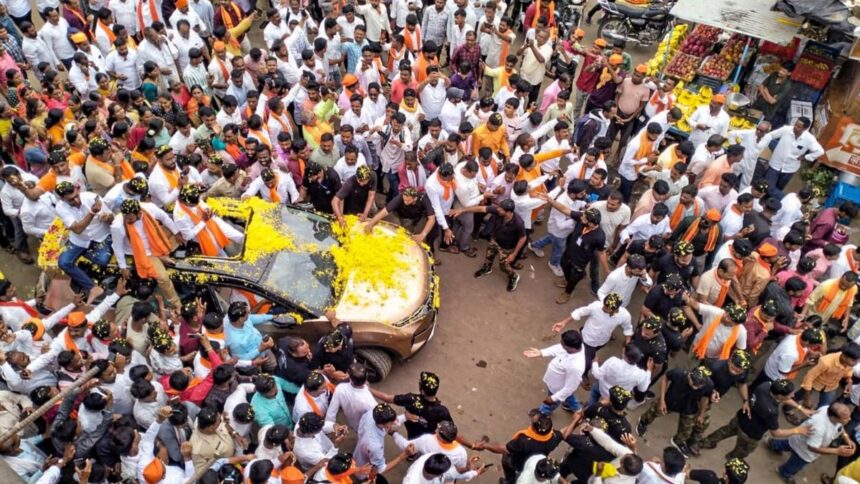
The Maratha quota agitation spearheaded by rights activist Manoj Jarange-Patil at Mumbai’s Azad Maidan has now entered its second consecutive day, marking a significant escalation in a protest that has already brought large sections of the city to a standstill. Launched to demand reservation for all Marathas under the Other Backward Classes (OBC) category, the indefinite hunger strike has drawn thousands of supporters from across Maharashtra, highlighting the depth of discontent among the Maratha community over perceived delays in government action. The protest, which began on Friday, witnessed overwhelming participation, with supporters crowding key hubs across Mumbai, severely affecting traffic and prompting warnings from city authorities. Jarange-Patil has declared his willingness to continue the hunger strike regardless of official approvals or government intervention, signaling a resolute determination that has captured widespread attention in both political and social spheres. As the movement intensifies, the state government has faced growing pressure to find a legally viable resolution, while civil society organizations have mobilized to provide basic amenities to protestors.
Escalation of Maratha Quota Protest and Public Mobilization
Manoj Jarange-Patil, a prominent Maratha rights activist, has reiterated that the agitation will persist irrespective of government sanction, framing the protest as a matter of dignity and community rights. “The protests will happen whether you give permission or not. It is in the government’s hands whether to break it up or grant permission,” he stated, reflecting a steadfast commitment to the cause. The hunger strike, described as indefinite, has drawn extensive participation, with thousands of Marathas converging on Azad Maidan and nearby areas including CSMT and Churchgate, many carrying food and cooking provisions intended to last for weeks. The protest has been strategically organized, with participants bracing for extended sit-ins and potential confrontations with authorities. Jarange-Patil also issued a stark warning regarding his determination to escalate the fast, stating he is prepared to face extreme personal risk and even to stop drinking water if governmental inaction continues. Such statements underscore the intensity of sentiment within the community and the leader’s readiness to leverage personal sacrifice to press for policy change.
The demonstration has significantly disrupted Mumbai’s daily functioning, with traffic snarls reported across the city. The city’s traffic police issued advisories on Friday and anticipated similar congestion as the protest continued into Saturday. The scale of mobilization reflects the broader support for Maratha reservation demands and signals the potential for sustained civil unrest if the government fails to respond adequately. Jarange-Patil accused city authorities of deliberately denying protestors access to essential services, stating that tea shops, restaurants, toilets, and even drinking water were made unavailable, drawing comparisons to colonial-era suppression. The protests have not only highlighted community grievances but have also brought attention to the organizational capabilities of civil society and community groups, which have played a crucial role in sustaining the movement.
Government Response and Political Dynamics Surrounding the Quota Issue
In response to mounting pressure, Chief Minister Devendra Fadnavis emphasized that the state government is exploring a legally viable solution to the Maratha quota demands. “During our earlier term, Marathas were given 10 per cent reservation. A cabinet sub-committee has been directed to hold discussions. Some are trying to create animosity between Marathas and OBCs, and we will ensure that does not happen,” Fadnavis clarified, highlighting the political sensitivity of the issue. The appointment of Water Resources Minister Radhakrishna Vikhe-Patil, a Maratha leader, to initiate discussions indicates the government’s recognition of the need for direct dialogue with protest leaders. Vikhe-Patil, upon arriving in Mumbai from Shirdi, assured that Jarange-Patil’s proposals would be considered, although he noted that the cabinet sub-committee meeting had not yet been scheduled.
Civil society organizations have stepped in to bridge the gap between protestor needs and government response. Groups such as Navi Mumbai’s Sakal Maratha Samaj have provided food, water, and shelter, while the CIDCO Exhibition Centre in Vashi has been prepared to accommodate up to 50,000 protestors over the coming days. This intervention underscores the role of community-led initiatives in sustaining prolonged political demonstrations and ensuring participant welfare during large-scale mobilizations. The scale of support, both in terms of manpower and logistics, reflects the deep-rooted nature of the Maratha community’s grievances and its determination to achieve equitable representation within the state’s reservation framework.
The protest’s continuity into a second day, despite logistical and administrative challenges, signals a strategic escalation aimed at drawing national attention. It also underscores the intersection of civil activism and political negotiation in contemporary India, where community mobilization can exert substantial influence on policymaking. As the agitation progresses, both the state government and community leaders are navigating a complex landscape, balancing public order, legal frameworks, and the imperative to address long-standing societal demands. The evolving scenario in Mumbai highlights the broader implications of quota politics in India, reflecting not only immediate administrative challenges but also enduring questions of social equity, representation, and political accountability.
Amid the unfolding events, the Maratha quota agitation serves as a case study in contemporary social movements, illustrating the dynamics of leadership, mobilization, and negotiation in a democratic society. Jarange-Patil’s approach, combining a symbolic hunger strike with mass participation, has amplified visibility and exerted pressure on political actors, demonstrating the potency of organized community action. The government’s measured response, focused on legal compliance and dialogue, reflects the challenges of accommodating widespread demands while maintaining administrative stability. Meanwhile, the involvement of civil society actors ensures that the protest remains sustainable, highlighting the interplay between grassroots organization and political responsiveness in shaping outcomes.
As the protest enters subsequent days, the potential for escalation or negotiation remains contingent upon both community resolve and government strategy. The Maratha community’s concerted effort to secure reservation under the OBC category underscores broader debates about social justice, historical inequities, and the mechanisms through which marginalized or underrepresented groups can advocate for institutional change. The agitation, therefore, operates on multiple levels—mobilizing local participation, influencing state-level political decisions, and contributing to national discourse on caste-based reservations and equitable governance.
Jarange-Patil’s warnings about intensifying the hunger strike, including the possibility of ceasing water intake, reflect both the personal stakes involved and the tactical use of protest to catalyze government action. The commitment of thousands of supporters to remain on-site, equipped with provisions for an extended period, indicates a level of organization and community solidarity rarely seen in recent civic demonstrations. This alignment of leadership and grassroots mobilization strengthens the protest’s visibility and moral authority, compelling political stakeholders to engage substantively with the demands being articulated.
The dynamics surrounding the Maratha quota protest also reflect the complex interplay between social identity, political representation, and governance. The involvement of Maratha leaders within the government, such as Radhakrishna Vikhe-Patil, alongside independent community activists like Jarange-Patil, exemplifies the multi-layered approach necessary to address deeply entrenched grievances. Simultaneously, the state’s emphasis on legal frameworks, cabinet sub-committee deliberations, and assurances against inter-community tensions demonstrates the delicate balancing act required in managing socio-political mobilizations in India’s diverse and pluralistic context.
In summary, the ongoing Maratha quota protest led by Manoj Jarange-Patil has rapidly evolved from a localized hunger strike into a citywide movement with significant implications for Mumbai’s administration, transportation, and public discourse. The sustained mobilization of thousands of participants, combined with the strategic articulation of demands and the engagement of civil society organizations, underscores the intensity and legitimacy of the community’s grievances. As the agitation continues, both the government and protest leaders navigate a complex terrain of political negotiation, legal considerations, and public sentiment, shaping the trajectory of this high-profile movement and its potential impact on reservation policy in Maharashtra.
The protest, therefore, represents more than a demand for quota; it symbolizes a broader struggle for recognition, equitable representation, and the exercise of civic agency within India’s democratic framework. As Mumbai grapples with the immediate logistical and administrative challenges posed by this movement, the Maratha quota agitation continues to be a focal point for media attention, political dialogue, and community mobilization across the state.
The scale, intensity, and duration of the agitation also provide insight into how social movements in contemporary India can influence policy discourse and compel governmental responsiveness. Jarange-Patil’s leadership, coupled with widespread community participation, highlights the evolving dynamics of civic activism in Maharashtra and the strategic deployment of protest to advocate for structural reforms.
Civil society’s role in sustaining the protest, ensuring participant welfare, and mediating between grassroots mobilization and political engagement demonstrates the multifaceted nature of contemporary social movements. The support from organizations like Sakal Maratha Samaj and the preparations at CIDCO Exhibition Centre illustrate the intersection of community solidarity, logistical planning, and advocacy in shaping sustained political action.
Ultimately, the Maratha quota agitation encapsulates the tensions, negotiations, and aspirations inherent in India’s democratic process. Through persistent advocacy, symbolic action, and widespread mobilization, the Maratha community has effectively brought attention to its demands, compelling political actors to respond while navigating the complexities of legal frameworks, administrative responsibilities, and social equity.
As the agitation unfolds, it continues to highlight critical questions about social justice, representation, and the mechanisms through which communities can assert their rights. Jarange-Patil’s hunger strike, strategic mobilization, and unyielding stance exemplify the potency of organized civic action in shaping political outcomes, influencing policy decisions, and reinforcing the importance of dialogue and negotiation in addressing long-standing societal grievances.