West Bengal Chief Minister Mamata Banerjee has announced a major protest march in Kolkata against recent Enforcement Directorate raids on the Indian Political Action Committee office, turning the episode into a fresh flashpoint in the escalating confrontation between the Trinamool Congress and the Bharatiya Janata Party-led Union government. The proposed protest, led personally by Banerjee, is being framed by the state’s ruling party as a defense of democracy, federalism, and political freedom, while the central agencies maintain that their actions are guided strictly by law and due process.
The controversy erupted after the Enforcement Directorate conducted searches at the premises of the Indian Political Action Committee, a political consultancy firm known for working with several opposition parties across the country, including the Trinamool Congress. The raids, carried out as part of a money laundering investigation, quickly drew sharp reactions from Trinamool leaders, who alleged that central agencies were being misused to intimidate political opponents and disrupt organisational functioning ahead of crucial electoral battles.
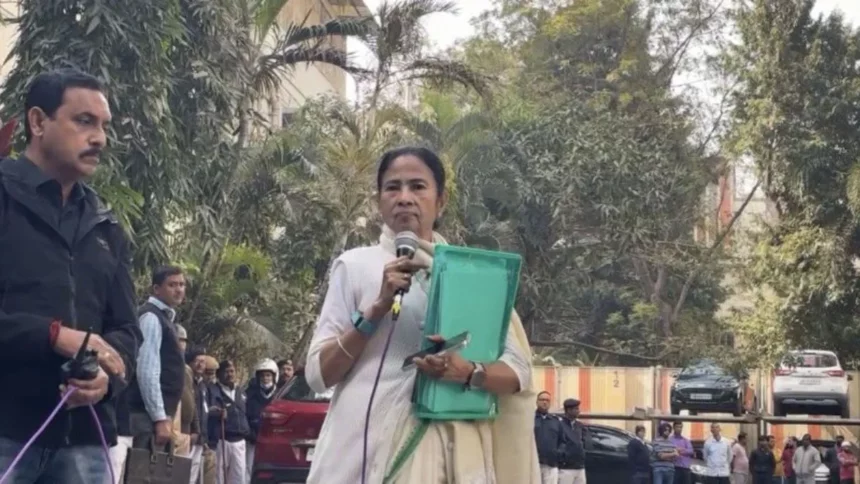
Mamata Banerjee, addressing party workers and the media, described the raids as an attack not merely on a political organisation but on democratic values themselves. She accused the Centre of selectively targeting opposition-linked entities while ignoring alleged irregularities involving leaders aligned with the ruling party at the national level. According to Banerjee, the repeated deployment of investigative agencies against opposition parties has created an atmosphere of fear and coercion that undermines the spirit of free political competition.
The Trinamool Congress leadership has asserted that the Indian Political Action Committee is a professional organisation offering strategic and analytical support, and that its association with political parties does not make it guilty of financial wrongdoing. Party leaders have argued that if there are genuine concerns, they should be addressed transparently through legal procedures rather than dramatic raids that generate public spectacle and political pressure.
Allegations of Political Targeting and Federal Tensions
At the heart of the dispute lies a broader accusation that central investigative agencies are being weaponised against opposition-ruled states. Mamata Banerjee has repeatedly positioned herself as a defender of federal autonomy, arguing that the Centre is encroaching upon the rights of states by using agencies like the Enforcement Directorate and the Central Bureau of Investigation to interfere in state politics. The proposed Kolkata protest, she said, is intended to send a clear message that West Bengal will not bow to intimidation.
Trinamool leaders point to a pattern in which raids and summons intensify around election periods or moments of political mobilisation. They claim that such actions divert administrative attention, damage reputations through media trials, and place an unfair burden on opposition parties trying to function within a democratic framework. Banerjee has warned that if this trend continues unchecked, it could weaken India’s pluralistic political structure and erode public trust in independent institutions.
The chief minister has also appealed to other opposition parties to view the issue as a collective concern rather than an isolated incident affecting only West Bengal. In her speeches, she has emphasised that the use of central agencies against one opposition party today could easily be turned against others tomorrow. By framing the protest as a broader democratic struggle, the Trinamool Congress aims to rally national attention and solidarity.
The Union government, however, has rejected these allegations, maintaining that investigative agencies operate independently and act solely on the basis of evidence. Officials have stressed that no individual or organisation is above the law, regardless of political affiliation. They argue that portraying legal कार्रवाई as political vendetta is an attempt to discredit institutions and influence public opinion.
Political Mobilisation and the Road Ahead
The planned protest march in Kolkata is expected to draw large crowds of party workers and supporters, with the Trinamool Congress mobilising its organisational strength across the city and surrounding districts. The party views the demonstration as an opportunity to energise its cadre, reinforce loyalty to the leadership, and project Mamata Banerjee as a fearless opponent of what it describes as authoritarian tendencies at the Centre.
Political observers note that street protests have long been a key element of Banerjee’s political style, helping her connect with grassroots supporters and dominate the public narrative. By taking to the streets herself, she signals that the issue is of utmost importance and that the party is willing to confront the Centre directly rather than limiting its response to courtrooms or press statements.
The episode also adds another layer to the already strained relationship between the West Bengal government and the Centre. Over the years, disputes over agency investigations, administrative control, and political rhetoric have kept tensions high. The latest controversy is likely to deepen mistrust and further polarise the political environment, particularly as national and state-level elections approach.
For the Trinamool Congress, the protests serve a dual purpose: defending an allied organisation and reinforcing its broader narrative of resistance against central domination. For the Union government, the challenge lies in maintaining the credibility of investigative agencies while countering accusations of bias. As both sides harden their positions, the unfolding confrontation underscores the complex intersection of law enforcement, politics, and federal balance in contemporary India.