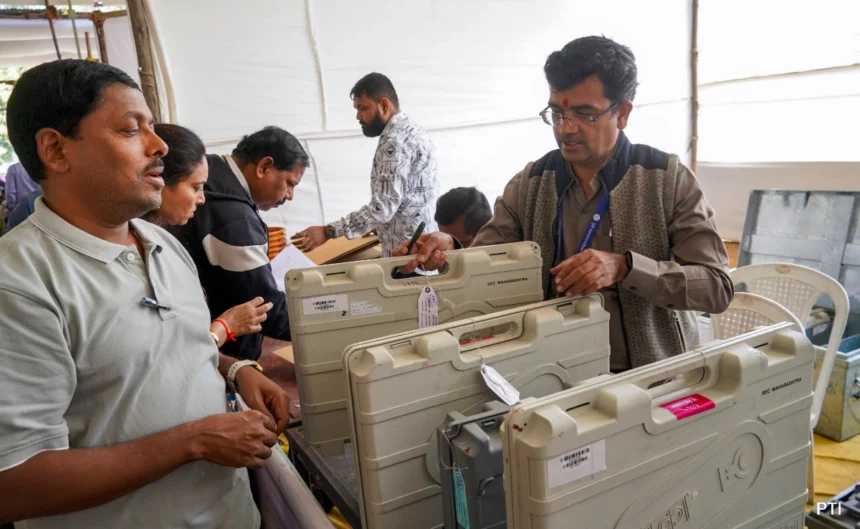
Voting across Maharashtra’s municipal corporations has moved into its most decisive stage as counting of ballots began for 29 civic bodies, including the politically and financially powerful Brihanmumbai Municipal Corporation, turning the spotlight on shifting alliances, emerging rivalries, and the future direction of urban governance in the state.
The commencement of vote counting in Maharashtra’s municipal elections marks a crucial political moment, particularly in Mumbai, where control of the Brihanmumbai Municipal Corporation has long been regarded as a measure of political influence and organisational strength. With results expected to reshape civic leadership across major cities, parties and alliances are closely watching early trends to assess public sentiment and recalibrate their strategies.
High-stakes counting begins as Mumbai and major cities await verdict
Counting of votes began early in the day across designated centres in Mumbai and other major urban hubs, drawing intense attention from political leaders, party workers, and citizens alike. The Brihanmumbai Municipal Corporation, India’s richest civic body with a vast annual budget and control over critical urban infrastructure, has emerged as the centrepiece of the electoral contest. With 227 wards at stake, the majority mark stands at 114 seats, making every early lead and narrow margin politically significant.
The elections have unfolded against a backdrop of evolving political alignments in Maharashtra. The ruling coalition led by the Bharatiya Janata Party entered the contest with confidence, seeking to consolidate its urban footprint. At the same time, opposition formations attempted to counter this momentum through new alliances and strategic seat-sharing arrangements, especially in Mumbai where traditional political loyalties have been tested by recent realignments.
A key feature of this election has been the collaboration between Uddhav Thackeray and Raj Thackeray, who came together in a bid to revive a consolidated regional political narrative. Their joint strategy was widely viewed as an effort to reconnect with Marathi-speaking voters and challenge the organisational strength of the ruling alliance in Mumbai’s wards. This partnership, though symbolically significant, faced the challenge of translating emotional appeal into electoral arithmetic.
Meanwhile, the Nationalist Congress Party opted to contest independently in several municipal corporations, a move that reflected internal strategic calculations and an attempt to assess its standalone strength in urban areas. The decision added another layer of complexity to the electoral landscape, with multi-cornered contests emerging in several wards.
Beyond Mumbai, vote counting is underway in major cities including Pune, Nagpur, Thane, Nashik, Navi Mumbai, Pimpri-Chinchwad, and Aurangabad. Each of these civic bodies plays a vital role in regional development, and the outcomes are expected to influence local governance priorities related to infrastructure, public transport, sanitation, housing, and healthcare. Early trends from some cities indicate close contests, underscoring the competitive nature of the elections.
Security arrangements at counting centres have been tight, with authorities ensuring orderly conduct as party workers gather to track results. The atmosphere outside counting halls has been charged with anticipation, as supporters react to updates ward by ward. For many candidates, these results represent years of grassroots work and personal political investment.
The scale of the elections is reflected in the sheer number of candidates and voters involved. Thousands of contestants competed across the 29 municipal corporations, making this one of the largest civic exercises in the state’s recent history. Voter turnout, while moderate in some cities, has been interpreted by analysts as a reflection of both urban apathy and selective engagement driven by local issues.
Political implications and future of urban governance in Maharashtra
The outcomes of these municipal elections are expected to carry implications far beyond local governance. Control of civic bodies, particularly the Brihanmumbai Municipal Corporation, has historically served as a launchpad for state-level political influence. Parties that dominate urban local bodies gain not only administrative authority but also access to grassroots networks, visibility, and resources that shape future electoral battles.
For the ruling alliance, strong performance in municipal polls would reinforce its narrative of political stability and governance efficiency in Maharashtra’s cities. Success in Mumbai and other major corporations would validate its strategy of organisational expansion and alliance management. Conversely, any setbacks could prompt internal reassessment and fuel opposition momentum.
For opposition leaders like Uddhav Thackeray and Raj Thackeray, the elections are widely seen as a test of relevance and revival. Their attempt to work together has been closely watched as an experiment in political consolidation. A credible showing would strengthen their claim to represent regional aspirations and provide a foundation for future collaborations. On the other hand, disappointing results could deepen questions about leadership direction and electoral appeal.
The Nationalist Congress Party’s solo approach also carries significant implications. By contesting independently, the party has sought to gauge its core support in urban Maharashtra without the buffer of alliances. The results will influence its bargaining power in future political negotiations and shape its roadmap ahead of upcoming state and national elections.
From a governance perspective, the composition of municipal corporations will directly affect policy priorities in the coming years. Urban local bodies are responsible for essential services such as water supply, waste management, road maintenance, public health, and disaster preparedness. Political stability within these bodies often determines how efficiently projects are executed and how responsively civic administrations address citizen grievances.
The elections have also highlighted broader questions about urban political participation. While civic polls traditionally attract less attention than state or national elections, their impact on daily life is immediate and tangible. Issues such as pothole-ridden roads, flooding during monsoons, housing shortages, and public transport efficiency often dominate voter concerns, influencing ward-level outcomes more than ideological debates.
As counting progresses and results become clearer, political narratives will begin to take shape. Victory claims, allegations, and interpretations are expected to dominate public discourse, with parties projecting outcomes as mandates for their respective visions of urban development. Analysts will closely examine voting patterns to understand demographic shifts, the role of local leadership, and the effectiveness of alliance strategies.
Ultimately, the municipal election results will serve as a barometer of public mood in Maharashtra’s cities. They will reveal how voters perceive current governance, which leadership styles resonate at the grassroots, and how political equations are evolving in urban India. As the numbers are tallied and councils take shape, the focus will gradually shift from electoral competition to the challenge of delivering effective, inclusive, and accountable civic governance across the state.