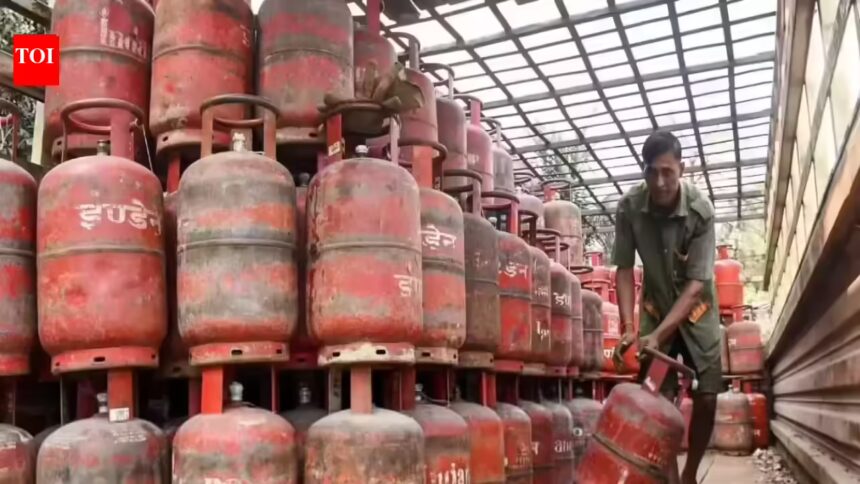
India is witnessing a growing LPG supply crisis as tensions in West Asia disrupt global energy supply chains, leading to shortages across several states and a surge in black marketing of gas cylinders. Reports from different parts of the country indicate that domestic LPG cylinders that normally cost under ₹1,000 are being sold for as high as ₹1,800 in the black market, while commercial cylinders are reportedly fetching prices of ₹3,500 to ₹4,000.
The shortage has resulted in long queues outside gas agencies, delays in deliveries, and a sharp rise in illegal reselling of LPG cylinders. Consumers in many cities are struggling to obtain cylinders even after waiting for hours, while restaurants, dhabas, and food establishments are switching to alternative cooking methods such as induction stoves to continue operations.
The situation has worsened in multiple states including Bihar, Madhya Pradesh, Uttar Pradesh, Punjab, Rajasthan, Uttarakhand and Haryana, where authorities are facing increasing pressure to control black marketing and restore normal LPG supply.
Black Market Prices Soar Across Multiple States
The shortage of LPG cylinders has led to widespread black marketing across several states. In Bihar, domestic cylinders that usually cost around ₹918 are reportedly being sold in the black market for ₹1,700 to ₹1,800. Similarly, commercial cylinders priced around ₹1,910 are being sold for as much as ₹5,000 in illegal markets.
In Madhya Pradesh, an investigation revealed that commercial cylinders officially priced at ₹1,918 are being sold openly in the black market for around ₹4,000 in Bhopal. Reports suggest that some private gas agency operators, brokers and illegal refilling operators are taking advantage of the supply crisis.
Authorities have invoked provisions of the Essential Commodities Act to prevent hoarding and illegal trading of LPG cylinders. However, despite these measures, black marketing continues in several areas due to the persistent gap between demand and supply.
In Uttar Pradesh, residents in cities like Lucknow have reported that domestic cylinders costing around ₹950 are being sold in the black market for ₹1,600. Commercial cylinders are also available illegally for approximately ₹3,500.
Punjab has also been severely affected by the shortage. In cities such as Jalandhar and Ludhiana, people have been seen standing in long queues outside gas agencies with empty cylinders in the hope of securing a refill. However, many consumers are returning empty-handed due to limited supply.
As a result, several restaurants and eateries in Punjab are reportedly purchasing commercial cylinders in the black market at inflated prices just to keep their kitchens running.
Businesses and Households Struggle Amid Supply Disruptions
The LPG shortage has begun affecting not only households but also commercial establishments across the country. Hotels, restaurants, dhabas, and street food vendors have been particularly impacted by the limited availability of commercial cylinders.
In Uttarakhand, particularly in cities like Dehradun and Haldwani, the shortage of commercial cylinders has forced many restaurants to remove nearly 70% of food items from their menus. Many establishments are attempting to arrange alternative cooking systems as gas supplies become increasingly uncertain.
In Rajasthan, the supply disruption has created significant difficulties for mess facilities and hostels that rely heavily on LPG cylinders for daily cooking. Due to the shortage, demand for traditional wood and coal furnaces has increased sharply. Workshops are now manufacturing large furnaces weighing 35–40 kilograms for use in institutional kitchens, although supply is struggling to keep up with demand.
Meanwhile, in Haryana, consumers are experiencing delays of up to a week for domestic LPG deliveries that previously took only one or two days. Long queues are being reported outside gas agencies in cities including Hisar, Sonipat, Panipat, Kaithal, Fatehabad, Hansi, Rewari and Faridabad.
Consumers have also complained about technical difficulties such as not receiving OTP verification codes required for LPG delivery, which has further complicated the distribution process.
Government Steps to Control Crisis and Boost Supply
In response to the growing LPG shortage and black marketing concerns, the central government has taken several steps to stabilise the supply and prevent hoarding.
The Ministry of Petroleum has formed a high-level committee consisting of executive directors from the country’s three major oil marketing companies to monitor the LPG supply situation and coordinate emergency measures.
The government has also implemented the Essential Commodities Act nationwide to prevent illegal hoarding and black marketing of LPG cylinders.
In addition, new rules have been introduced for domestic cylinder bookings. Consumers will now be able to book a new cylinder only after 25 days from the delivery of their previous one. This measure aims to reduce panic buying and prevent stockpiling.
To ensure transparency in delivery, authorities have made OTP verification and biometric authentication mandatory for LPG cylinder deliveries. These measures are intended to prevent illegal diversion of cylinders.
Furthermore, the government has instructed oil refineries across the country to increase LPG production. According to sources, production levels have already increased by approximately 10% in response to the rising demand.
Global Energy Disruptions Behind the LPG Crisis
The primary cause of the LPG shortage is the ongoing conflict involving Iran, Israel and the United States, which has significantly disrupted global oil and gas supply chains.
One of the major challenges facing India is the near closure of the Strait of Hormuz, a crucial maritime route through which around 20% of the world’s petroleum supply passes.
The Strait of Hormuz connects the Persian Gulf to the Arabian Sea and plays a vital role in global energy trade. Due to the security risks created by the conflict, several oil tankers have reportedly avoided this route, affecting energy shipments worldwide.
India imports about 50% of its crude oil and approximately 54% of its liquefied natural gas (LNG) through routes connected to the Strait of Hormuz. Any disruption in this corridor therefore has a direct impact on the country’s energy supply.
Another major factor behind the shortage is the reduction in LNG production following drone attacks on energy facilities in the Gulf region.
Qatar, which is the largest supplier of LNG to India, reportedly halted operations at one of its LNG plants following drone strikes during the conflict. India imports nearly 40% of its LNG requirements from Qatar, amounting to approximately 27 million tonnes annually.
The disruption in Qatar’s LNG production has further strained energy supplies and contributed to the LPG shortage in India.
Efforts to Stabilise Energy Supplies
Officials have stated that the government is working to secure alternative energy supplies to reduce the impact of the crisis.
According to Indian Oil Corporation officials, consumers should avoid panic buying as the government is actively exploring additional import options from countries such as the United States and other energy exporters.
At the global level, discussions are underway among G7 nations to release oil from strategic petroleum reserves to stabilise energy markets and reduce supply disruptions.
Additional crude oil shipments are also expected from countries including Russia and Algeria, which could help ease the pressure on global energy markets in the coming weeks.
Meanwhile, the Indian government has also revised domestic LPG prices. The price of a 14.2 kg domestic cylinder has been increased by ₹60, bringing the price in Delhi to ₹913 from the previous ₹853.
Similarly, the price of a 19 kg commercial cylinder was increased by ₹115 earlier this month, taking its official price to ₹1,883.
Officials remain hopeful that once global supply routes stabilise and alternative energy shipments arrive, the LPG supply situation across India will gradually return to normal.