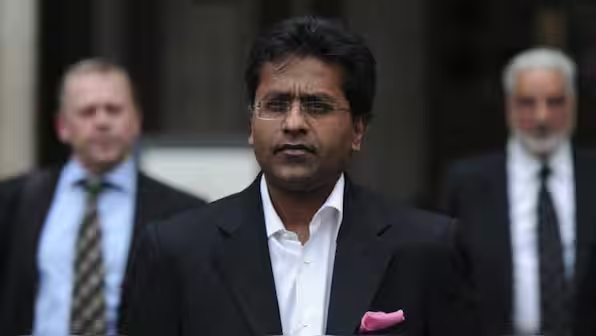
The debate around the financial sustainability and structural integrity of the Indian Premier League has intensified after former commissioner Lalit Modi alleged that the league is incurring annual losses of nearly ₹2,400 crore. His remarks have reignited conversations about whether the current format truly reflects the original vision of the tournament. Modi’s criticism centers on the departure from a full home-and-away structure, which he claims was the foundation of the league’s commercial model. According to him, the reduction in matches has significantly affected revenue generation, thereby impacting both the Board of Control for Cricket in India and franchise owners. His assertion that “that is not what we sold” reflects a deeper concern about whether the IPL has drifted from its original blueprint in pursuit of expansion without adequate structural planning.
Home-And-Away Format Debate Raises Questions Over IPL Revenue Model
At the heart of Lalit Modi’s argument lies the home-and-away format, which he describes as the backbone of the IPL’s financial success. In the early conception of the league, every team was meant to play against each other twice, once at home and once away. This format not only ensured competitive balance but also maximized revenue streams through ticket sales, broadcasting rights, and sponsorship deals. However, with the expansion to ten teams, the league shifted away from this model, reducing the total number of matches to 74 instead of the originally projected 90 league games plus playoffs.
Modi argues that this deviation has led to a significant financial shortfall. He estimates that nearly 20 matches are effectively lost each season due to the current structure. Given that each match contributes substantial revenue through media rights deals, the cumulative impact is enormous. He claims that if the league had maintained a full home-and-away schedule with approximately 94 matches, it could have generated an additional ₹2,400 crore annually. This figure, according to him, would have been distributed between the BCCI and franchises, strengthening the overall economic ecosystem of the tournament.
The financial model of the IPL is structured in a way that revenue from each match is shared between the governing body and participating teams. Typically, half of the revenue goes to the BCCI, while the remaining half is distributed among franchises. By reducing the number of matches, Modi believes that franchises are being deprived of their rightful share, which he describes as a contractual obligation. He questions whether all stakeholders had agreed to such a structural shift, suggesting that the decision may not have had unanimous approval.
Beyond the financial implications, Modi’s criticism also touches upon the broader identity of the IPL. The home-and-away format creates a strong connection between teams and their local fan bases, fostering loyalty and enhancing the overall viewing experience. By limiting this aspect, the league risks diluting one of its most unique features. The reduced number of matches also impacts player opportunities, local economies, and the overall entertainment value of the tournament.
Governance Concerns And Lalit Modi’s Controversial Legacy Add Complexity To Debate
While Lalit Modi’s observations have sparked a fresh debate, they cannot be viewed in isolation from his own controversial past. His tenure as IPL commissioner came to an abrupt end in 2010 when the Board of Control for Cricket in India suspended him following allegations of financial irregularities, misconduct, and lack of transparency. These allegations included manipulation of franchise bids, unauthorized broadcasting agreements, and violations of financial regulations.
Following his suspension, Modi left India and has since been residing in London. Legal cases related to money laundering, bid rigging, and violations of the Foreign Exchange Management Act continue to be associated with his name. The Enforcement Directorate had also issued notices against him, further complicating his public image. This background inevitably influences how his current statements are perceived, with critics questioning his credibility even as they acknowledge the relevance of some of his points.
Despite this, Modi’s role in conceptualizing and launching the IPL remains undeniable. The league has grown into one of the most valuable sports properties globally, attracting top players, massive sponsorships, and a huge fan following. His insights into the league’s financial structure, therefore, carry a certain weight, even if they are met with skepticism due to his past.
The governance of the IPL has evolved significantly since Modi’s departure. The BCCI has implemented stricter regulations, improved transparency, and expanded the league’s reach. However, the challenges of balancing expansion with sustainability continue to persist. The addition of new teams has increased competition and broadened the league’s appeal, but it has also introduced logistical complexities, including scheduling constraints and player workload management.
Modi’s suggestion that the league should not have expanded without ensuring sufficient calendar space raises important questions about long-term planning. Cricket calendars are increasingly crowded, with international commitments, bilateral series, and other franchise leagues competing for time. In this context, maintaining a longer IPL season with a full home-and-away format becomes a complex task. However, Modi argues that such challenges should have been addressed before expanding the league, rather than compromising on its core structure.
The financial implications of his claims extend beyond immediate revenue losses. A reduction in matches could potentially affect future media rights valuations, sponsorship deals, and overall investor confidence. The IPL’s success has largely been driven by its ability to deliver consistent and high-quality entertainment, backed by a robust financial model. Any perceived deviation from this model could have long-term consequences.
At the same time, it is important to consider the counterarguments. The current format allows for a more compact schedule, reducing player fatigue and ensuring higher intensity matches. It also accommodates international cricket commitments, which remain a priority for many players and boards. The balance between commercial interests and sporting integrity is a delicate one, and decisions regarding the IPL format must take multiple factors into account.
Lalit Modi’s remarks have once again brought the spotlight on the evolving nature of the IPL. Whether his claims of ₹2,400 crore annual losses are accurate or exaggerated, they have undoubtedly triggered a necessary discussion about the league’s future direction. The debate highlights the challenges of managing a global sports property in an increasingly complex and competitive environment, where financial considerations, fan engagement, and logistical realities must all be carefully balanced.