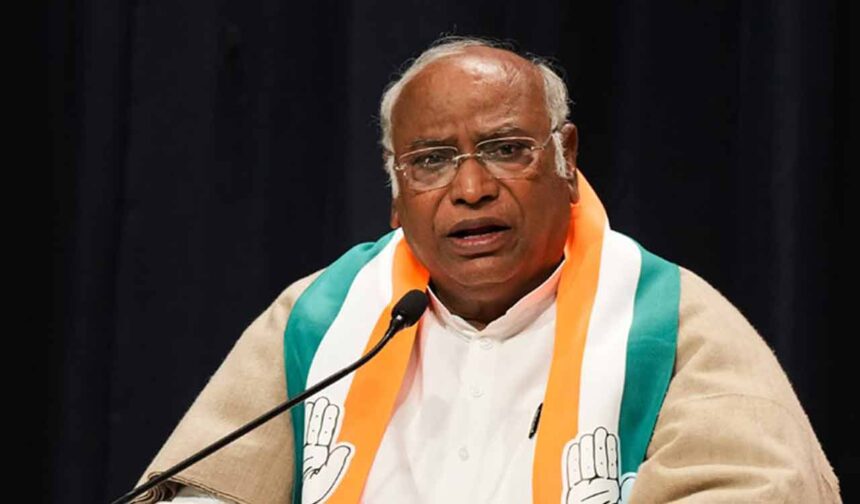
The political debate over women’s reservation and delimitation intensified after Congress president Mallikarjun Kharge reaffirmed support for the women’s reservation framework while strongly opposing the proposed delimitation exercise, calling it politically driven and harmful to federal balance.
The Opposition-led INDIA bloc has sharpened its stance on the government’s legislative agenda, particularly over the linkage between the women’s reservation bill and the delimitation exercise. Mallikarjun Kharge stated that while the Opposition fully supports the idea of reserving seats for women in Parliament and state assemblies, it has serious objections to the way the government is attempting to implement the reform through delimitation-linked constitutional changes. The remarks came after a high-level Opposition meeting where parties discussed their joint strategy ahead of parliamentary debates on electoral reform bills. The controversy has added to an already heated political environment, with both ruling and Opposition parties exchanging sharp accusations over intent, timing, and constitutional propriety.
Women’s Reservation Support with Conditional Opposition
Kharge and other INDIA bloc leaders reiterated that their opposition is not to women’s reservation itself, but to the structural changes being introduced alongside it. The women’s reservation law, passed earlier in Parliament, provides for 33 percent reservation for women in the Lok Sabha and state assemblies. However, its implementation has been linked to the completion of the census and subsequent delimitation exercise, which involves redrawing constituency boundaries.
Opposition leaders argue that combining these two processes raises concerns about fairness and transparency. They claim that the government’s approach could alter political representation across states in ways that may disadvantage certain regions, particularly those with slower population growth. Kharge emphasized that the reservation should be implemented in its original form without being tied to broader electoral restructuring.
Congress leaders have also raised concerns that the current proposal may reshape parliamentary strength distribution, potentially increasing the total number of Lok Sabha seats while altering state-wise representation patterns. This, they argue, makes the issue not just about gender representation but also about federal balance.
Delimitation Debate and Federal Concerns
The delimitation exercise, which involves redrawing constituency boundaries based on population data, has become the central point of opposition criticism. Historically, delimitation has been carried out to ensure equal representation based on demographic changes, but political sensitivities arise when population growth varies significantly across states.
Opposition parties argue that states which successfully implemented population control measures could lose proportional influence in Parliament if seat distribution is revised strictly on population growth. This concern has been echoed by several regional parties as well, who fear that delimitation may shift political weight toward more populous regions.
Kharge described the proposed approach as “politically motivated,” asserting that any restructuring of parliamentary seats must be done only after broad consensus among all states. He also called for greater transparency in how delimitation commissions are expected to function under the new framework.
Political Consensus vs Electoral Strategy
The INDIA bloc’s position reflects a broader demand for separating women’s reservation from delimitation. Opposition leaders maintain that the women’s quota enjoys cross-party support and should not be delayed due to procedural or structural changes linked to electoral redistribution.
At the same time, the government and its allies argue that delimitation is a necessary constitutional step following the census process and that linking it with women’s reservation ensures proper implementation of constitutional guarantees. Supporters of the move say that expanding representation and restructuring constituencies is essential for reflecting India’s current demographic realities.
The debate has now evolved into a larger political confrontation over how democratic representation should be defined in a rapidly changing population landscape. While the government frames the reforms as modernization of electoral structure, the Opposition views them as potentially altering the balance of power in favor of ruling interests.
Parliamentary Debate Ahead
With the special parliamentary session underway, both issues are expected to dominate legislative discussions. The women’s reservation bill, already passed in principle, awaits implementation mechanisms, while delimitation proposals are still under debate. Political analysts expect intense debate in Parliament as parties attempt to shape public perception on representation, federalism, and gender inclusion.
The outcome of these discussions is likely to have long-term implications for India’s electoral structure, particularly in how parliamentary seats are allocated and how women’s representation is operationalized in legislative bodies.