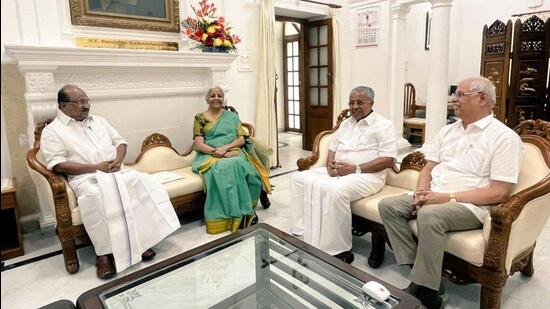
Kerala Chief Minister Pinarayi Vijayan met Union Finance Minister Nirmala Sitharaman at Kerala House in New Delhi on Wednesday. The meeting, which was followed by breakfast, was also attended by Kerala Governor Rajendra Arlekar. This discussion came just a day after the governor’s unusual interaction with Lok Sabha and Rajya Sabha MPs from the state, where he urged them to put aside political differences and work collectively for Kerala’s interests.
While no official statement detailed the discussions, sources close to the chief minister indicated that Pinarayi Vijayan raised multiple concerns, including the need for increased central assistance for rehabilitation efforts in Wayanad, which was affected by landslides. Additionally, he reportedly discussed measures for the long-term development of the Vizhinjam transshipment port, a crucial infrastructure project for the state. Former Union minister and Kerala’s special representative in Delhi, KV Thomas, who was also present at the meeting, described the talks as “positive.”
The meeting, however, has also sparked political speculation due to the governor’s presence. Analysts believe that his involvement hints at a deeper political strategy, especially with the upcoming elections in the state. Former political science professor J Prabhash noted that there was no constitutional or legal requirement for the governor to participate in discussions regarding Centre-State matters. His presence, he suggested, could be interpreted as a sign of increasing political alignment between the Communist Party of India (Marxist) [CPI(M)] and the Bharatiya Janata Party (BJP) in Kerala.
According to Prabhash, both CPI(M) and BJP share a common political goal in Kerala: to diminish the influence of the Congress-led United Democratic Front (UDF). He argued that if the Congress is weakened, it would create a political vacuum that the BJP could capitalize on to strengthen its presence in the state.
Despite the political undercurrents, the Kerala Chief Minister’s Office clarified in a statement that the finance minister’s visit to Kerala House was unofficial and that Nirmala Sitharaman left soon after breakfast. This meeting has drawn attention due to the evolving political dynamics in Kerala, where the role of the governor in state affairs has been a topic of debate.
With the governor openly backing the chief minister in advocating Kerala’s demands before the Union government, questions arise about whether this signals a shift in Centre-State relations or if it is merely a strategic move ahead of upcoming political battles. Either way, the meeting marks an interesting development in Kerala’s political landscape.