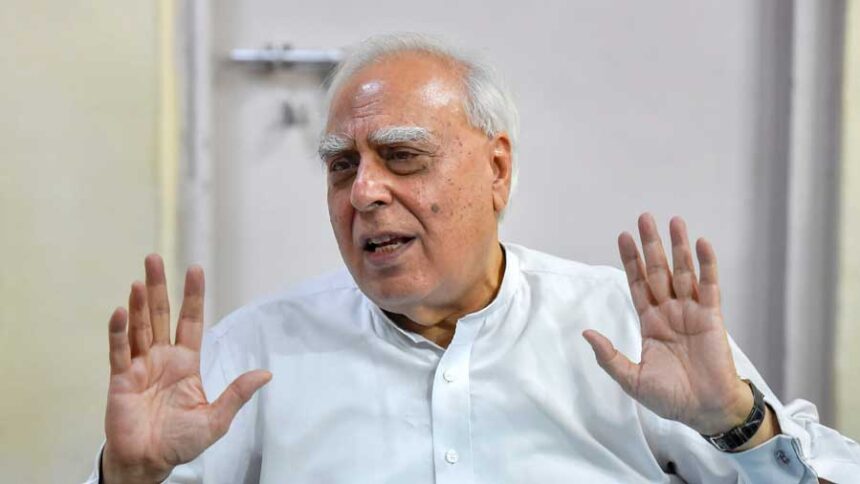
Rajya Sabha MP Kapil Sibal, a prominent member of the opposition, recently expressed deep concerns over the judiciary’s response—or lack thereof—to issues of corruption, misconduct, and partisanship within its ranks. Speaking at the Idea Exchange event, Sibal made a compelling case for the judiciary to address these issues in a more institutional and transparent manner, highlighting the risks of the lack of accountability to the public trust placed in India’s judicial system. The conversation, moderated by Apurva Vishwanath, National Legal Editor of The Indian Express, focused on multiple pressing matters regarding the functioning of India’s judiciary and its impact on public perception.
Sibal was asked to comment on the recent case that has rocked the judiciary: the discovery of a large sum of cash found at the official residence of Delhi High Court judge Justice Yashwant Verma. This event has raised serious questions regarding the probity of judges and, by extension, the independence of the judiciary. In response, Sibal emphasized that it would be inappropriate for any responsible citizen, or the legal community, to make assumptions about the case until the inquiry is concluded. “Till the inquiry is complete, I do not think any responsible citizen of India should comment on it,” he remarked. However, he made it clear that the larger issues concerning the judiciary need to be addressed without delay.
According to Sibal, there are three major issues that plague the judiciary: financial corruption, alleged sexual misconduct, and ideological alignment with political forces. He pointed out that the institution has not adequately responded to these concerns, which he finds highly disturbing. The first of these problems, he argued, is financial corruption, for which there is no institutional mechanism to address it. Sibal pointed out that allegations such as those against former Chief Justice Ranjan Gogoi related to sexual misconduct further compounded the issue of transparency and accountability within the judiciary. He then moved on to the case of Justice Shekhar Yadav, whose open alignment with a specific political ideology has raised further questions about the judicial system’s impartiality.
Sibal’s critique underscores the deep institutional inertia regarding these issues. Despite years of public debate surrounding them, the judiciary, in his view, has failed to respond meaningfully or address the concerns raised by various quarters. This lack of institutional response, according to Sibal, is highly problematic because it fuels growing public dissatisfaction. It has left the door open for political figures and parties to propose alternative systems for judicial appointments, such as the National Judicial Appointments Commission (NJAC), which aims to give the executive more power in deciding the appointment of judges. Sibal pointed out that such proposals are often presented as solutions to the judicial system’s failings, but they miss the larger point about the need for internal reforms. “We should have had these debates much earlier as to why the institution is not responding to its failings in dealing with issues that reduce public credibility in the institution,” he stressed.
One of Sibal’s key concerns was the opacity in handling high-profile cases, such as that of Gogoi. Despite the serious allegations and the public interest surrounding the case, there was little in the way of transparency. Sibal questioned the lack of public information regarding the investigation or any actions taken in the case. He further challenged the selective transparency of the institution, which, according to him, only makes certain cases public while leaving others in the dark. “When you talk about transparency, you can’t possibly be selective about it,” Sibal remarked. He emphasized the need for the judiciary to adopt a transparent approach to all matters of misconduct, corruption, and ideological bias, ensuring that all allegations are handled impartially and publicly, without fear or favor.
Sibal’s remarks also reflect a larger frustration with the judicial system’s handling of both internal and external challenges. The judiciary, he argues, is crucial to maintaining the balance of power in a democracy, and its credibility is essential for the proper functioning of the state. When the public perceives that the judiciary is not sufficiently holding its members accountable, or when judges are seen to be acting in ways that compromise their impartiality, the entire system risks losing the trust of the people it serves.
In his comments, Sibal also alluded to the broader political implications of a judiciary that is seen as failing to self-correct. He pointed to the political ramifications that such institutional failures can have, including the potential erosion of the judiciary’s independence and its growing politicization. The lack of institutional mechanisms to address corruption, misconduct, and ideological alignment could eventually lead to external interventions in judicial appointments and the broader functioning of the judiciary. For Sibal, this would be a step backward in the long struggle to preserve judicial independence in India.
Sibal’s statements resonate with a growing sentiment in the country, where concerns over the judicial system’s integrity have been raised time and again. The debate around judicial accountability, transparency, and independence is not new, but Sibal’s critique serves as a timely reminder that these issues remain unresolved. As the judiciary continues to grapple with questions of probity, corruption, and political alignment, the public remains anxious about whether it will take the necessary steps to preserve its independence and restore public confidence.
In conclusion, Kapil Sibal’s remarks offer a powerful critique of the judiciary’s current approach to handling corruption, misconduct, and ideological bias. His call for a more institutional response to these issues reflects a broader concern about the erosion of trust in the judicial system. As the inquiry into the recent allegations against Justice Yashwant Verma unfolds, Sibal’s words serve as a crucial reminder of the importance of transparency, accountability, and reform within one of the most essential pillars of the Indian state.