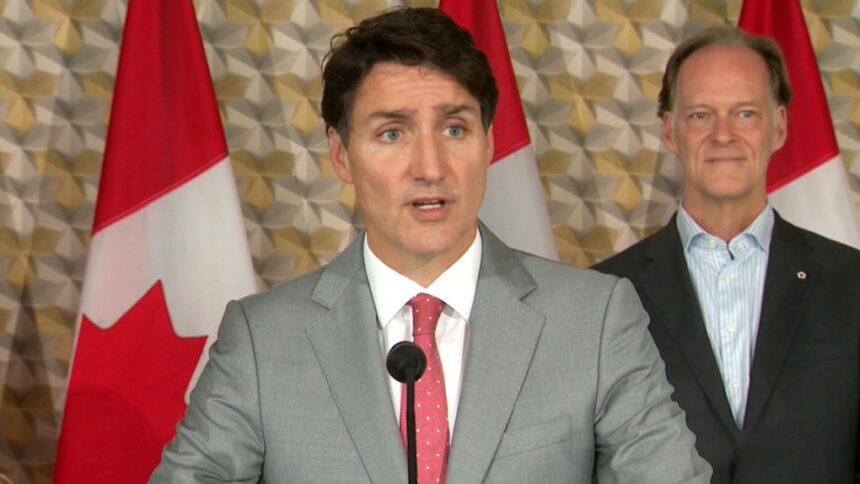
In a recent statement, Canadian Prime Minister Justin Trudeau dismissed U.S. President-elect Donald Trump’s remarks about possibly annexing Canada, calling it a distraction tactic aimed at diverting attention from the economic implications of his proposed tariffs. Justin Trudeau’s comments came after Donald Trump stated on Tuesday that he was contemplating using economic force to acquire Canada, following his announcement that he would impose a 25% tariff on all Canadian imports unless Canada increases security measures at the border.
Justin Trudeau, speaking with CNN, explained that Donald Trump’s provocative remarks were intended to shift the conversation away from the substantial economic consequences that could arise if the proposed tariffs were implemented. “What I think is happening in this is President Donald Trump, who is a very skillful negotiator, is getting people to be somewhat distracted by that conversation,” Justin Trudeau said, referring to the discourse surrounding the annexation comments. According to Justin Trudeau, Donald Trump’s focus on Canada’s potential acquisition was a deliberate move to shift public attention from the substantial cost increase of everyday goods.
Justin Trudeau further emphasized the negative impact such tariffs would have on both American and Canadian economies. He explained that if the tariffs were imposed, essential goods such as oil, gas, electricity, steel, aluminum, lumber, and concrete—products heavily relied upon by American consumers—would see a significant rise in prices. “Oil and gas and electricity and steel and aluminum and lumber and concrete and everything the American consumers buy from Canada (are) suddenly going to get a lot more expensive if he moves forward on these tariffs,” Justin Trudeau warned.
The Canadian Prime Minister, who has repeatedly asserted that Canada will never become part of the United States, also expressed strong disapproval of Donald Trump’s comments. “There’s not a snowball’s chance in hell that Canada would ever become part of the United States,” he said. Justin Trudeau reiterated that if Donald Trump pursued this threat of annexation or imposed the tariffs, Canada would retaliate with countermeasures to protect its economic interests.
Justin Trudeau referenced a similar situation in 2018 when Canada and the U.S. were embroiled in a bilateral trade dispute. During that time, Canada imposed retaliatory tariffs on a variety of American products, including Heinz ketchup, playing cards, bourbon, and Harley Davidson motorcycles. He acknowledged that such tariffs were designed to hurt American workers, but stressed that the Canadian government did not want to resort to such measures, as they raised prices for Canadian consumers and strained relations with its closest trading partner.
Despite the heightened rhetoric from Donald Trump, Justin Trudeau made it clear that Canada’s response would always be measured and focused on safeguarding the nation’s interests. “We don’t want to do that because it drives up prices for Canadians and it harms our closest trading partner,” he concluded, reinforcing Canada’s commitment to defending its sovereignty and economic interests in the face of external pressures.
As the discussions between the two nations continue, Justin Trudeau’s comments underscore the deepening tensions regarding trade and economic relations between Canada and the United States. With the potential imposition of tariffs still looming, the world will be closely watching the evolving dynamics between the two neighboring countries.