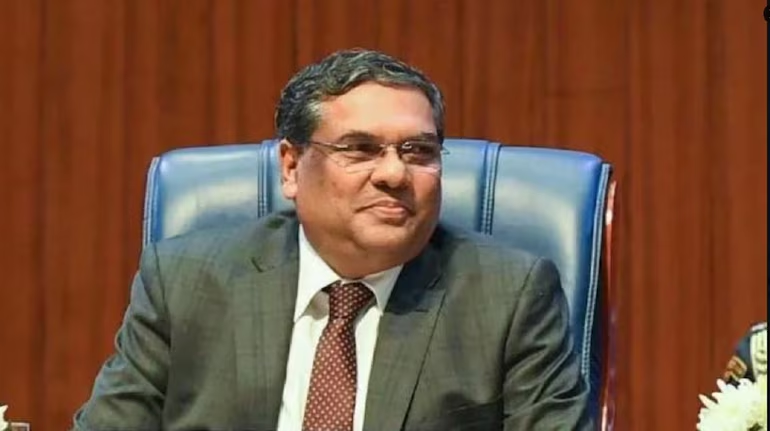
Justice Sanjiv Khanna was sworn in as the 51st chief justice of India at the Rashtrapati Bhavan on Monday, following the retirement of Justice DY Chandrachud. The oath of office was administered by President Droupadi Murmu in a ceremony attended by Prime Minister Narendra Modi, Vice President Jagdeep Dhankhar, Defence Minister Rajnath Singh, Minister of Parliamentary Affairs Kiren Rijiju, Minister of Power Manohar Lal Khattar, former chief justice DY Chandrachud, and other dignitaries.
Justice Sanjiv Khanna, born on May 14, 1960, pursued his law degree from the Campus Law Centre at Delhi University. Coming from a family of legal professionals, he was a third-generation lawyer before being appointed as a judge of the Delhi High Court. He later served as the executive chairman of the National Legal Services Authority (NALSA), an institution dedicated to providing free legal aid and ensuring access to justice for the underprivileged.
His elevation to the Supreme Court came in January 2019, and during his tenure, he played a key role in adjudicating significant cases. Among his notable judgments was his involvement in granting bail to Aam Aadmi Party (AAP) leader and former Delhi chief minister Arvind Kejriwal in the Delhi liquor policy case. Justice Sanjiv Khanna’s bench granted interim bail to Arvind Kejriwal in May, allowing him to campaign for the Lok Sabha elections. The case was later referred to a larger bench, and interim bail was again granted in July, considering concerns regarding the possible misuse of the Prevention of Money Laundering Act (PMLA).
Justice Sanjiv Khanna also contributed significantly as part of the Constitution Bench in several landmark cases, including the revocation of Article 370, which had granted special status to Jammu and Kashmir, and the case concerning electoral bonds. His decisions have shaped key aspects of India’s legal and political landscape, reinforcing constitutional principles and ensuring judicial scrutiny of executive actions.
Additionally, he was part of benches addressing issues related to electronic voting machines (EVMs) and Voter Verified Paper Audit Trails (VVPATs), highlighting concerns about electoral transparency. His tenure as chief justice is expected to uphold the judiciary’s commitment to constitutional values, fairness, and judicial accountability. Justice Sanjiv Khanna will serve as the chief justice of India until May 13 next year.