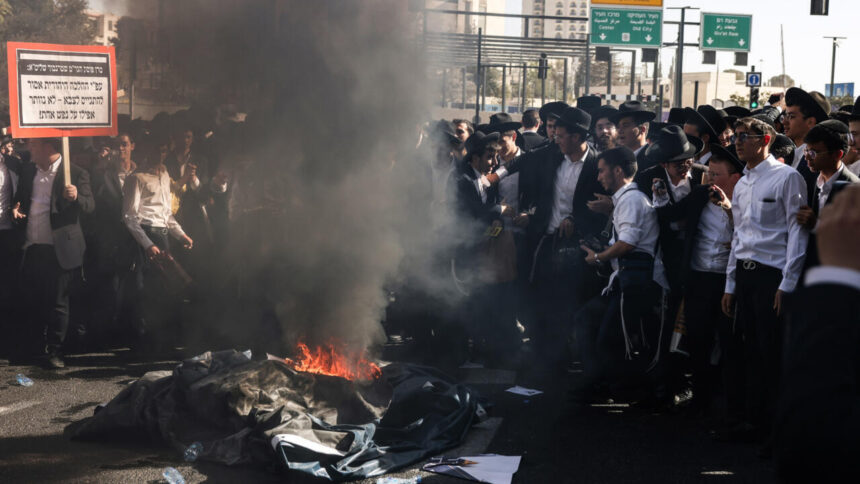
Jerusalem witnessed one of the largest ultra-Orthodox demonstrations in recent history as hundreds of thousands of Haredi men gathered on Thursday to protest against Israel’s attempts to draft them into the army. The rally, described by organizers as the “demonstration of the million,” marked a rare moment of unity among the country’s diverse ultra-Orthodox factions but was overshadowed by the tragic death of a 15-year-old boy who fell from a construction site during the event. The protest highlighted the long-running and deeply contentious issue of ultra-Orthodox military exemption, which continues to test the relationship between religion and state in Israel amid ongoing national and regional conflicts.
Unprecedented Mobilization of Ultra-Orthodox Factions in Jerusalem
The demonstration began early Thursday as streams of ultra-Orthodox men poured into Jerusalem from across Israel, many traveling by train and others on foot after major roads were closed by police due to overcrowding. Highway 1, the main road connecting Tel Aviv and Jerusalem, was completely blocked, and rail stations were packed with demonstrators clad in traditional black coats and wide-brimmed hats, chanting prayers and slogans opposing army service.
The gathering brought together multiple religious sects, including Hasidic, Lithuanian, and Sephardic groups, in a rare display of solidarity. Even the Chabad movement, known for its relatively apolitical stance, issued a public call urging members to join the “prayer and cry rally in Jerusalem.”
“Today, all ultra-Orthodox factions have come together,” said Yehuda Hirsch, a 20-year-old protester affiliated with the anti-Zionist faction Neturei Karta. “We will not enlist in the army under any circumstances. We are two opposites—the state and the army on one side, and the world of Torah on the other.”
Hirsch emphasized that this was the first united protest of its kind in nearly a decade, recalling earlier struggles where the ultra-Orthodox successfully resisted state attempts to impose conscription. “Just as we do not enlist with Hamas, we will not enlist with the IDF,” he declared.
For many demonstrators, the protest was not only about avoiding military service but also about defending their religious identity and way of life. A 25-year-old man, who refused to reveal his name, said he was currently facing an arrest warrant for draft evasion but remained unafraid. “I sat in detention before, and I’ll sit again if I have to,” he said. “This isn’t about war. I mourn every soldier killed, but the state wants to make us secular, and that’s something we cannot accept.”
Michael, a 19-year-old yeshiva student from Bnei Brak, echoed that sentiment. “I have a draft order. But as long as the rabbis don’t tell me to go, I won’t show up,” he said. For many in the ultra-Orthodox community, the ultimate authority lies with their rabbis rather than the state, reinforcing the deep divide between the religious and secular segments of Israeli society.
The demonstration was not without tragedy. During the protest, a 15-year-old boy fell from a construction site near the gathering area and later died, casting a somber mood over an otherwise defiant and emotionally charged event. Despite the incident, the crowd remained largely peaceful, though the massive turnout posed logistical challenges for city authorities.
A Deep and Divisive History of Conscription in Israel
The issue of ultra-Orthodox conscription has been a flashpoint in Israeli politics since the establishment of the state in 1948. Israel’s founding Prime Minister, David Ben-Gurion, originally granted a limited exemption from military service to a small number of yeshiva students dedicated to full-time religious study. At the time, the ultra-Orthodox population was a tiny fraction of Israel’s society, and the exemption was viewed as a way to preserve Jewish religious scholarship after the devastation of the Holocaust.
However, as the ultra-Orthodox population grew rapidly over the decades, the exemption became one of the most divisive issues in Israeli society. By the 1970s, public debate intensified over whether the growing number of Haredi men avoiding military service undermined national equality and burdened the rest of the population. Despite multiple court rulings and legislative attempts, no government has successfully passed a lasting law to regulate or end the exemption.
The current controversy was reignited amid the ongoing conflict in Gaza, where the Israeli Defense Forces (IDF) have mobilized hundreds of thousands of reservists. As the war intensified and the number of military casualties rose, pressure mounted on the government to include the ultra-Orthodox in the draft, especially as the country’s manpower needs increased.
The right-wing coalition government, which includes ultra-Orthodox parties, has faced internal divisions over the issue. Prime Minister Benjamin Netanyahu’s government has struggled to balance its dependence on Haredi political support with growing public anger among secular Israelis who view the exemption as unfair. The failure to pass legislation protecting the exemption has fueled resentment among the ultra-Orthodox community, who see the recent arrests of yeshiva students as an attack on their faith and way of life.
Last week, several ultra-Orthodox students were detained by military police for refusing to enlist, sparking outrage within the community and prompting this week’s massive protest. United Torah Judaism lawmaker Meir Porush condemned the arrests, calling them “a campaign of persecution against religion” and a “disgrace that indicates heartlessness.”
Moshe Gafni, another senior ultra-Orthodox politician and leader of the United Torah Judaism party, addressed his followers during the rally, describing the demonstration as “beyond imagination.” He said, “People from all over the country have come to this big rally, which is almost unprecedented. The cry from here will be heard all over the world.”
Gafni compared the arrests of yeshiva students to the persecution of Jews in ancient times, saying, “The arrest of ultra-Orthodox youth is reminiscent of the dark days under Roman rule. It’s a decree from heaven that you cannot live with.” His remarks reflected the deep sense of grievance among the religious community, which perceives state pressure as a violation of divine authority and Torah values.
Many ultra-Orthodox leaders argue that their religious study itself is a vital form of national service—one that preserves Jewish identity and spiritual strength. They believe that conscription would expose young Haredi men to secular influences, threatening their way of life and religious devotion. This view stands in stark contrast to the broader Israeli public, where mandatory military service is seen as a cornerstone of citizenship and national solidarity.
The demonstrations in Jerusalem also revealed the internal contradictions within the Israeli government. While ultra-Orthodox parties hold key positions in the ruling coalition, their opposition to conscription clashes with the priorities of other right-wing factions, particularly those emphasizing national security and unity. As the war in Gaza continues, these tensions are likely to intensify, posing fresh challenges for Israel’s fragile political landscape.
The scale of the Jerusalem protest underscored the determination of the ultra-Orthodox community to resist any attempts at forced conscription. Organizers framed the event not merely as a political statement but as a spiritual act of defiance. Many participants prayed, sang religious hymns, and held banners declaring, “Torah will not be replaced by the army.” Others carried signs reading, “Our study protects the nation,” emphasizing their belief that their devotion contributes to Israel’s spiritual defense as much as the soldiers contribute to its physical protection.
Over the years, Israeli courts have repeatedly ruled that the government must find a solution to the exemption issue, describing the current arrangement as discriminatory. Yet every attempt to pass a new conscription law has failed due to political infighting and pressure from religious parties. The Supreme Court is currently reviewing petitions challenging the legality of continued exemptions, which could result in a constitutional crisis if the government refuses to comply with future rulings.
For many Israelis, the issue symbolizes broader social divides—between secular and religious citizens, between those who see Israel as a modern democratic state and those who view it primarily as a religious homeland. The massive protest in Jerusalem has once again exposed these fractures, revealing that the question of “who serves” remains one of the most sensitive and unresolved dilemmas in Israeli society.
In the aftermath of the protest, the ultra-Orthodox leadership has vowed to continue resisting state pressure while urging followers to remain peaceful. “We do not seek confrontation,” said one senior rabbi addressing the crowd. “But we will not allow the Torah world to be destroyed by those who wish to make us like everyone else.”
As night fell over Jerusalem, the streets slowly cleared, leaving behind a powerful message of defiance from a community that continues to stand apart from the state that governs it. The demonstration may have ended, but the battle over ultra-Orthodox conscription—one rooted in decades of ideological conflict—shows no sign of resolution, and its outcome will likely shape the future of Israeli society for years to come.