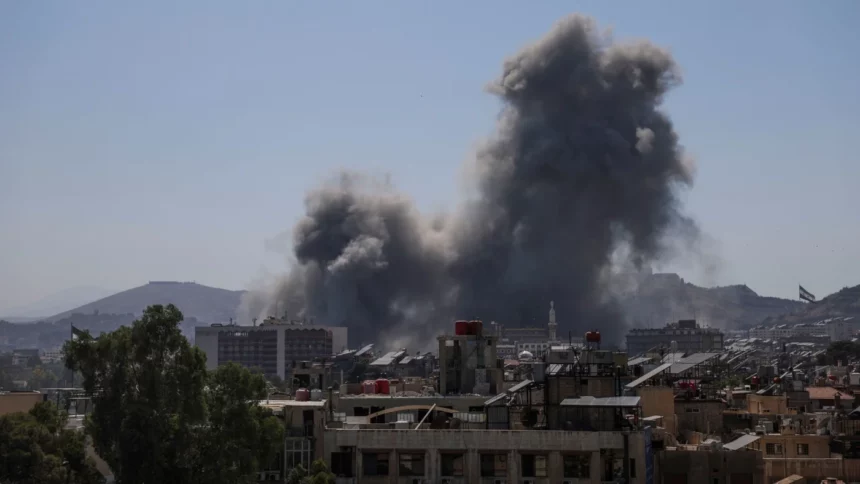
In a move highlighting deepening rifts between the US and Israel over Syria’s future, Israel has launched significant airstrikes on Damascus, including areas near the presidential palace and the defence ministry, defying the Donald Trump administration’s plan for a unified Syria backed by Gulf allies and Turkey. The strikes, framed by Israel as an effort to protect Syria’s Druze minority, risk undermining backchannel efforts between Israel, Syria, and Gulf states, while revealing diverging strategies between Washington and Tel Aviv on managing Syria after years of conflict.
Israel’s Strategic Calculations in Syria
The airstrikes, which Israel justified as a response to requests from Druze communities, signal its intent to carve out zones of influence in Syria rather than support Washington’s vision of an integrated state. Sheikh Hikmat Salaman al-Hajri, a Druze leader seen as close to Israel, called for intervention, claiming the minority faced a “total war of extermination,” though other Druze leaders opposed Israeli involvement. US diplomats noted there was genuine pressure from Druze within Israel, but regardless of the reason, Israel’s strikes effectively establish its dominance in southern Syria, dictating Syrian military movements and redrawing informal boundaries.
While the Donald Trump administration has pushed for a reduction in US military presence in Syria, focusing instead on encouraging Gulf investment and Turkish involvement to stabilise the country under a central authority, Israel views Syria’s fractured state as an opportunity to secure its strategic interests. The US, aiming to support a unified Syria as a patchwork of diverse communities, sees stability as critical to the region, while Israel’s actions suggest it prefers a weakened neighbour with fragmented power centres.
Tensions Over Backchannel Diplomacy and Normalisation Efforts
The US has reportedly been involved in backchannel discussions with Syrian President Ahmed al-Sharaa, encouraging him to join the Abraham Accords and normalise ties with Israel, Qatar, Saudi Arabia, and Turkey. Envoy Tom Barrack emphasised the US preference for a single Syrian authority, rejecting the notion of separate Druze or Alawite states. Despite these efforts, Israel’s latest military actions demonstrate a reluctance to fully embrace Washington’s roadmap, with analysts arguing that for Israel, weakening Syria remains a priority over normalisation.
Following the removal of Bashar al-Assad, Syria has experienced continued sectarian violence, including attacks against Alawites and Christian communities, complicating US-led efforts for peace. While President Donald Trump has maintained a focus on lifting sanctions and encouraging Gulf investments to ease sectarian tensions, Israel’s strikes complicate these plans, potentially jeopardising the fragile progress made in regional talks.
The US had facilitated discussions for a deconfliction line between Israel and Turkey in Syria, aiming to avoid military clashes while maintaining stability, but Israel’s willingness to strike Damascus amid diplomatic talks signals its preference for military leverage over diplomatic patience. As Congressman Joe Wilson criticised the strikes as “suicidal for Israel,” regional diplomats fear that Israel’s aggressive posture may derail broader plans for regional normalisation and integration.
While Donald Trump has deferred direct comments on the strikes, his administration’s pivot towards diplomatic solutions, supported by Gulf allies, may face increasing challenges from Israel’s assertive military strategies in Syria, highlighting a significant policy divergence between the two allies over the region’s future.