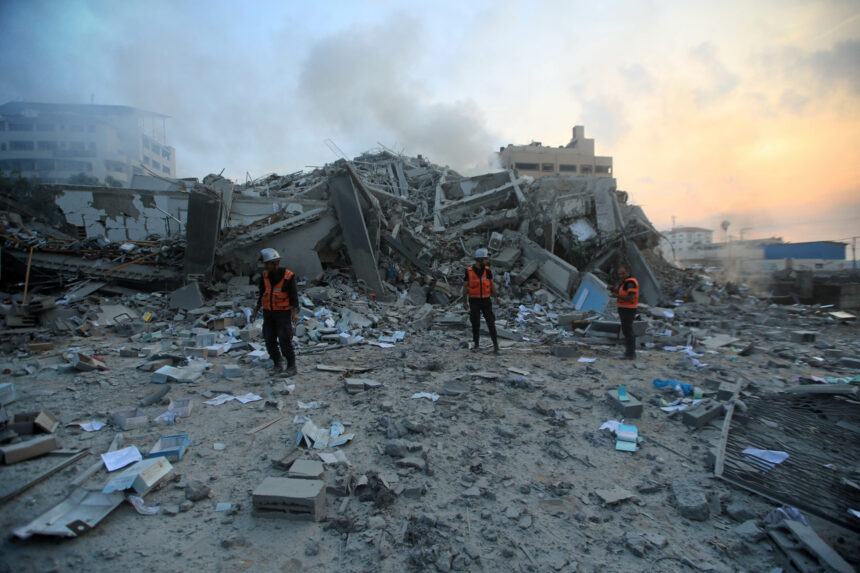
Israeli National Security Minister Itamar Ben Gvir has sparked global outrage by ordering giant posters of Gaza’s devastation to be displayed inside prisons housing Palestinian detainees. The move, presented as a warning to prisoners, highlights the increasingly aggressive and humiliating tactics deployed against Palestinians in Israeli custody since the war began in October 2023. Rights groups, international observers, and humanitarian organisations have warned that this act represents a chilling escalation in psychological warfare, with detainees now being forced to confront images of their destroyed homes and neighbourhoods while enduring worsening conditions of imprisonment.
A Political Gesture Turned into Psychological Warfare
The latest episode unfolded through a video released on Ben Gvir’s personal Telegram channel. In it, the far-right minister appears before towering images of Gaza reduced to rubble, gesturing proudly as if unveiling a trophy. Standing against the backdrop of flattened neighbourhoods and ruined lives, he declared that Palestinian prisoners must walk past these visuals during their daily exercise. According to his own claims, at least one prisoner even identified his own destroyed home among the wreckage.
The calculated symbolism of this act goes beyond simple intimidation. Ben Gvir has positioned himself as one of Israel’s most hardline politicians, often using public gestures to reinforce his nationalist and punitive credentials. By showcasing the destruction of Gaza inside prison facilities, he seeks to remind detainees of both their helplessness and the total power the Israeli state holds over their lives. In his words, these images serve as proof that “you don’t mess with the people of Israel.”
Human rights defenders argue this approach represents a deliberate form of psychological warfare, intended not only to humiliate but also to break the spirit of prisoners who already face some of the harshest detention conditions in the world. The imposition of such reminders of loss—homes, families, and entire neighbourhoods obliterated—strikes at the core of prisoners’ identities. For Palestinians, where land and memory form an essential link to community, the act of being forced to stare at that destruction daily amounts to a cruel and degrading punishment.
This display is not an isolated incident but part of an ongoing pattern of abuse under Ben Gvir’s watch. Only days earlier, another video surfaced of him visiting Marwan Barghouti, the most prominent Palestinian prisoner, issuing direct threats of obliteration against anyone who dares resist Israel. Such theatrics are designed not only for domestic audiences who support his policies but also as a message to Palestinians everywhere that the price of opposition is severe, extending from the battlefield to the prison cell.
Worsening Prison Conditions Amid Escalating War
According to the Palestinian prisoner support group Addameer, more than 10,000 Palestinians are currently held in Israeli prisons—more than double the number before Israel launched its military campaign in Gaza in October 2023. Testimonies from current and former detainees detail patterns of systemic abuse that have grown more severe since the war began. Accounts include starvation, beatings, sexual assault, and mass solitary confinement, often carried out in ways intended to strip prisoners of dignity and instill fear.
Human rights organisations emphasize that these practices, compounded by humiliating stunts such as the Gaza destruction posters, create an environment of constant psychological and physical torture. Families of prisoners, already reeling from the devastation back home, see their loved ones subjected to not only physical hardship but also deliberate psychological torment. Experts argue that this is part of a broader Israeli strategy to weaponize incarceration as an extension of its military campaign.
The United Nations, through its Office for the Coordination of Humanitarian Affairs (OCHA), has reported staggering levels of destruction in Gaza. According to satellite imagery and assessments from the UN Satellite Centre and UNHCR’s Shelter Cluster, Israel has destroyed or damaged 92 percent of Gaza’s housing units and 70 percent of all structures. This devastation has left 1.3 million of Gaza’s 2.2 million residents in urgent need of emergency shelter. Satellite images show cities such as Rafah and Khan Younis almost completely leveled, their once-bustling streets reduced to ghostly expanses of dust and concrete.
For prisoners forced to view this destruction on posters while confined behind bars, the images are not just abstract photographs but painful reminders of their vanished communities. Some detainees have allegedly identified their own houses in these posters, a fact Ben Gvir himself boasts about. For many, this compounds the trauma of displacement and loss already endured, adding layers of grief to an existence defined by captivity.
At the heart of these developments is Ben Gvir’s personal ideology. As a leader of Israel’s far-right movement, he has long advocated harsh measures against Palestinians. Critics describe his approach as rooted in humiliation and domination rather than security or justice. By imposing images of destruction on prisoners, he is enacting what many view as a form of collective punishment, prohibited under international law but increasingly normalized in Israel’s treatment of Palestinians.
International reaction has been swift but muted in impact. Human rights groups have condemned the move as cruel and degrading, pointing out that it exemplifies Israel’s disregard for international humanitarian law. Yet, despite strong words from NGOs and UN bodies, tangible consequences for Israel remain elusive. This sense of impunity emboldens figures like Ben Gvir to escalate their tactics without fear of accountability.
The wider context of these actions underscores their cruelty. Gaza’s population has been reduced to a state of humanitarian emergency, with nearly all infrastructure destroyed and essential services collapsing. To transform this collective suffering into prison propaganda strips away the last vestiges of humanity from those caught in Israel’s detention system. It sends the chilling message that not even imprisonment shields Palestinians from the reach of destruction.