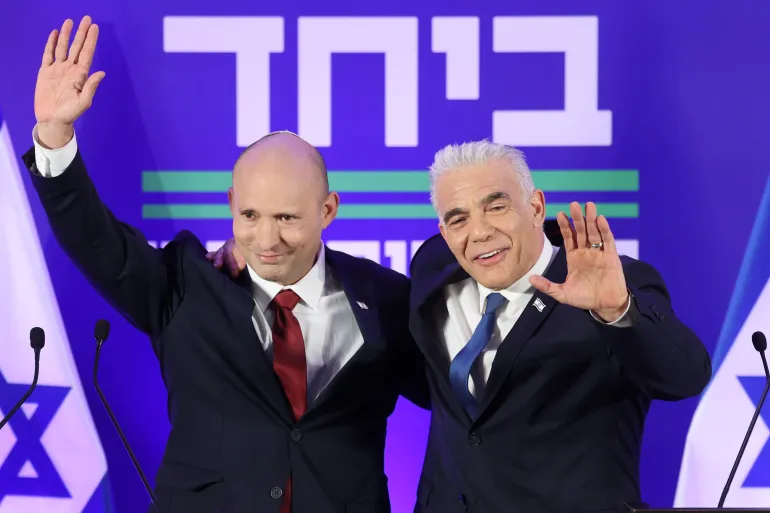
Two of Israeli Prime Minister Benjamin Netanyahu’s most prominent political rivals have announced a strategic alliance in a bid to unseat his government in the upcoming national elections scheduled for October 2026. The move marks a significant development in Israel’s political landscape, as opposition forces attempt to consolidate their strength against a long-standing and deeply entrenched leadership.
Former prime ministers Naftali Bennett and Yair Lapid revealed that their respective parties will merge to form a new political entity called “Together.” The announcement was made during a joint press conference in Herzliya, signaling a renewed effort to unify a fragmented opposition that has struggled to present a cohesive challenge to Netanyahu in recent years.
The alliance is rooted in a shared objective rather than ideological alignment. Bennett, known for his right-wing stance, and Lapid, a centrist leader, have historically represented different segments of Israeli society. However, both leaders have been vocal critics of Netanyahu’s governance, particularly in the aftermath of the October 2023 Hamas-led attack and the subsequent conflicts in the region. Their collaboration reflects a strategic decision to prioritize political change over ideological differences.
Bennett, who will lead the newly formed party, described the alliance as a decisive and patriotic step aimed at reshaping Israel’s future. He emphasized the need to overcome internal divisions within the opposition and focus on winning the upcoming elections. Lapid echoed this sentiment, highlighting the importance of trust and cooperation despite differing political views. He noted that unity among opposition forces is essential to present a credible alternative to the current government.
This is not the first time Bennett and Lapid have joined forces. In 2021, their alliance played a crucial role in ending Netanyahu’s 12-year tenure, leading to the formation of a coalition government. However, that government lasted only 18 months, reflecting the challenges of maintaining unity among diverse political factions. The new alliance seeks to learn from past experiences and build a more stable and effective coalition.
Netanyahu, Israel’s longest-serving prime minister, returned to power in 2022 and currently leads one of the most right-wing governments in the country’s history. His leadership has been both influential and controversial, with strong support from certain segments of the population and significant opposition from others. The political environment has become increasingly polarized, making the upcoming elections particularly significant.
Recent opinion polls suggest a competitive race between Netanyahu and Bennett. Surveys indicate that Bennett’s political base is gaining traction, positioning him as a leading contender against the incumbent prime minister. Lapid’s party, while experiencing a decline in seat projections, still plays a crucial role in consolidating opposition support.
One of the key issues shaping the election narrative is the handling of national security and military conflicts. The October 2023 attack and subsequent military responses have had a profound impact on public perception. Critics argue that the government’s response exposed vulnerabilities and raised questions about strategic decision-making. Bennett has pledged to establish a national commission of inquiry into the events leading up to the attack, a move that has not been supported by the current administration.
Lapid has also been critical of recent diplomatic and military decisions, including ceasefire agreements and broader regional strategies. He has described certain policies as detrimental to Israel’s long-term interests, emphasizing the need for a more balanced and effective approach.
The alliance between Bennett and Lapid also reflects broader societal dynamics within Israel. Lapid has positioned himself as a representative of the secular middle class, advocating for policies that address economic and social concerns. Issues such as taxation, military service, and social equity have become central to his political agenda. Bennett, on the other hand, brings a background that combines military experience and business leadership, appealing to voters seeking strong security credentials and economic expertise.
The formation of the “Together” party is expected to reshape the electoral landscape by consolidating opposition votes and reducing fragmentation. In previous elections, multiple opposition parties often divided the vote, making it easier for Netanyahu’s coalition to maintain power. By uniting under a single banner, Bennett and Lapid aim to create a more cohesive and competitive opposition.
However, challenges remain. The ideological differences between the two leaders and their supporters could pose difficulties in maintaining unity, particularly when addressing policy decisions. Additionally, Netanyahu’s political experience and established support base make him a formidable opponent.
The upcoming elections are also taking place against a backdrop of broader regional tensions and global geopolitical shifts. Israel’s relationships with neighboring countries, ongoing conflicts, and international alliances will all play a role in shaping voter sentiment. Economic factors, including inflation and cost of living, are also expected to influence the election outcome.
The alliance’s success will depend on its ability to present a clear and compelling vision for the future. Voters will be looking for leadership that can address both immediate challenges and long-term goals. The ability to build trust, maintain unity, and effectively communicate policies will be critical factors in determining the outcome.
As the election approaches, political campaigning is expected to intensify, with both sides seeking to mobilize their support bases. The Bennett-Lapid alliance represents a significant attempt to alter the balance of power in Israeli politics, setting the stage for a highly competitive and closely watched election.
In conclusion, the decision by Naftali Bennett and Yair Lapid to join forces marks a pivotal moment in Israel’s political landscape. By forming the “Together” party, they aim to unify the opposition and challenge the leadership of Benjamin Netanyahu. The upcoming elections will not only determine the future of Israel’s government but also reflect broader societal and political dynamics shaping the country.