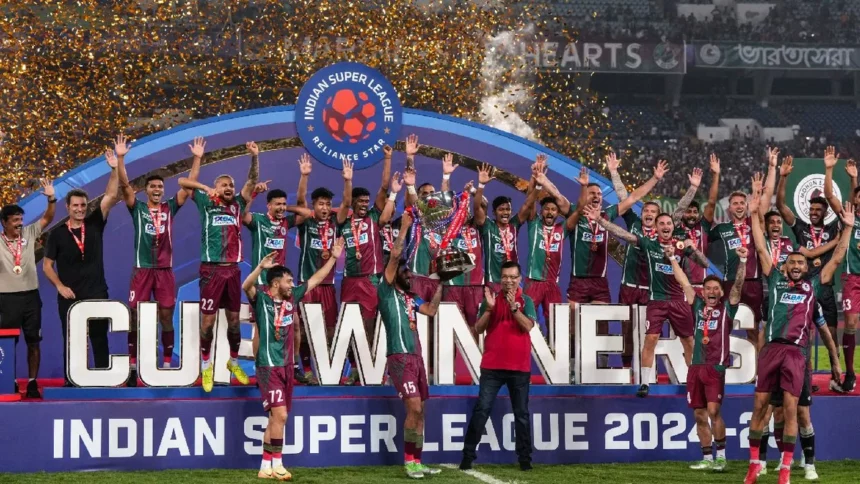
Indian football has received a long-awaited boost with the announcement that the Indian Super League 2025–26 season will begin on February 14, bringing an end to months of uncertainty that had cast a shadow over the sport. The decision was formally announced by Union Sports Minister Mansukh Mandaviya following a high-level meeting involving the government, the All India Football Federation, and representatives of participating clubs in New Delhi on January 6. For players, clubs, fans, and administrators alike, the confirmation of dates signals a decisive step forward after a prolonged deadlock that threatened to disrupt the entire domestic football calendar and undermine confidence in the country’s top-tier league.
The 2025–26 edition of the Indian Super League will feature 14 clubs and will be played in a single-leg home-and-away format, comprising a total of 91 matches. Traditionally held in the September window, the league’s delayed start was the result of unresolved commercial and structural issues, particularly the absence of a confirmed commercial partner after the expiry of key agreements. With the new timeline now set, Indian football stakeholders are hopeful that stability can be restored and that the focus can shift back to on-field performance and long-term development.
Isl format, participating clubs, and restructuring of domestic competitions
According to the announcement, all 14 ISL clubs have agreed to participate in the upcoming season, putting an end to speculation about possible withdrawals. Among the clubs whose representatives attended the meeting were storied rivals Mohun Bagan and East Bengal, along with Mumbai City FC, Mohammedan SC, Kerala Blasters, FC Goa, Inter Kashi FC, Chennaiyin FC, SC Delhi, Bengaluru FC, Odisha FC, NorthEast United FC, and Jamshedpur FC. The inclusion of these teams ensures continuity in the league’s competitive structure and preserves the regional diversity that has become a hallmark of the ISL.
The tournament will follow a single-leg home-and-away format, meaning each team will face every other team once at home and once away, creating a balanced schedule that rewards consistency and adaptability. With 91 matches scheduled, the league promises a packed calendar that will test squad depth and tactical flexibility. Detailed fixtures and scheduling logistics are expected to be finalised and announced separately, but the confirmation of the overall structure has already been welcomed as a sign of clarity returning to Indian football.
Alongside the ISL, the I-League will also resume after its own pause, albeit in a shortened format. The I-League will feature all 11 participating clubs and will be limited to 55 matches during the season. In a significant structural change, I-League Division 1 and Division 2 have been merged, resulting in a competition that will involve 40 teams divided into five zones. This restructuring is aimed at streamlining the domestic pyramid and reducing operational complexity while still providing competitive opportunities across regions.
The women’s game has also been factored into the revised calendar. Both Division 1 and Division 2 of the Indian Women’s League will be conducted, ensuring continuity for women footballers and reinforcing the federation’s stated commitment to developing the women’s football ecosystem alongside the men’s competitions.
funding model, aiif intervention, and resolution of the isl deadlock
One of the most critical aspects of the announcement relates to funding, which lay at the heart of the ISL impasse. The league had been put on hold primarily because of uncertainty surrounding the renewal of the Master Rights Agreement between the AIFF and Football Sports Development Limited, the former commercial operator of the ISL. The agreement expired on December 8, and subsequent efforts to float the league’s commercial rights failed to attract bidders, leaving the competition without a revenue partner and threatening its viability.
To break the deadlock, the AIFF stepped in with a direct financial commitment. AIFF president Kalyan Chaubey announced that the federation would fund both the ISL and the I-League until a commercial partner is secured. A central pool of ₹25 crore has been created exclusively for the conduct of the ISL. Under the original plan, 10 percent of this amount was to be contributed by the AIFF and 30 percent by a commercial partner. In the absence of such a partner, the federation has agreed to cover that shortfall.
As a result, the AIFF will contribute approximately ₹14 crore towards the ISL and about ₹3.2 crore towards the I-League for the interim period. In addition, the federation will provide 100 percent funding for the Indian Women’s League, underscoring an effort to protect the women’s competition from the financial uncertainty that affected the men’s leagues. Chaubey also revealed that a Governing Council Board would be formed to manage the leagues in the future, with the authority to take all commercial decisions, a move intended to professionalise governance and reduce the risk of similar disruptions.
The announcement comes just days after Indian and foreign players competing in the ISL publicly appealed to FIFA to intervene and help resolve the crisis. Prominent Indian footballers such as Sunil Chhetri, Sandesh Jhingan, and Gurpreet Singh Sandhu were among those who featured in a video highlighting the uncertainty faced by players due to the league’s suspension. Their appeal drew attention to contractual insecurity, training disruptions, and the broader impact on careers, adding urgency to the need for a resolution.
By confirming the ISL start date and committing financial resources, the government and the AIFF have sought to reassure stakeholders that Indian football will not be allowed to drift. The intervention reflects a recognition of the ISL’s role not just as a professional league but as the backbone of the national football structure, influencing youth development, national team preparation, and the sport’s commercial visibility.
While challenges remain, particularly in securing a sustainable long-term commercial partner and rebuilding confidence among investors and sponsors, the February 14 kickoff date represents a turning point. For clubs, it provides a fixed horizon around which to plan logistics, player contracts, and pre-season preparations. For fans, it restores anticipation and continuity after months of uncertainty. And for Indian football as a whole, it offers a chance to reset, stabilise, and move forward after a period that tested the resilience of the sport’s institutions.