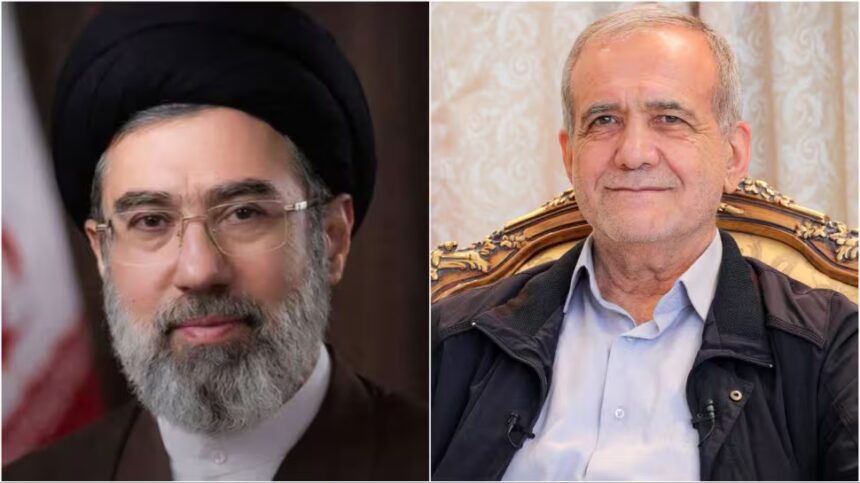
Iran is witnessing growing uncertainty and internal tensions as reports claim that the Islamic Revolutionary Guard Corps (IRGC) has significantly expanded its control over state affairs. According to emerging reports, a power struggle is unfolding between the IRGC and President Masoud Pezeshkian, raising serious questions about who truly governs the country during a time of conflict.
The situation has drawn international attention, especially after Donald Trump stated that discussions were underway to ease tensions between the United States and Iran. However, Iranian officials quickly dismissed these claims, insisting that no such talks were taking place. The contradiction has further fueled speculation about internal divisions within Iran’s leadership and the actual chain of command.
Power struggle intensifies as IRGC overrides presidential authority
At the center of the crisis is an apparent clash between civilian leadership and military influence. Reports suggest that President Pezeshkian has been unable to exercise full authority, with the IRGC increasingly intervening in key decisions. One major flashpoint reportedly occurred when the president attempted to appoint a new intelligence minister, only for the move to be blocked by IRGC leadership.
The IRGC, now reportedly led by Ahmad Vahidi, has argued that wartime conditions require centralized control over sensitive appointments. This marks a significant shift from Iran’s usual governance structure, where such decisions are typically finalized with the approval of the Supreme Leader.
Meanwhile, confusion continues over the leadership at the highest level. Following reports of the death of Ali Khamenei during the early phase of the conflict, his son Mojtaba Khamenei was reportedly elevated to the position of Supreme Leader. However, his absence from public view and lack of direct communication have deepened uncertainty about his status and authority.
Military council and strategic control signal growing IRGC dominance
Sources cited in reports indicate that a “military council” composed of senior IRGC officials is now taking day-to-day decisions, effectively sidelining the elected government. There are also claims that President Pezeshkian has been unable to meet Mojtaba Khamenei despite repeated attempts, suggesting restricted access to the country’s top leadership.
The IRGC’s expanding role is not entirely new, but the current developments point to an unprecedented level of control. Originally established after the Iranian Revolution as a paramilitary force, the IRGC has grown into a powerful institution with influence across military, political, and economic sectors.
Its reach now reportedly extends to critical infrastructure and strategic assets, including oversight of the Strait of Hormuz, one of the world’s most important oil transit routes. Control over such a vital corridor further strengthens the IRGC’s position, both domestically and globally.
Amid these developments, speculation about Mojtaba Khamenei’s condition continues to circulate, with unverified claims ranging from serious illness to death. Comments from figures like Pete Hegseth have added to the uncertainty, though no official confirmation has emerged.
The evolving situation suggests a deepening power vacuum within Iran, where military authority appears to be overshadowing civilian governance, potentially reshaping the country’s political structure in the midst of ongoing conflict.