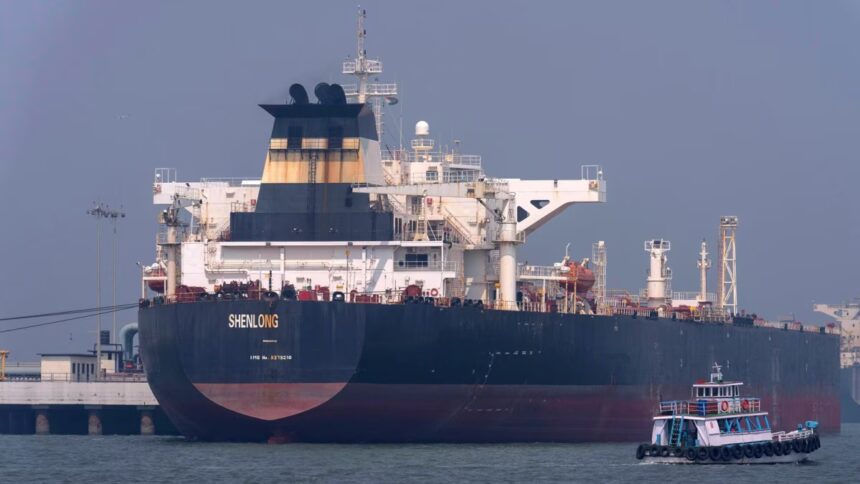
Iraq has announced steep discounts on crude oil exports amid the ongoing Hormuz Strait crisis, creating a major opportunity for large buyers like India despite rising geopolitical risks in the Gulf region.
Amid escalating tensions in the Middle East and severe disruption in global maritime oil trade routes, Iraq has introduced one of the biggest crude oil discounts seen in recent years in an attempt to sustain exports during the ongoing crisis surrounding the Strait of Hormuz. The move is expected to attract major oil-importing countries, particularly India, which remains one of Iraq’s largest crude oil customers.
According to reports, Iraq’s state-owned oil marketing company State Oil Marketing Organization, commonly known as SOMO, is offering discounts of up to 33.40 US dollars per barrel on its Basra Medium crude for buyers willing to load shipments during May 2026.
The aggressive pricing strategy comes at a time when the Gulf region is facing extraordinary instability following the intensifying conflict involving Iran, the United States, and Israel. The ongoing security crisis has severely disrupted commercial shipping movement through the strategically critical Strait of Hormuz, one of the world’s most important energy transportation corridors.
The Strait of Hormuz connects the Persian Gulf to the Gulf of Oman and serves as a major route for global oil exports. Approximately 20 to 30 percent of the world’s crude oil supply normally passes through this narrow maritime channel every day.
However, since the escalation of the US-Iran conflict earlier this year, the region has become increasingly dangerous for oil tankers. Military threats, rising insurance costs, fears of attacks on commercial vessels, and operational uncertainty have dramatically reduced tanker movement through the corridor.
As a result, Iraq’s oil export system has come under severe pressure.
According to ship-tracking data cited in reports, only two oil tankers loaded crude from Iraq’s southern Basra export terminal during April 2026. In March, the number stood at twelve, while under normal conditions approximately eighty tankers load oil from Basra each month.
The dramatic collapse in export activity has reportedly caused Iraq’s storage infrastructure to fill rapidly, forcing authorities to aggressively cut prices in order to attract buyers willing to take the risk of operating through the conflict-affected Gulf waters.
Under the latest pricing structure announced by SOMO, Basra Medium crude is being offered at an extraordinary discount of 33.40 dollars per barrel for shipments loaded between May 1 and May 10.
After May 11, the discount will reportedly reduce slightly to around 26 dollars per barrel, though this still represents a highly attractive pricing offer compared to prevailing international oil benchmarks.
At the same time, Iraq’s Basra Heavy crude has reportedly been offered at discounts approaching 30 dollars below official prices.
Industry analysts say such deep discounts are extremely rare in global oil markets and reflect the extraordinary circumstances facing Gulf exporters during the current crisis.
Despite the attractive pricing, the risks associated with these shipments remain exceptionally high.
According to notices issued by SOMO, buyers accepting these cargoes will not be allowed to invoke “force majeure” clauses in case of unforeseen events linked to regional instability. In international trade, force majeure provisions typically allow contractual obligations to be suspended during emergencies such as war, natural disasters, or political disruptions.
By removing this protection, Iraq has effectively shifted all operational and security risks onto buyers.
The notices reportedly state that all purchasers are already aware of the extraordinary geopolitical conditions in the Gulf and therefore cannot later cancel agreements or seek compensation due to conflict-related disruptions.
This means any attack on vessels, shipment delays, insurance complications, or maritime security incidents would become entirely the responsibility of the buyer.
The unusually tough contractual conditions underline the severity of the situation currently unfolding around the Strait of Hormuz.
In addition to Basra crude, traders also revealed that SOMO recently issued spot tenders for Kayyarah crude, another Iraqi oil grade. Similar to Basra shipments, tankers transporting Kayyarah crude would also need to navigate deep into the Persian Gulf, increasing operational risk considerably.
So far, SOMO has not officially commented publicly regarding the broader export strategy or future pricing plans.
For India, however, the developments could create both opportunity and concern.
India remains one of the world’s largest crude oil importers and Iraq has consistently ranked among its top suppliers. According to data from energy analytics firm Kepler, Iraq was India’s third-largest oil supplier in February 2026.
Russia remained India’s largest supplier, delivering approximately 1.042 million barrels per day, followed closely by Saudi Arabia with around 1.009 million barrels daily.
Iraq supplied approximately 0.981 million barrels per day during the same period, making it one of India’s most important energy partners.
Other suppliers to India included the United Arab Emirates, United States, and Nigeria.
India’s total crude oil imports during February reportedly stood at nearly 106 million barrels.
Given India’s enormous energy requirements and price-sensitive import strategy, the discounted Iraqi crude could become highly attractive for Indian refiners despite the geopolitical risks associated with Gulf shipping routes.
Indian refiners have historically shown flexibility in sourcing discounted crude from regions facing geopolitical challenges, particularly when price advantages are significant enough to offset logistical complications.
However, experts caution that operating through the Strait of Hormuz during the present conflict environment involves considerable uncertainty.
Shipping insurance premiums for vessels operating near the Persian Gulf have risen sharply in recent months. Maritime security concerns have also increased operational costs for tanker companies, with many shipping firms reportedly reluctant to send vessels into conflict-prone waters without substantial financial incentives.
This explains why Iraq has been forced to offer unusually deep price cuts to sustain export volumes.
The broader implications for global oil markets are also substantial.
The Gulf region remains central to international energy supply. Any prolonged disruption in Hormuz shipping routes could trigger volatility in global crude prices, supply shortages, and inflationary pressure across multiple economies.
Even though Iraq is discounting oil heavily, the wider conflict has already caused nervousness among energy traders due to fears that further escalation could reduce overall regional production and transportation capacity.
Energy economists say the situation illustrates the fragile balance between geopolitical instability and global energy security.
While importers like India may temporarily benefit from cheaper Iraqi crude, the long-term risks associated with regional conflict remain serious. If tensions escalate further or Hormuz traffic becomes completely blocked, oil prices could surge globally despite current discounts.
The situation also highlights India’s ongoing challenge of balancing affordable energy procurement with strategic energy security.
India imports a majority of its crude oil requirements from overseas, making it highly vulnerable to external geopolitical shocks. Gulf instability therefore has immediate implications for domestic fuel prices, inflation, transportation costs, and industrial production.
In recent years, India has attempted to diversify its import basket by increasing purchases from Russia, the United States, and African suppliers. However, Middle Eastern oil continues to remain critically important due to geographical proximity, refinery compatibility, and long-established trade relationships.
For Iraq, the current export strategy represents an attempt to maintain revenue flow during one of the most difficult operating environments the Gulf energy sector has faced in years.
Oil revenues remain the backbone of Iraq’s economy and government finances. Prolonged export disruptions could severely damage public finances, economic stability, and state spending capacity within the country.
The discount-driven sales strategy therefore reflects both economic necessity and geopolitical pressure.
As military tensions continue around the Gulf region, the future of oil trade through the Strait of Hormuz remains uncertain. Governments, refiners, shipping companies, and energy traders across the world are closely monitoring developments due to the enormous consequences any prolonged disruption could have for global markets.
For now, Iraq’s discounted crude presents a rare opportunity for risk-tolerant buyers. But behind the attractive pricing lies one of the most volatile and dangerous energy trading environments seen in recent years.