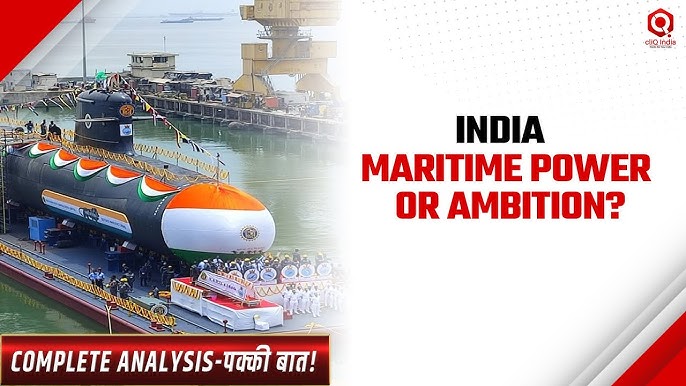
In a recent statement, Prime Minister Narendra Modi expressed his aspirations for India to emerge as a major maritime power, citing advancements like the induction of INS Surat, Nilgiri-class frigates, and INS Vaghsheer as key developments in this vision. But the question arises: is India truly on the cusp of becoming a maritime superpower, or is this an ambitious goal facing significant hurdles?
Strategic Location and Geopolitical Dynamics
India’s geographical position makes it a critical player in the Indian Ocean Region (IOR), a hub for nearly 80% of global maritime oil trade. With strategic chokepoints like the Malacca Strait and Hormuz Strait under its influence, India’s role in maintaining regional security has grown. Through multilateral alliances like QUAD and strategic developments at Chabahar Port (Iran) and Duqm Port (Oman), India has worked to secure its maritime interests.
However, challenges persist. China’s Belt and Road Initiative and its stronghold over ports like Gwadar (Pakistan) and Hambantota (Sri Lanka) present stiff competition, raising concerns about India’s ability to counter Beijing’s growing influence.
Modernization and Technological Advancements
India’s naval modernization is gaining momentum, with significant achievements under the Atmanirbhar Bharat initiative. The INS Surat stealth destroyer, Nilgiri-class frigates, and the INS Vikrant—India’s first indigenous aircraft carrier—are prime examples of the country’s push for self-reliance. Furthermore, technological advancements such as the BrahMos missile systems and drones have bolstered India’s maritime capabilities.
Yet, despite these strides, India’s naval fleet remains limited compared to China’s 355+ ships. Additionally, gaps in cyber capabilities and budgetary constraints—only 15-18% of the defence budget is allocated to naval modernization—hinder rapid progress.
Economic Pillar: The Role of Maritime Trade
India’s economy heavily relies on maritime trade, which accounts for 95% of the country’s trade volume. The Sagarmala Project, aimed at modernizing ports and improving coastal connectivity, is a cornerstone of India’s maritime economic strategy. By 2030, the project aims to expand port capacity to 800 million tonnes and promote the blue economy through fisheries, offshore energy, and coastal tourism.
However, achieving these goals will require sustained investment and efficient execution, areas where challenges often emerge.
Diplomacy and Alliances
India’s growing diplomatic and military alliances have enhanced its maritime influence. Naval exercises like Malabar and Varuna, as well as the Andaman and Nicobar Command’s strategic positioning, showcase India’s commitment to Indo-Pacific security. Collaborative projects with Mauritius and Seychelles further strengthen India’s presence in the region. However, China’s naval base in Djibouti and increasing African coastal investments remain obstacles to India’s dominance.
Reality Check: Challenges to Overcome
Despite progress, India’s naval fleet size, budget constraints, and manpower gaps pose significant challenges. With China’s larger fleet and advanced investments in maritime infrastructure, India needs consistent investment in technology, infrastructure, and training to achieve its maritime power vision.
The Road Ahead
While India’s ambitions are grounded in a strategic vision, the journey to maritime dominance is fraught with challenges. To truly become a major maritime power, India must address fleet limitations, bolster budget allocations, and deepen global partnerships.
India stands at a pivotal point in its maritime journey. Whether it emerges as a maritime superpower or remains an ambitious contender depends on its ability to navigate these challenges. As the nation progresses, the global maritime landscape will closely watch India’s next moves.
Watch full video here: https://youtu.be/OwwDV_fPovU