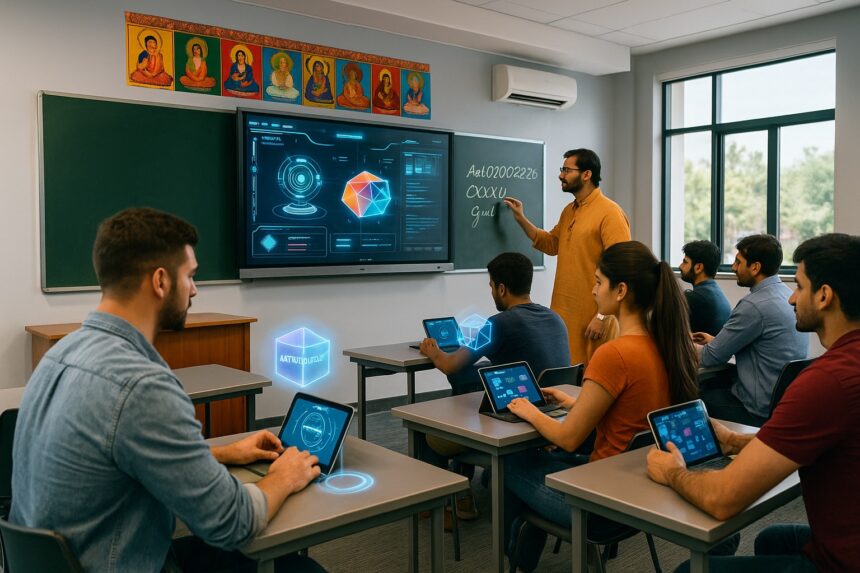
Artificial Intelligence is no longer a distant concept in Indian higher education; it has rapidly become central to transforming teaching, learning, and administrative operations across colleges and universities. According to the EY-Parthenon–FICCI report, “Future-Ready Campuses: Unlocking the Power of AI in Higher Education,” over 60 per cent of higher education institutions (HEIs) in India now permit the use of AI tools, signaling a major shift from experimental adoption to systematic integration. The study, based on a survey of 30 leading HEIs, highlights how AI is shaping curriculum design, student engagement, automated assessment, and campus-wide operational efficiency. As educational institutions increasingly rely on AI-driven solutions, the report identifies both the immense potential and the governance challenges accompanying this technological transition, emphasizing the importance of balancing innovation with ethical, responsible usage.
Integration of AI in Teaching, Learning, and Campus Operations
The adoption of AI in Indian higher education is moving beyond pilot projects and experimental trials. The report shows that 40 per cent of HEIs have implemented AI-powered tutoring systems and chatbots to support students in real time, offering personalized guidance and instant assistance. Similarly, 39 per cent of institutions have introduced adaptive learning platforms, allowing students to learn at their own pace while teachers gain insights into progress and knowledge gaps. Automated grading systems, now deployed by 38 per cent of surveyed institutions, are streamlining evaluation processes, reducing administrative burdens, and providing more consistent, objective assessments. Collectively, these technologies are enabling Indian colleges and universities to create AI-enabled knowledge ecosystems that enhance the quality and efficiency of both teaching and learning.
Generative AI tools have emerged as a key asset for faculty, assisting in the development of course materials, lesson plans, and interactive learning modules. By automating certain aspects of content creation, these tools free educators to focus on designing meaningful educational experiences rather than spending excessive time on routine material preparation. Chatbots and virtual assistants, on the other hand, provide students with on-demand support for course queries, assignment guidance, and administrative questions. This dual use of AI—supporting both instructors and learners—marks a fundamental shift in the classroom experience, making learning more interactive, responsive, and personalized.
AI’s integration extends beyond the classroom into broader campus operations. Institutions are leveraging AI for plagiarism detection, monitoring academic integrity, and ensuring fair grading practices. Administrative departments are using AI to manage scheduling, optimize resource allocation, and streamline student services. By embedding AI across teaching, evaluation, and operational functions, Indian HEIs are creating digitally advanced campuses capable of scaling efficiency while maintaining quality standards.
However, the report also underscores the necessity of implementing strong governance frameworks to manage AI adoption responsibly. With over 56 per cent of institutions already establishing AI-related policies, India is laying the regulatory groundwork to ensure ethical deployment, accountability, and the mitigation of risks such as algorithmic bias, data misuse, and over-reliance on technology. The report emphasizes that AI should enhance human learning rather than replace critical thinking, creativity, and engagement, reinforcing the principle that technological tools must complement—not substitute—the educational process.
AI Literacy, Challenges, and the Future of Indian Higher Education
The report highlights that embedding AI literacy across disciplines is essential for preparing students for an increasingly AI-driven world. Whether in humanities, business, or sciences, students must develop foundational knowledge in AI concepts, ethical considerations, and practical applications. The integration of AI literacy fosters critical thinking, digital competence, and awareness of data privacy, algorithmic fairness, and responsible use. STEM programs, in particular, are incorporating advanced topics such as machine learning, natural language processing, and robotics into their core curriculum, equipping graduates not only to use AI tools but also to innovate and create AI-driven solutions.
Despite the progress, challenges remain. Faculty readiness and digital infrastructure are cited as critical bottlenecks in scaling AI adoption across campuses. Institutions must invest in faculty training programs that build both technical proficiency and pedagogical strategies for AI-enabled teaching. Infrastructure improvements, including high-speed connectivity, cloud computing resources, and AI platforms, are essential to fully realize the potential of AI across large, diverse student populations. Additionally, institutions need coherent governance models that establish standards, protocols, and accountability measures for AI usage, ensuring that ethical and operational considerations are maintained alongside technological adoption.
According to Avantika Tomar, Partner and Education Sector Leader at EY-Parthenon India, India must “move beyond experimentation to scale,” integrating AI comprehensively across teaching, learning, and administrative functions. Achieving this will require a combination of robust faculty training, digital infrastructure investment, and curriculum redesign that embeds AI literacy in all academic disciplines. These measures, Tomar asserts, will position India as a global leader in AI-driven education, fostering a generation of graduates who are not merely consumers of AI but creators, innovators, and ethical practitioners of this transformative technology.
The integration of AI in Indian higher education also carries implications for maintaining the balance between innovation and integrity. While AI tools can streamline grading, content creation, and student support, institutions must guard against over-reliance on automated systems. Human oversight remains critical to ensure that AI enhances rather than replaces critical pedagogical judgment, creativity, and mentorship. By combining technological capabilities with skilled faculty guidance, HEIs can create hybrid educational environments where AI amplifies human expertise, supports personalized learning, and fosters equitable access to knowledge for all students.
The EY-Parthenon–FICCI report emphasizes that Indian higher education is on the cusp of a transformative era. With AI integration gaining momentum, colleges and universities are poised to redefine the student experience, enhance faculty effectiveness, and optimize institutional operations. Generative AI, chatbots, adaptive platforms, and automated assessment tools collectively contribute to an ecosystem where learning is personalized, interactive, and data-driven. Institutions that successfully implement these tools, supported by governance frameworks and faculty development, will set benchmarks for global best practices in AI-enabled education.
As Indian HEIs expand AI usage, the focus will increasingly shift to fostering AI creativity and innovation. Students trained in AI literacy and equipped with practical, hands-on experience will be capable of designing algorithms, developing intelligent systems, and leveraging AI for societal and industrial applications. The report underscores that such skills are critical for maintaining India’s competitive edge in the global knowledge economy, ensuring that graduates are not just proficient users but pioneers in AI-driven innovation.
The future of AI in higher education will depend on striking a delicate balance: leveraging technology to enhance learning while preserving academic integrity, critical thinking, and ethical standards. Institutions must cultivate an environment where AI supports both operational efficiency and educational excellence, empowering faculty, students, and administrators to collaborate effectively within AI-enabled knowledge ecosystems. This approach will ensure that the benefits of AI are maximized while risks are mitigated, promoting equitable access to educational opportunities across diverse institutions.
The report also identifies the broader societal impact of AI in education. By equipping students with AI knowledge, India is preparing a workforce capable of contributing to AI innovation across industries, research, and governance. Universities and colleges become incubators of AI talent, driving technological adoption, research breakthroughs, and ethical AI practices that extend beyond the campus. In doing so, Indian HEIs are playing a pivotal role in shaping the country’s future as a global hub for AI-enabled education, research, and industry collaboration.
The integration of AI into Indian higher education represents a paradigm shift from experimentation to systemic adoption. By leveraging AI tools for teaching, learning, assessment, and administrative operations, HEIs are creating technologically advanced, interactive, and personalized campuses. The success of this transformation depends on faculty readiness, digital infrastructure, governance frameworks, and AI literacy embedded across disciplines. As India continues on this path, its higher education system is poised to become a model of AI-driven innovation, producing graduates who are not only proficient users of AI but also ethical creators and innovators, positioning the country at the forefront of global AI-enabled knowledge ecosystems.