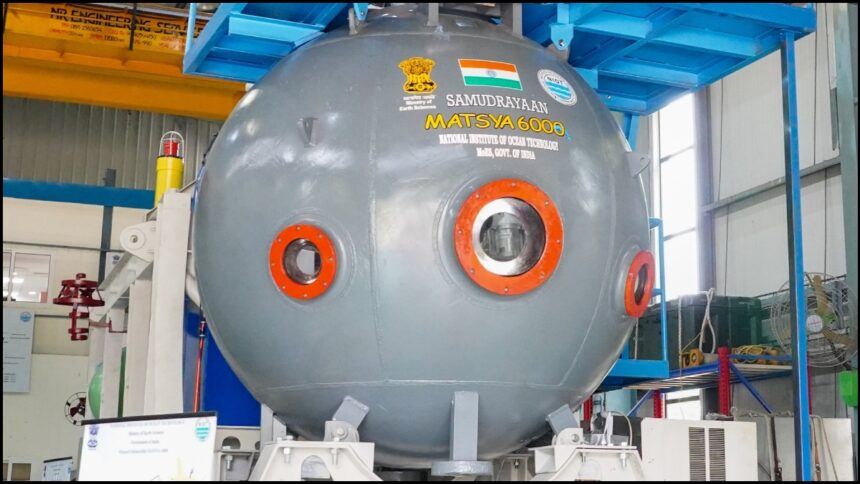
India is set to achieve a major milestone in deep-sea exploration with the launch of its first manned submersible, Matsya 6000, by 2026. The ambitious project, part of the Deep Ocean Mission, aims to send three crew members to a depth of 6,000 metres beneath the ocean’s surface, marking a significant advancement in underwater research and mineral exploration.
Union Minister of State (Independent Charge) for Science and Technology and Earth Sciences Jitendra Singh, in a written reply to the Rajya Sabha, confirmed the expected timeline for the realisation of Matsya 6000. He highlighted that the mission will play a crucial role in exploring ocean biodiversity, conducting deep-sea surveys, and assessing mineral resources using state-of-the-art scientific sensors.
The development of Matsya 6000 is expected to significantly enhance India’s capabilities in deep-sea exploration and foster the development of advanced manned underwater vehicles. The project will also contribute to the sustainable utilisation of deep-sea resources, including both living and non-living elements. Additionally, the mission will lead to significant innovations in underwater engineering, asset inspection technologies, and the promotion of ocean literacy.
At the heart of Matsya 6000 is a 2.1-metre internal diameter Titanium alloy personnel sphere, designed in collaboration with ISRO, to ensure the safe journey of human occupants to the extreme depths of the ocean. This advanced submersible will be equipped with high-end subsystems, including a buoyancy management system, power and control mechanisms, maneuvering propellers, subsea intervention manipulators, navigation and positioning devices, data and voice communication systems, onboard energy storage batteries, and emergency support features.
Designed for continuous operation at a depth of 6,000 metres for up to 12 hours, Matsya 6000 will also be equipped with an emergency endurance capability of up to 96 hours, ensuring the safety of the crew in case of unforeseen circumstances. A Human Support and Safety System has been developed to facilitate crew acclimatisation and provide essential support during routine and emergency operations.
India’s Deep Ocean Mission represents a bold step towards unlocking the mysteries of the deep sea and positioning the country at the forefront of underwater exploration. With the successful launch of Matsya 6000, India is poised to make substantial progress in the fields of deep-sea mining, ocean biodiversity research, and technological advancements in submersible vehicle development.