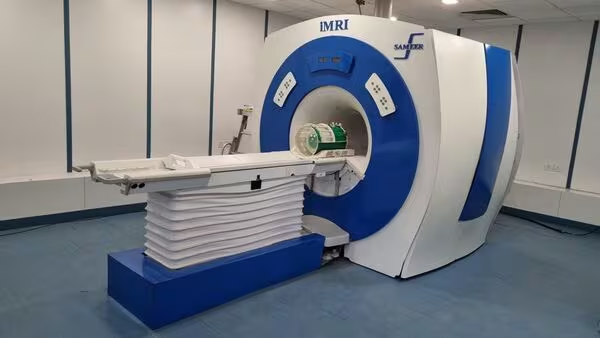
India is on the verge of a significant breakthrough in medical technology with the development of its first indigenous Magnetic Resonance Imaging (MRI) machine. Aimed at reducing the cost of MRI scans by over 30%, this initiative will not only make advanced imaging more affordable but also reduce India’s dependency on imported machines, which currently account for 80-85% of the market. The machine, a result of years of research and collaboration between premier institutions, is expected to be commercially available by June 2026, with clinical trials set to begin soon.
The idea for this project was first proposed eight years ago during an internal meeting at the Ministry of Electronics and Information Technology (MeitY). SAMEER (Society for Applied Microwave Electronics Engineering and Research), an autonomous R&D institute under MeitY, has spearheaded the design and development of the machine in collaboration with the All India Institute of Medical Sciences (AIIMS), New Delhi, and other institutions like the Centre for Development of Advanced Computing (C-DAC) and the Inter University Accelerator Centre (IUAC). While the government has funded the project, multiple industries have been onboarded to manufacture different components.
Unlike imported MRI machines, which cost between Rs 6 to Rs 9 crore for a 1.5 Tesla unit, the Made-in-India version will be at least 30% cheaper. This reduction in cost will be passed down to hospitals, laboratories, and ultimately patients, making MRI scans significantly more affordable. The machine’s design incorporates a Radio Frequency (RF) system and spectroscopy developed by SAMEER, with software and imaging algorithms from C-DAC. One of the most complex components, the superconducting magnet, has been developed at IUAC, marking a major milestone in India’s self-reliance in medical technology.
The deployment process will be conducted with caution to ensure the machine meets global medical standards. AIIMS, New Delhi, will play a crucial role in validating and fine-tuning the system, with deployment expected by November 2025. Meanwhile, regulatory approvals for human clinical trials are awaited, and once granted, rigorous testing will commence.
Government hospitals, R&D centers, and primary healthcare centers (PHCs) will be the first to receive the indigenous MRI machines, with private hospitals and laboratories also gaining access. The initiative aligns with the government’s broader vision to strengthen India’s medical infrastructure and reduce reliance on foreign technology. With this groundbreaking development, India is set to make advanced diagnostic imaging more accessible, affordable, and self-sufficient, marking a new era in medical technology.