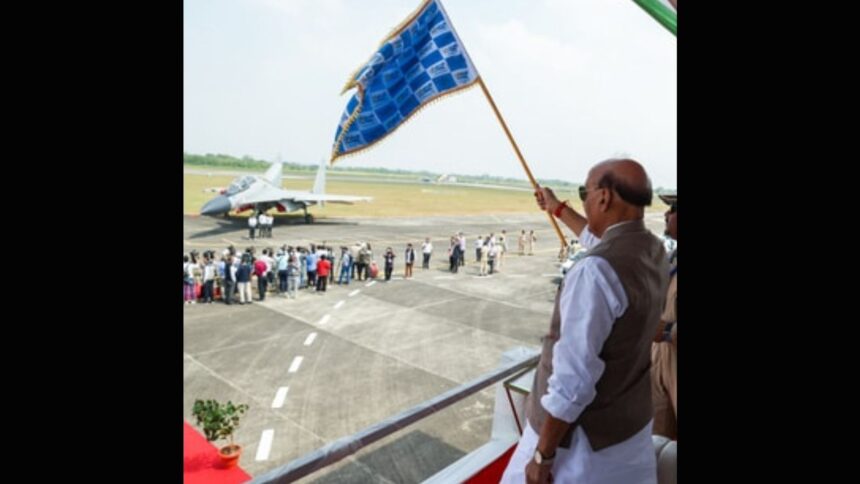
Defence Minister Rajnath Singh has lauded the relentless support of Hindustan Aeronautics Limited (HAL) to the Indian Air Force (IAF) during Operation Sindoor, a four-day military confrontation between India and Pakistan earlier this year. HAL provided uninterrupted 24/7 maintenance and operational assistance that kept India’s fighter jets and helicopters combat-ready in real time, marking a significant moment in India’s evolving defence ecosystem. The minister also inaugurated new production lines of the LCA Mk-1A fighter and HTT-40 basic trainer aircraft in Nashik, reinforcing India’s focus on self-reliance in defence manufacturing.
HAL’s 24/7 role in Operation Sindoor strengthens combat readiness
In a strong acknowledgment of India’s indigenous defence manufacturing capabilities, Rajnath Singh praised HAL for its tireless operational support to the IAF during the high-stakes confrontation in May. “HAL provided support at various operational sites 24 hours a day during Operation Sindoor. It ensured the IAF’s operational readiness by carrying out prompt maintenance on fighter jets and helicopters,” Singh stated during his address at Nashik.
Operation Sindoor was launched in the early hours of May 7 in response to the deadly Pahalgam terror attack on April 22, which claimed 26 lives. The operation marked a rare and decisive military response, with India striking key terror and military installations in Pakistan and Pakistan-occupied Kashmir (PoK). During this period, HAL’s teams were deployed at strategic operational sites, ensuring that the IAF’s frontline fighter jets and helicopters were mission-ready around the clock.
A critical component of the operation involved the integration of the BrahMos supersonic cruise missile with the IAF’s Russian-origin Su-30 fighter aircraft. HAL’s Nashik Division played a crucial role in this task, installing the missile systems on the jets in record time. Singh emphasized the strategic importance of this integration, stating, “The Nashik team performed the crucial task of installing the BrahMos missile on the Su-30, which destroyed terrorist hideouts during the operation. This proved that when it comes to national security, we can make our own equipment and protect ourselves with it.”
This successful deployment demonstrated the strength of India’s indigenous defence ecosystem. Instead of depending on external maintenance support, HAL’s domestic capabilities ensured immediate turnaround and full mission readiness of the fleet. Fighter jets were serviced, maintained, and armed on the ground in real time while operations were underway. Officials familiar with the operation said that the swift repairs and upgrades carried out by HAL engineers enabled sorties to be flown with minimal downtime, increasing operational efficiency and tactical advantage.
The success of the operation is seen by many in the defence establishment as a turning point. For years, India’s dependence on foreign platforms and maintenance has slowed operational readiness during conflict scenarios. Operation Sindoor showcased a new phase — one where domestic capacity and rapid response capabilities could sustain real-time combat operations.
In addition to aircraft maintenance, HAL also ensured critical spares, ground support equipment, and technical manpower were available without delay. This not only enhanced the tempo of operations but also reduced dependency on foreign suppliers during a period of heightened military engagement.
Rajnath Singh’s praise reflects a growing confidence in the role of state-owned defence enterprises. HAL, which has faced criticism in the past for delays in production and delivery, is now being positioned as a backbone of India’s indigenous defence manufacturing ecosystem. Singh’s remarks also signal the government’s intent to integrate HAL more strategically into the country’s combat preparedness planning, rather than treating it purely as a production agency.
New production lines mark a milestone in India’s defence self-reliance
The minister’s visit to Nashik was not limited to acknowledging past achievements. He inaugurated two major production lines — one for the LCA Mk-1A and another for the HTT-40 basic trainer aircraft — marking a significant expansion in HAL’s manufacturing capabilities outside its Bengaluru base.
The inauguration of the Nashik production line for the LCA Mk-1A is particularly significant. It is India’s third such production line and the first outside Bengaluru, underscoring the government’s intent to decentralize and scale up manufacturing. This comes weeks after the defence ministry signed a ₹62,370-crore contract with HAL to procure 97 more LCA Mk-1A fighter jets for the IAF. With this, the total number of LCA Mk-1A aircraft ordered by the government has reached 180, including the earlier order of 83 jets placed in February 2021 for ₹48,000 crore.
The LCA Mk-1A program is a cornerstone of India’s effort to modernize its fighter fleet amid a worrying shortage of aircraft. The IAF currently operates a fleet that is well below its sanctioned strength of 42 squadrons. The induction of LCA Mk-1A aircraft is expected to bridge some of this gap while providing a potent, agile, and indigenously built combat platform. Although none of the 83 aircraft ordered in 2021 has been delivered yet, the first deliveries are expected shortly. HAL’s Bengaluru facility currently has the capacity to produce 16 LCA Mk-1A aircraft annually. With the addition of the Nashik production line, this capacity will increase to 24 jets per year, significantly shortening delivery timelines.
The HTT-40 production line, also inaugurated in Nashik, is the second such line for the basic trainer aircraft and the first outside Bengaluru. HAL plans to deliver the first HTT-40, powered by TPE331-12B turboprop engine from Honeywell, to the IAF in January 2026. The contract, valued at ₹6,838 crore, covers the delivery of 70 trainer aircraft. HAL aims to deliver 12 aircraft in the first fiscal year after production begins. This will allow the IAF to strengthen its pilot training program with a modern indigenous platform.
Rajnath Singh described these production lines as tangible evidence of effective collaboration between government, industry, and academia. “LCA Mk-1A and HTT-40 production lines are proof of government-industry-academia synergy. No challenge is too big if faced together,” he said. He also emphasized the trust placed by the IAF in these platforms, calling it a reflection of India’s maturing defence industrial base.
The Nashik Division has played a historic role in India’s aircraft manufacturing journey. Established in 1964 for the licensed production of MiG-21 fighters, it went on to build over 900 aircraft and overhaul more than 1,900 military aircraft, including MiG-27 and Su-30 fighters. With the decommissioning of the last MiG-21 earlier this year, the division has been fully reoriented to support modern indigenous fighter programs and expansion of its manufacturing capacity.
The decision to expand production outside Bengaluru is a strategic one. Defence planners have long pointed out that relying on a single location for fighter production creates bottlenecks and delays. By adding Nashik as a parallel production hub, HAL can accelerate output, distribute workload more efficiently, and meet the growing needs of the IAF without compromising on timelines.
HAL Chairman and Managing Director DK Sunil called the operationalization of these new production lines a testament to HAL’s evolving capabilities. “HAL’s Nashik Division’s capacity to produce indigenous advanced fighters, in addition to Su-30s, has added momentum to our production efforts to meet delivery timelines. It has also resulted in the creation of around 1,000 jobs and the development of more than 40 industry partners in and around Nashik, aligning with the government’s goal of forging an effective public-private partnership,” he said.
This ecosystem-building is a crucial element of India’s broader defence indigenization strategy. The participation of private industry partners, small and medium enterprises, and academic institutions ensures that the benefits of defence production are not limited to HAL alone. Instead, they create a multiplier effect across the defence-industrial landscape, generating employment, building technological capabilities, and fostering innovation.
Rajnath Singh also highlighted the progress India has made in indigenization. “The country, which once imported 65-70% of critical military hardware, is now manufacturing 65% of the equipment on its own soil,” he said. He further added that the government’s long-term vision is to increase this figure to 100%, making India fully self-reliant in defence manufacturing.
The success of programs like LCA Mk-1A and HTT-40 is central to achieving this vision. Unlike in the past, when India relied heavily on foreign suppliers for combat aircraft and training platforms, these projects represent a new era of indigenous capability. They also provide strategic autonomy, ensuring that critical national security assets are not subject to external political or logistical pressures.
HAL’s recent achievements are not isolated developments. They are part of a larger policy shift under the government’s ‘Atmanirbhar Bharat’ initiative in the defence sector. Over the past few years, the government has prioritized indigenous defence procurement, restricted imports of several categories of weapons, and encouraged domestic manufacturing. The growing confidence of the IAF in indigenous platforms is a direct outcome of these reforms.
As India faces a complex regional security environment, including an active Line of Control and Line of Actual Control, the ability to rapidly produce, maintain, and deploy fighter aircraft becomes a strategic imperative. Operation Sindoor served as a real-time test case, demonstrating how indigenous manufacturing and maintenance capabilities can support frontline operations during conflict.
The combination of combat support during the operation and the strategic expansion of production capacity reflects HAL’s central role in India’s future air power strategy. With advanced indigenous aircraft, increased production capacity, and a growing ecosystem of partners, HAL is being positioned not just as a manufacturer but as a key pillar of India’s national security architecture.