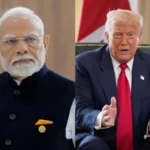
In a jarring start to Thursday’s trading session, the Indian stock market witnessed a sharp and sudden plunge, erasing over ₹5 lakh crore in investor wealth within just 15 minutes. This staggering decline was triggered by heightened global concerns after a surprise tariff announcement by the United States, which sent shockwaves through Indian equity markets and left almost all sectors deep in the red. Oil and gas companies were among the hardest hit, with even blue-chip stocks tumbling sharply, highlighting the vulnerability of markets to external policy shocks.
The early morning rout left benchmark indices bleeding as the BSE Sensex crashed over 780 points shortly after opening, while the NSE Nifty shed more than 210 points in a matter of minutes. The total market capitalisation of BSE-listed firms dropped from ₹458.8 lakh crore to ₹453.3 lakh crore during the early hours, marking a massive erosion of wealth for investors across the board.
Oil and Energy Stocks Lead the Fall
Among the worst affected sectors were oil and gas stocks, which bore the brunt of the sell-off amid fears that higher import duties and potential volatility in global trade could impact margins and growth forecasts. Shares of major oil companies including Indian Oil Corporation, BPCL, ONGC, Gujarat Gas, and Mahanagar Gas slipped significantly, reflecting investors’ anxiety over their exposure to global crude price fluctuations and trade-related risks.
Reliance Industries, a heavyweight on the Sensex, was one of the biggest contributors to the market’s fall. Other major laggards included Tata Motors, Mahindra & Mahindra, Bharti Airtel, Titan, and the State Bank of India—indicating that the sell-off was widespread and not limited to a particular sector.
Despite the overall gloom, a few select stocks managed to trade in the green. Hindustan Unilever, PowerGrid Corporation, and Eternal were among the rare exceptions, offering a sliver of resilience in an otherwise downbeat session. However, their gains were not enough to offset the overwhelming negativity that dominated the broader market sentiment.
Foreign Institutional Investors (FIIs), who often play a critical role in influencing market movements, were net sellers once again. On the day before the plunge, FIIs had pulled out equities worth ₹850.04 crore from Indian markets, continuing their trend of cautious withdrawal amid rising global uncertainty and increasing risk aversion toward emerging markets.
Global Cues and Currency Movement Add to Pressure
The situation was compounded by weak cues from Asian markets. South Korea’s Kospi, China’s SSE Composite, and Hong Kong’s Hang Seng all traded in negative territory, reflecting broader concerns about slowing global growth and rising geopolitical tensions. Japan’s Nikkei 225, however, bucked the trend and was seen trading in the green.
Back home, the Indian rupee showed some signs of recovery after hitting an all-time low against the US dollar in previous sessions. In early morning trade, the rupee appreciated by 14 paise to reach 87.66 at the interbank foreign exchange market. The improvement was modest, but it offered slight relief to market watchers who have been alarmed by the currency’s recent depreciation trend.
The currency’s partial recovery, however, did little to calm nerves rattled by the US announcement of steep tariffs on imports from key trading partners, including India. Investors fear that a prolonged tariff war or retaliation from other economies could create an unstable trade environment, ultimately affecting corporate earnings and growth prospects.
Investor sentiment was further dampened by worries that the recent surge in valuations, driven by strong domestic liquidity and optimism around economic recovery, may have reached unsustainable levels. The sell-off on Thursday could be interpreted by some as a long-overdue correction, but the pace and scale of the decline made it feel more like a panic reaction to global developments rather than a routine market adjustment.
Traders and analysts are now closely monitoring signals from both the Indian government and the US administration to see how the situation might evolve in the coming days. There are expectations that the Indian government could take some steps to stabilize markets or address investor concerns, but no immediate announcements had been made by the time of this market update.
Meanwhile, trading volumes remained high as institutional investors and retail participants rushed to adjust positions and manage risks. Derivative segments also saw increased activity, with many opting for protective strategies to hedge against further downside. However, experts caution that unless some clarity emerges from the US side regarding the scope and duration of the tariff measures, volatility is likely to persist in the near term.
The magnitude of Thursday’s sell-off underscores the interconnected nature of global financial markets, where a single policy decision thousands of miles away can have a domino effect across continents. For Indian investors, it served as a harsh reminder that global risks continue to loom large despite strong domestic fundamentals and optimistic growth projections.
With all eyes now on how the global trade scenario unfolds, market participants are bracing for more turbulence and preparing for heightened volatility in the days ahead. The coming sessions could be crucial in determining whether Thursday’s crash was an isolated reaction or the beginning of a more prolonged downtrend driven by global uncertainty and macroeconomic fears.