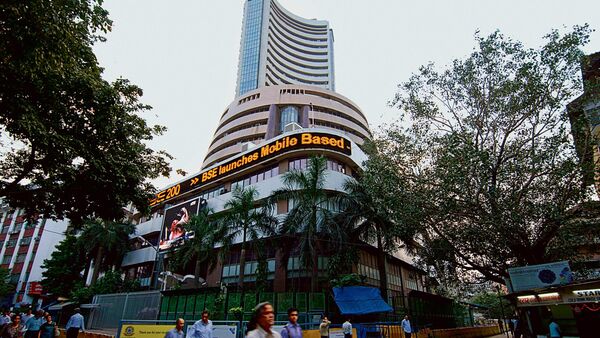
Mumbai, February 5, 2026: The Indian equity market snapped its three-day winning streak on Thursday, with benchmark indices ending sharply lower amid broad-based selling pressure. The Sensex tumbled 503 points to close at 83,313, while the Nifty fell 133 points to settle at 25,642.
Selling pressure was most pronounced in metal stocks, which emerged as the worst-performing sector of the day. Weakness was also seen across auto, financial services, FMCG, IT, pharma, media, private banks, realty, and oil & gas sectors.
Out of the 30 stocks on the Sensex, 26 ended in the red, while only four managed to post gains. Shares of Zomato, Bharti Airtel and Bharat Electronics declined by up to 2.5%.
Key reasons behind the market decline
Heavy selling in metal stocks:
Metal shares witnessed the sharpest correction, with the sectoral index declining around 1.5%. Global metal prices came under pressure as the US dollar strengthened, making commodities more expensive for buyers using other currencies. The metal index had gained nearly 6% over the previous three sessions, prompting profit booking.
Profit booking after recent rally:
Investors locked in gains following the strong rally seen over the past three days. Most sectoral indices ended lower, with PSU bank stocks being the only pocket showing relative stability.
Weak global cues:
Asian markets recorded sharp losses, weighing on investor sentiment. South Korea’s KOSPI plunged over 3%, while Japan’s Nikkei, China’s Shanghai Composite and Hong Kong’s Hang Seng also closed lower. US markets had ended weak overnight, with the Nasdaq falling 1.51%. Wall Street futures remained under pressure during Asian trading hours.
FII buying slows sharply:
Foreign Institutional Investors (FIIs) purchased shares worth only ₹30 crore on Wednesday, a sharp drop compared to over ₹5,000 crore of buying seen on Tuesday. The slowdown in foreign inflows added to market caution.
RBI policy uncertainty:
Markets remained cautious ahead of the outcome of the Reserve Bank of India’s Monetary Policy Committee (MPC) meeting, with the policy decision due on Friday. While most expect interest rates to remain unchanged, uncertainty kept investors on edge.
Rise in market volatility:
India’s volatility index (India VIX) rose to 12.28, reflecting increased nervousness among investors and contributing to sharp intraday swings.
Expiry-day impact:
Thursday marked the expiry of Sensex derivatives contracts. Such expiry sessions often see heightened volatility due to position rollovers and unwinding, amplifying market movements.
Global market snapshot
Japan’s Nikkei closed down 0.88% at 53,818
South Korea’s KOSPI plunged 3.86% to 5,163
Hong Kong’s Hang Seng ended marginally higher by 0.14% at 26,885
China’s Shanghai Composite fell 0.64% to 4,075
Overnight in the US, the Dow Jones gained 0.53% to close at 49,407, while the Nasdaq and S&P 500 declined by 1.51% and 0.51% respectively.
Institutional activity
On February 4, FIIs bought shares worth ₹30 crore, while Domestic Institutional Investors (DIIs) purchased equities worth ₹250 crore. In December 2025, FIIs had sold shares worth ₹34,350 crore, while DIIs provided strong support by buying shares worth ₹79,620 crore.
Previous session performance
On Wednesday, February 4, the market had ended higher, with the Sensex gaining 79 points to close at 83,818, while the Nifty rose 48 points to settle at 25,776.