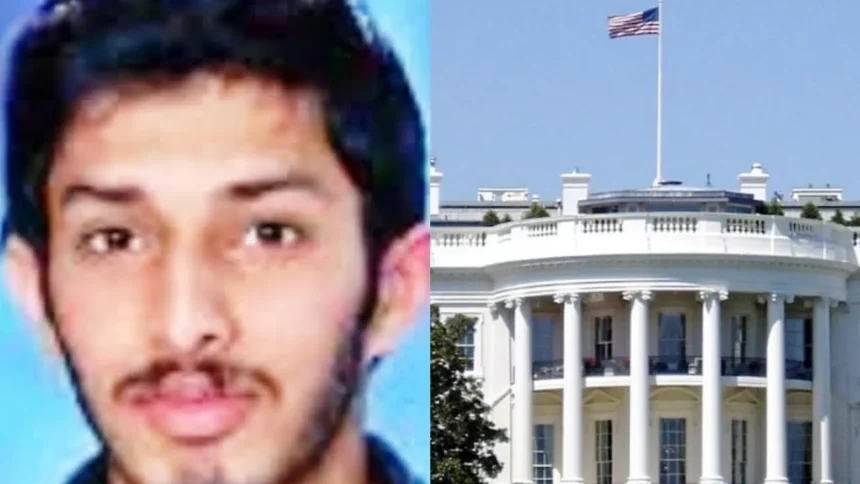
An Indian-origin man, Sai Varshith Kandula, 20, has been sentenced to eight years in prison for his attempted attack on the White House in May 2023. The incident, which occurred on May 22, involved Sai Varshith Kandula attempting to drive a rented truck into the White House barriers with the aim of overthrowing the U.S. government and replacing it with a dictatorship influenced by Nazi ideology. The sentence was handed down on Thursday after Sai Varshith Kandula pleaded guilty to willfully injuring or damaging U.S. property in May 2024.
Sai Varshith Kandula, who was born in Chandanagar, India, and was a lawful permanent resident of the United States with a green card, had planned the attack meticulously for several weeks. On the day of the incident, Sai Varshith Kandula traveled from St. Louis, Missouri, to Washington D.C., arriving at Dulles International Airport at 5:20 p.m. Upon arrival, he rented a truck and set off towards the White House, making stops for food and gas before heading to his targeted location.
At approximately 9:35 p.m., Sai Varshith Kandula drove the truck into the barriers that surround the White House and President’s Park. The impact caused the truck to back up and strike the barriers a second time, causing the truck to become disabled, emitting smoke and leaking fluids. The crash sent pedestrians running in panic as the vehicle came to a halt. Sai Varshith Kandula exited the truck and went to the back, from which he retrieved a red-and-white banner adorned with a Nazi swastika and displayed it in front of the authorities.
U.S. Park Police and the U.S. Secret Service arrived at the scene and arrested Sai Varshith Kandula. In their investigation, it was revealed that his primary objective was to seize control of the White House and replace the democratically elected government with a Nazi-inspired dictatorship. Sai Varshith Kandula admitted to investigators that he was prepared to go as far as arranging for the killing of the U.S. President and others if necessary to achieve his goal. His actions were clearly calculated to intimidate or coerce the U.S. government into submission.
The Department of Justice confirmed that Sai Varshith Kandula’s attack resulted in significant damages to the National Park Service, totaling approximately $4,322. This amount covered the costs of repairing the barriers, removing oil and chemical spills, cleaning up the scene, and disposing of fluids from the crashed truck.
In his attempts to execute his plan, Sai Varshith Kandula had previously reached out to security companies for assistance. On April 22, 2023, he requested a convoy of 25 armed guards and an armored vehicle from a security firm in Virginia. Later, on May 4, 2023, he made further attempts to rent large vehicles such as a commercial tractor-trailer truck or a dump truck, which he believed would assist in his mission. Unfortunately for him, Sai Varshith Kandula was unsuccessful in acquiring these resources.
The U.S. government has underscored the gravity of the attack, emphasizing that Sai Varshith Kandula’s intent was to disrupt the functioning of the government and install a regime driven by Nazi ideology. His calculated actions have been described as an attempt to influence the government’s conduct through fear and coercion.
The case has raised alarms about the potential threats posed by individuals attempting to execute violent actions under the guise of political ideology. It also serves as a reminder of the importance of vigilance and security in protecting the integrity of government institutions and the safety of the public. Despite Sai Varshith Kandula’s sentencing, the ongoing investigation into his actions and their motivations continues to shed light on the depths of his preparations for the attack.
This attack on the White House, though thwarted, underscores the persistent risks posed by domestic threats and the lengths to which some individuals are willing to go in pursuit of their extremist agendas. The federal government, law enforcement agencies, and security personnel remain committed to safeguarding national security and preventing similar attacks in the future.