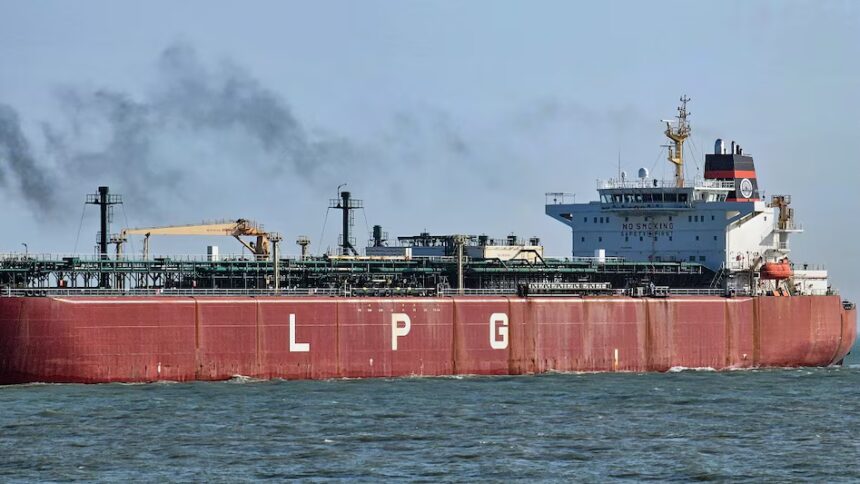
Amid escalating tensions in West Asia and growing global concerns over maritime security, the Indian Navy has successfully assisted another India-bound LPG tanker through the strategically critical Strait of Hormuz, reinforcing India’s efforts to secure vital energy supply routes during regional instability.
Officials confirmed that the vessel, MV Sunshine, safely crossed the sensitive maritime corridor while being closely monitored and supported by multiple Indian agencies, including the Navy. The tanker is currently on its way to India carrying liquefied petroleum gas cargo essential for domestic energy supplies.
According to officials, MV Sunshine is the 15th LPG vessel bound for India to be safely guided out of the Persian Gulf amid continuing geopolitical tensions involving Iran, the United States, and other regional actors.
The development highlights India’s increasing focus on protecting maritime trade routes as instability around the Gulf region continues to threaten global energy transportation networks.
Strait of Hormuz Remains Global Energy Lifeline
The Strait of Hormuz is widely regarded as one of the world’s most strategically important maritime chokepoints. A significant portion of the world’s crude oil and liquefied gas shipments passes through the narrow waterway connecting the Persian Gulf with international shipping routes.
Any disruption in the region can immediately affect global energy prices, fuel supply chains, shipping insurance costs, and international trade.
The latest safe passage of the India-bound tanker comes as tensions continue simmering across West Asia following heightened diplomatic and military friction involving Iran and the United States.
Global shipping companies and governments have remained on alert due to concerns that instability in the region could impact commercial vessels navigating the corridor.
Indian authorities have reportedly intensified monitoring of all India-linked cargo ships moving through the Gulf region to ensure uninterrupted supply of critical energy resources.
Indian Navy Expands Maritime Monitoring Operations
Sources indicated that the Indian Navy has been maintaining enhanced surveillance and operational coordination in the region to monitor merchant vessel movement and provide assistance wherever necessary.
Over the past several weeks, India has increased its maritime readiness due to fears that regional tensions could affect oil and gas transportation routes crucial for the country’s energy security.
India imports a significant share of its crude oil and LPG requirements from Gulf nations, making the safety of shipping lanes in the region strategically vital for the economy.
Officials familiar with the matter stated that multiple agencies are coordinating in real time to track vessel movement, assess maritime risks, and ensure commercial ships linked to India can navigate safely through sensitive waters.
The successful movement of fifteen LPG vessels out of the Persian Gulf despite regional tensions is being viewed as an important logistical and strategic achievement.
Security analysts note that maritime monitoring operations have become increasingly important as geopolitical rivalries continue influencing shipping patterns across the Middle East.
Iran Signals Stability if Peace Efforts Succeed
Meanwhile, Iranian officials have indicated that the security situation around the Strait of Hormuz could improve significantly if diplomatic efforts succeed in restoring peace in the region.
Speaking in New Delhi ahead of the BRICS Foreign Ministers’ meeting, Kazem Gharibabadi said stability and transparency in the Strait of Hormuz would improve once peace is established.
He stated that Iran would continue operating within the framework of international law and suggested that the maritime corridor could become safer than before if tensions reduce.
Gharibabadi also criticized the United States, alleging that Washington was not pursuing “serious diplomacy” in addressing regional conflicts.
His remarks come amid ongoing international concern over military escalation, sanctions, and strategic competition across West Asia.
Iran Welcomes India’s Diplomatic Role
During interactions with reporters in New Delhi, the Iranian Deputy Foreign Minister welcomed the possibility of diplomatic initiatives by India aimed at reducing tensions in the region.
He emphasized India’s longstanding support for peace and described India and Iran as nations connected by deep historical and cultural ties.
Calling the relationship between the two countries significant, Gharibabadi highlighted the importance of people-to-people engagement and broader diplomatic cooperation.
He said any initiative from India intended to ease regional tensions would be welcomed by Tehran.
India has traditionally maintained diplomatic engagement with multiple countries across West Asia while balancing strategic partnerships and energy interests in the region.
Experts believe New Delhi may continue emphasizing dialogue, stability, and maritime security as concerns over regional escalation persist.
Energy Security Concerns Rise for India
The safe movement of LPG vessels through the Strait of Hormuz has become increasingly important for India as energy markets react to geopolitical uncertainty.
India remains heavily dependent on imported crude oil and liquefied gas to meet domestic energy demands. Any prolonged disruption in Gulf shipping routes could significantly impact fuel prices, supply chains, and inflation inside the country.
Market analysts warn that even limited instability around the Strait of Hormuz can trigger volatility in global oil and gas markets because of the route’s central role in energy transportation.
Shipping insurance premiums and freight costs have also shown signs of increasing due to heightened regional risks.
The Indian government has reportedly remained in close contact with maritime agencies and energy suppliers to ensure continuity of fuel imports amid changing geopolitical conditions.
Strategic Importance of Maritime Security Grows
The latest operation involving MV Sunshine once again underlines the growing importance of maritime security in India’s strategic planning.
As geopolitical tensions increasingly intersect with energy security and trade logistics, safeguarding shipping routes has become a key national priority.
Defence analysts believe India’s proactive naval monitoring in the Gulf region demonstrates its expanding role in protecting commercial maritime interests and ensuring uninterrupted access to critical energy supplies.
The Indian Navy’s continued coordination with merchant vessels and regional monitoring agencies is expected to remain crucial as the situation in West Asia evolves.
With tensions still unresolved and diplomatic efforts continuing, the safe navigation of commercial vessels through the Strait of Hormuz remains closely watched by governments, global energy markets, and shipping operators worldwide.